
What Is Hedge Betting?

Quick answer: hedge betting is the practice of placing one or more opposing bets to counter your original bet, allowing you to minimise potential losses or even lock in a profit.
Hedge betting, or hedging as it’s often known, has been around for a very long time - around 350 years! It’s even become part of the way we speak - ‘hedging your bets’ can be used in almost any situation now, with its connection to real betting half forgotten by many.
But, as with a lot of sports betting terminology, many of us will have heard of hedge betting without ever really understanding how it works.
In this article, we’ll lay out exactly what hedge betting is, how it works, and how you can take advantage of it - as well as other alternatives to ensure a profit from sports betting.
By the time you reach the end, you’ll be a hedging expert!
What Is Hedge Betting?
At its most basic, hedge betting is the practice of betting on more than one outcome on an event, either to mitigate losses or to guarantee profits.
Hedge betting usually relies on odds changing over time, which makes it possible to place a bet on two or more outcomes of an event, and to come out in profit regardless.
Depending on the odds, it can be possible to place a bet on two (or more) opposing outcomes, with the result that you ensure a profit no matter the outcome - a bit like Matched Betting, or arbitrage betting.
And even if the odds don’t allow you to guarantee a profit, they might reduce your potential loss to an acceptable level, if you suspect your bet is unlikely to go on to win.
| Hedge Betting | Matched Betting | Arbitrage Betting |
|---|---|---|
| Generally relies on odds changing over time | Makes use of odds available at the same time | Requires favourable opposing odds to be available simultaneously |
| Either locks in profit or reduces losses | Locks in profit with free bet | Locks in profit with every bet |
| Best for expert bettors | Ideal for beginners | Suitable for beginners and experts |
How Do You Hedge A Bet?
It does take some expert knowledge and a level of skill to put yourself in a position to successfully hedge a bet - this technique is most commonly used by professional gamblers, who understand the markets extremely well.
Furthermore, it won’t always be possible to lock in a profit on a certain event, so you shouldn’t make the assumption that you’ll find an opportunity to hedge a bet later on.
Expert Insight
A key mistake is treating a hedge as something you think about only after the odds move. Before placing the original bet, consider what price movement would make a hedge attractive and how much capital you could realistically commit to the second position.
To illustrate the principle, we’ll take football as an example - specifically, the Premier League.
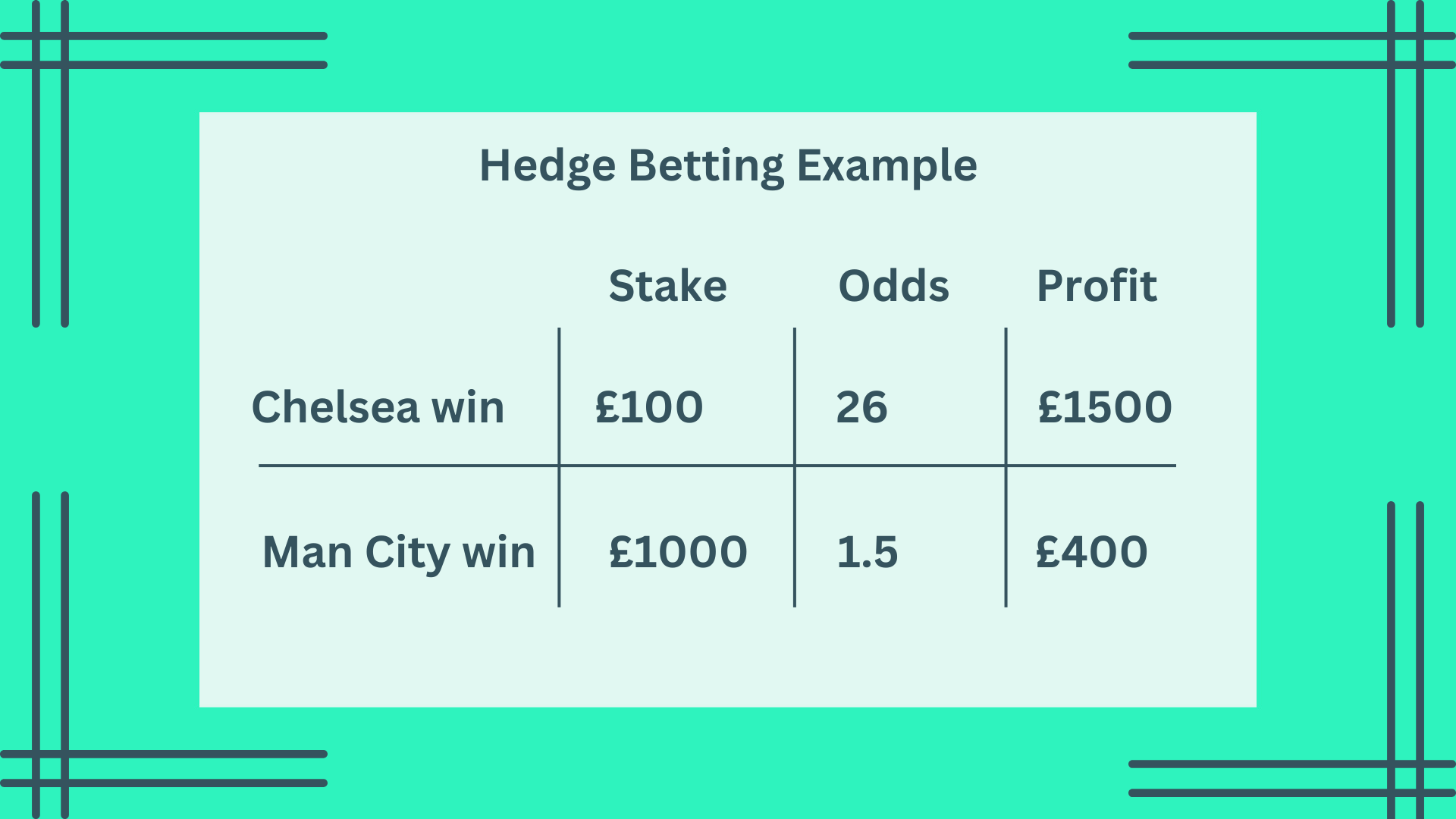
The odds that Chelsea win the Premier League near the start of the season might be 25/1 (26 in decimal odds), so if you were to bet £100 early on, you’d stand to make a return of £2600 if they did indeed go on to win.
If Chelsea end up having a great season and make it to the final, you’ll be feeling pretty excited - but also distinctly anxious about their chances. What if they let you down at the last hurdle?
They might face Manchester City in the final as the underdogs, with Manchester City at odds of 1/2 (1.5 in decimal odds) to come out the winners.
To hedge your bet, you could place a bet of £1000 on Manchester City.
If Chelsea go on to win, you’ll make a profit of £1500 (£2600 minus your original stake on Chelsea and your £1000 stake on Manchester City), and if Man City win, you’ll still have a profit of £400 (£1500 minus your £1000 stake and your £100 stake on Chelsea).
Hedging isn’t restricted to team sports; bettors will also sometimes place hedge bets on horse racing. For example, imagine you’d placed a pre-race bet of £20 on a relative long shot at 20/1 (decimal odds of 21).
By the middle of the race, your pick is neck and neck with the favourite to win, with the rest of the pack a good way behind. By placing an in-race hedge bet of £100 on the favourite at odds of 1/1 (decimal odds of 2), you could lock in a profit so long as one of those two horses did indeed win - which would be looking extremely likely at that point.
Data Insight
60% of online bettors surveyed by the UK Gambling Commission had placed an in-play bet within the previous four weeks. That matters for hedge bettors because in-play markets are particularly dynamic, with prices changing continuously as new information becomes available during an event.
If your original long shot came in as the winner, you’d have made a total of £300 in profit (£420 minus your original stake and your hedge stake), or if the favourite was victorious, you’d have £80 of profit (£200 minus your stakes).
Of course, unless you put money on all the remaining horses, you couldn’t be completely certain of a profit - and in most cases you’d be unlikely to come out in profit by hedging all the other competitors - but you would be able to put yourself in a position where you’d be very likely to come out in profit either way.
Hedging with a betting exchange
If you're keen to mitigate your position with a hedge bet, there's no reason you have to go to another bookmaker - you can always use a betting exchange.
In an almost identical process to a matched bet, even using a Matched Betting calculator, you can work out the ideal stakes to hedge your back bet with a lay bet on a betting exchange. Then, regardless of the result of the event, you'll have created to create the best possible outcome either way.
Cashing out
In some cases, it may be possible to cash out your original bet, rather than place a hedge against it, and end up with a very similar overall position. For simplicity's sake, you may prefer this option - all you'll have to do is click the 'cash out' button on your betslip with the bookie, and you'll either end up with a small profit, or make a small loss.
However, cashing out is rarely the best choice from a profit perspective, because the amount offered by the bookie is typically significantly lower than the odds of your bet winning would imply.
You're quite likely to find that hedging your bet results in a greater profit, or a smaller loss, so it's typically worth taking the time to investigate hedge betting options if you're considering cashing out your bet.
When Should You Hedge A Bet?
As a general rule, hedging a bet is worthwhile if it improves your position - and this is usually only going to be the case if your original bet has been placed in advance of an event, allowing time for the odds to change. You’d certainly be unwise to place large numbers of bets in advance in the hope that circumstances result in a hedging opportunity, though - it’s often just as likely that the odds will work against you, and that the most you’ll be able to do is to mitigate your losses.
That said, it’s worth keeping an eye out for hedging opportunities. Sometimes, a competitor that seems like a long shot can rapidly become a favourite for a particular event - so if you’d placed a bet when the odds on them were higher, you might well have a chance to bet on their opponents as well, and to come out with a profit either way.
Expert Insight
A better way to judge a hedge is by the price available now, not by how much profit your original bet is showing on paper. Once the market has moved, the question is whether the new odds offer enough value to justify tying up additional capital.
Advantages And Disadvantages Of Hedge Betting
Advantages
- The possibility of locking in a profit. Normally, there’s inherent risk in sports betting - and a wily hedge bet can negate that risk. Depending on the stakes in question, the profits can even be pretty high (although not, of course, as high as if a bet was left un-hedged and went on to win).
- The possibility of reducing a loss. Even when you can’t lock in a profit, you can still lessen your potential losses if your original bet loses - and still make a profit if your original bet wins.
Disadvantages
- Hedge betting is not a guaranteed strategy. When you place your original bet, you cannot know that the odds will change in such a way as to put you in a position to lock in a profit later on. It cannot therefore be used as your only strategy for successful sports betting.
- The reduction of your return. Hedging a bet means that your returns have to be reduced - so if your original bet goes on to win, you’ll receive less in winnings than if you hadn’t hedged your bet.
- It depends on extensive sports betting knowledge. Hedge betting is definitely not a tactic for beginners. If you’re just starting out in the world of sports betting, there are easier and more reliable ways to make dependable profits - more on this below.
Data Insight
4.31% of 14,923,840 active customer accounts were subject to some form of commercial restriction, according to UK Gambling Commission data. The figure highlights a practical consideration for bettors who regularly place sizeable or strategically sophisticated bets: access to advertised stakes is not necessarily guaranteed indefinitely.
| Advantages | Disadvantages |
| Can lock in a profit | Not a guaranteed strategy |
| Can reduce losses | Reduces your return |
| Requires extensive sports betting knowledge |
Hedging In Other Fields

Hedging is also a tactic used in finance. It’s not quite so straightforward a strategy as in sports betting, but it works on the same principle: that of offsetting the risk of potential losses by placing money on an opposing position.
In finance, it works as a form of insurance (and, indeed, can literally be in the form of insurance), so that if one investment in a portfolio performs worse than expected, another opposing investment will balance that out.
Hedge funds, which many of us will have heard of without fully understanding, began with the specific intention of hedging specific investments by shorting other similar assets (i.e. investing in such a way as to profit if the market value of that asset fell). Nowadays, however, they use a variety of investment strategies (although these are still likely to include hedging).
Other Ways To Lock In Profit From Sports Betting
Hedge betting can be a profitable strategy, but it’s not especially beginner-friendly, and it can be very intimidating to bettors who aren’t particularly familiar with the sports betting world.
A much more beginner-friendly way to lock in profits when sports betting is through Matched Betting. This is a technique that involves placing bets both for and against a certain outcome to earn free bets, which allow you to make a profit regardless of the result (so long as you follow the instructions correctly).
Most offers run along the lines of ‘Bet £10 and get a £10 free bet’. By matching the first bet, you break even - and you’re then able to make a profit on the free bet.
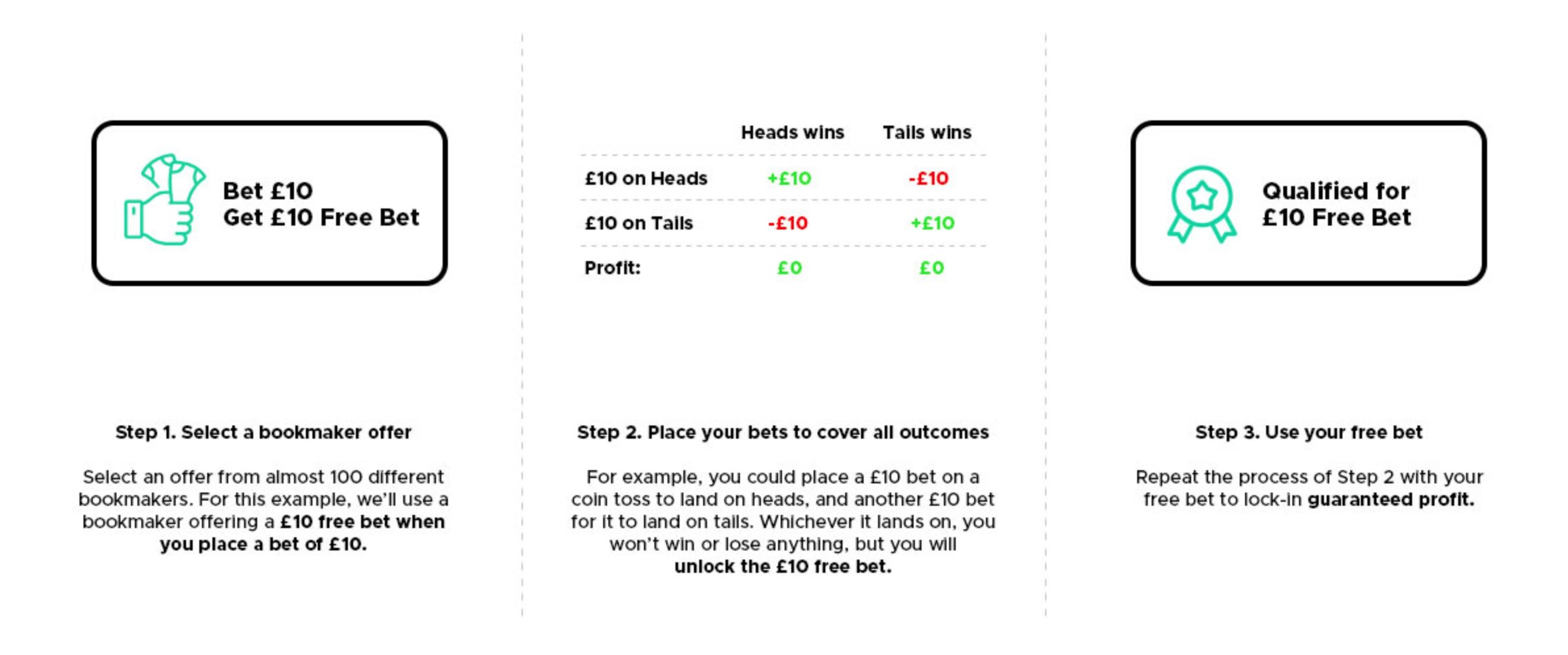
To find out more about how Matched Betting works, check out our complete guide for beginners - or if you’re keen to get stuck in, sign up for our free trial to start making your first profits today.
Combining Hedge Betting With Other Strategies
For more advanced bettors, it's well worth considering combining hedge betting with other smart betting strategies, specifically Value Betting - for more info about how this strategy works, check out our dedicated guide.
Because Value Betting explicitly relies on looking for disproportionately high odds, it's also more likely that a value bet might later turn into a hedge betting opportunity, as the available opposing odds balance out later on.
Experienced value bettors aren't likely to want to hedge every bet, as Value Betting doesn't require all bets placed to win, but there may be times when hedging a bet can be to their advantage. For example, they might place an outright bet well in advance, and later feel that they're somewhat overexposed, or that the changing odds have resulted in a hedging opportunity too good to miss.
Regardless of when and whether any value bettor does choose to hedge a bet, it's certainly worth their while to be aware of the principles of hedge betting, allowing them the option to hedge if at any point it becomes advantageous.
Summary
Hedge betting can be an incredibly useful strategy in the right situations, allowing experienced sports bettors to lock in a profit if the odds allow. It’s not a strategy that can be relied upon in all circumstances, however, and it’s best employed by bettors with extensive knowledge and experience, as mistakes could be very costly.
For an alternative that involves minimal risk, Matched Betting is a much safer option, especially for novice bettors. If you’re keen to get started, Outplayed’s free trial is the perfect tool to allow you to get stuck into your new side hustle right away.
sign up nowFAQs
1. What's the difference between hedge betting and Matched Betting?
If you're Matched Betting, you specifically look for close matches between the back and lay odds to begin with, to allow you to place a qualifying bet, unlocking your reward, and then a free bet, with which you make a profit. Normally, hedge betting is employed some time after your original back bet was placed, when changing odds have made it possible either to lock in a profit or at least to lower potential losses.
2. What's the difference between hedge betting and arbitrage betting?
These techniques are incredibly similar, but arbitrage betting involves searching for pairs of opposing odds that allow you to lock in a profit immediately. It's possible for a hedged bet to lock in a profit due to favourable odds, but this isn't typically the original intent of the bettor, and they may also hedge a bet in order to minimise a loss, with no expected profit at all.
3. Is hedge betting a good strategy for beginners?
If you're new to sports betting, we wouldn't particularly recommend trying to rely on hedging for profits. You're far better off starting with Matched Betting, where the risk of any losses is negligible, and building up a good bankroll and plenty of experience before you branch out into more advanced betting techniques.
4. Is hedge betting legal?
Yes, hedge betting is perfectly legal - all you're doing is placing bets at the odds offered by bookmakers and exchanges. However, it may be a breach of bookmaker terms and conditions, as they will often restrict customers from taking any action to reduce their risk.
5. Should I hedge all my bets?
Probably not. Hedge betting can be very useful, but it will minimise the profit made on any successful bets, making it harder to generate significant profits. If you're uncomfortable with the risk of sports betting, we'd strongly recommend trying out Matched Betting rather than relying on hedges.
Updated: 17 Aug 2026
The Author
Stephanie is a published author and, having taken up Matched Betting fairly recently, she knows exactly how beginners feel when they first start Matched Betting. She loves breaking down complex subjects in straightforward terms to make them accessible to newcomers, and to speed them on their way to making their first profits.