
Positive Expected Value Betting Guide
9 min read
Stephanie Sorrell
30 Jul 2026

Value Betting is one of the best ways you can harness sports betting for profit. It involves tracking down bets at higher odds than their real chance of winning would imply - and in the long run, this generally results in making consistent profits overall.
Value bettors talk about ‘positive expected value’ and ‘negative expected value’ when it comes to potential bets, to help them make decisions about their selections.
- Positive expected value means a bet that, based on its odds and its true probability of winning, holds value for the bettor. That doesn’t mean it’s guaranteed to win, but that it would be statistically likely to make money for the bettor in the long run.
- Negative expected value means the opposite - that you would expect to lose money by consistently betting at the odds given, considering the true probability of a win.
Expected value is what value bettors use to guide their betting. On an individual level, you can’t expect any single bet to actually result in its expected value - but over hundreds or even thousands of bets, you’re very likely to find that your total profits are very close to the total expected value of those bets.
The difficulty lies in identifying bets that hold positive value - largely because it relies on knowing the true probability of any particular bet winning. Having done this, you can use a simple mathematical formula to establish the expected value of any bet.
This guide will talk you through how to identify bets that hold positive expected value (often abbreviated to +EV) and the best methods out there to track down as many value bets as possible, to help you get started on a successful Value Betting career.
What Are Positive Expected Value Bets?
We know that Value Betting works on the principle of finding and placing bets at higher odds than the true probability of a win would imply, and that those bets can be said to hold positive expected value.
Over time, consistently betting on bets with positive expected value is highly likely to result in profits overall, and for this reason Value Betting is the technique used by pretty much all professional sports bettors to make their living.
It can be tricky to grasp exactly how this works, though, so we’ll take a look at a couple of examples to help you see how a bet with positive (or negative) expected value works in practice.
Example A
- Red Rum is listed at odds of 5 (4/1 in fractional odds) with a bookie to win its next race
- It has a true probability of 25% to win its next race
An experienced value bettor will instantly know that they’re seeing a bet with positive expected value - but how do they work it out?
First of all, we have to convert between odds and implied probability. Odds can be directly translated into a percentage representing a selection’s chance of winning. You can use an odds converter to work this out, but you’ll probably find that, with experience, you end up memorising the conversion for the most common sets of odds.
| Decimal odds | Fractional odds | Implied probability |
|---|---|---|
| 1.2 | 1/5 | 83.3% |
| 1.5 | 1/2 | 66.7% |
| 1.8 | 4/5 | 55.6% |
| 2 | 1/1 (evens) | 50% |
| 3 | 2/1 | 33.3% |
| 5 | 4/1 | 20% |
| 10 | 9/1 | 10% |
| 15 | 14/1 | 6.7% |
| 20 | 19/1 | 5% |
For now, we can tell you that a 25% chance of winning directly translates to true decimal odds of 4. Bookies make their money through a margin on their odds, meaning that you’d usually see odds of 3 or maybe 3.5 with a bookie if the true odds are 4.
In this case, with odds of 5, there’s a clear opportunity for a value bet.
Of course, with only a 25% chance of winning, you’re more likely to lose this particular bet than to make any money from it. However, Value Betting means playing the long game.
If you got the chance to place 100 £10 bets with true odds of 4 and actual odds of 5, you’d expect 25 of those bets to win.
You’d have staked a total of £1000 on those bets, but you’d make a £50 return from each of the 25 bets that win, making a total return of £1250, a profit of £250.
| Expected number | Odds | Amount staked | Return | Total profit | |
|---|---|---|---|---|---|
| Winning bets | 25 | 5 | £250 | £1250 | |
| Losing bets | 75 | 5 | £750 | £0 | |
| Total | 100 | £1000 | £1250 | £250 |
Example B
- Black Caviar is listed at odds of 2.5 to win its next race
- It has a true probability of 33.33% to win its next race
Once again, we need to convert its true chance of winning into odds so we can compare the true odds with what we’re seeing at the bookie. A 33.33% chance equates to odds of 3.
As the odds at the bookie are lower than the true odds, we can see that this bet holds negative expected value, despite having a better chance of winning than Red Rum did in Example A.
If you got the chance to place 100 £10 bets with true odds of 3 and actual odds of 2.5, you’d expect 33.33 of those bets to win (though admittedly, it isn’t technically possible for 0.33 of a bet to win).
You’d have staked a total of £1000 on those 100 bets, and you’d make a return of £833.33 from your winning bets, resulting in a £166.67 loss.
You can therefore see exactly why this bet holds negative expected value.
| Expected number | Odds | Amount stakes | Return | Total profit | |
|---|---|---|---|---|---|
| Winning bets | 33.33 | 2.5 | £333.33 | £833.33 | |
| Losing bets | 66.66 | 2.5 | £666.66 | £0 | |
| Total | 100 | £1000 | £833.33 | £-166.67 |
How To Find Positive Expected Value
When it comes to calculating the expected value from any particular bet, there’s an easy formula you can use:
(Amount won per bet * probability of winning) – (Amount lost per bet * probability of losing) = expected value
For example, if we took the figures from Example A with Red Rum, we’d do the following calculation for a £10 bet:
EV = (£40 * 0.25) - (£10 * 0.75) = £10 - £7.50 = £2.50
And for Black Caviar in Example B, the calculation would run as follows:
EV = (£15 x 0.33) - (£10 * 0.66) = £5 - £6.66 = £-1.66
If you know the true probability of a selection winning, you can use this formula on your bet to work out the expected value it holds, and therefore whether it’s worth your while going ahead with it.
True Probability
The difficulty, of course, lies in working out the true probability of a selection winning. Bookies have invested huge amounts in software and staff to assess the likelihood of a win for any bet they offer, as their profits rely on accurately predicting what will happen in any given sporting event.
However, as Value Betting relies on finding discrepancies between a bookie’s odds and the real chances of any particular outcome occurring, you can hardly take a bookie’s odds as an indication of true probability, especially as bookies also adjust their odds to maximise their profits.
Data Insight
Academic research has consistently found that bookmaker markets exhibit a "favourite-longshot bias", meaning longshots generally offer lower expected returns than favourites. This reinforces why successful value betting depends on identifying genuine pricing errors rather than simply backing bigger odds.
- Wiley (Bulletin of Economic Research)
Working out the true probability of any outcome therefore involves a huge amount of research, factoring in form, environment, performance history, past match-ups, and even sport psychology.
Or, for an easier life, you can take advantage of Outplayed’s Value Betting tools, which eliminate all the hard work of finding positive expected value - more on this later!
Expert Insight
Most beginners spend too much time perfecting the expected value calculation and not enough time questioning their probability estimate. The maths is straightforward; the edge comes from having a more accurate view of an event than the market has at the moment you place your bet.
Why Should You Find Positive Expected Value
If you plan to start Value Betting, finding bets with positive expected value is essential - otherwise, all you’re really doing is gambling.
Data Insight
A 2025 peer-reviewed study found that average bettor loss rates across football and tennis markets were consistently higher than standard overround calculations predicted. The researchers concluded that relying on superficial odds alone can underestimate the true long-term cost of poor-value betting.
- Research by University College Dublin
If you’re currently Matched Betting, you might well be quite intimidated by the idea of Value Betting. It is important to be aware that it involves much more risk than Matched Betting, and you will need to be starting with a good bankroll to ensure that you can weather any downswings in your profits.
That said, if you’re an experienced matched bettor or sports bettor, and if you do have a good bankroll available to you, Value Betting has the potential to make you incredible profits in the long run, so it’s absolutely worth giving it a go!
Value Betting can be employed on pretty much any sport you can find betting markets on, which means there are almost limitless opportunities out there to find positive expected value and make a profit from it.
Expert Insight
A common mistake is judging whether a strategy works after ten or twenty bets. Positive expected value only reveals its advantage over a sufficiently large sample, so disciplined staking and consistent execution matter far more than short-term winning streaks or losing runs.
Positive Expected Value At Outplayed
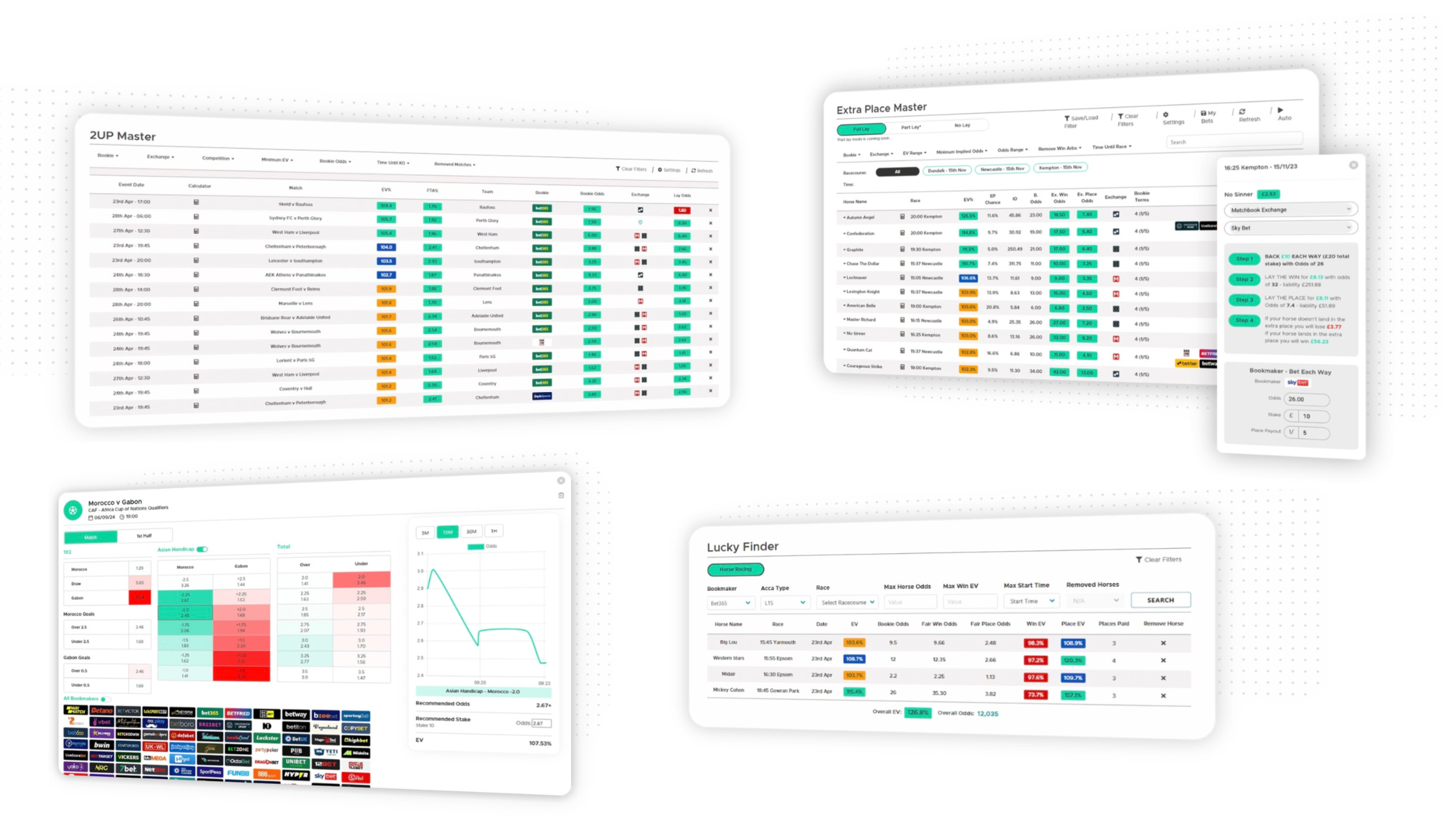
Value Betting on your own requires exhaustive research - but an Outplayed Pro or Elite membership takes care of all that for you.
As well as a range of powerful tools to help maximise your Value Betting profits, Outplayed Pro and Elite offer full step-by-step guides and world class customer support, making a membership the best possible environment for learning all there is to know about Value Betting.
Our Value Betting tools include the following:
- Extra Place Master. Use this tool’s No Lay mode to identify the best value each-way bets on horse racing every single day.
- Lucky Finder. This software automatically builds you Lucky 15 bets with positive EV, offering you the opportunity to make incredible profits in the long run.
- Golf Master. Available with the Elite membership package, this tool identifies high value each-way golf bets, with the potential to make hundreds of pounds a month all year round.
- Steam Chaser. Available with the Elite membership package, this is an incredibly powerful tool designed to take advantage of delays in bookie odds software, which give you the opportunity to bet on overvalued selections.
With these handy tools by your side, you have the potential to make £1000+ extra in profits every single month, thanks to the positive expected value bets they locate each day.
To find out more, check out our full guide to Outplayed Pro, which tells you all you need to know to get started on your Value Betting journey, or take out our trial to make your first Matched Betting profits completely free.
Take our trialFAQs
1. What is expected value?
Expected value refers to the average amount of profit (or loss) you can expect to make over time from a certain bet.
2. Why does expected value matter?
In Value Betting, expected value is the metric you use to decide whether a bet is worth taking. If a bet holds positive expected value, it's likely to be worth placing as part of a Value Betting strategy.
3. Am I guaranteed to make the expected value of my bets in profit?
No; any individual bet may win or lose, and the actual amount of profit you make probably won't exactly match the expected value of your bets. However, the higher your betting volume, the more closely your profit is likely to correlate with the total expected value of your bets.
4. How do I know the true probability of a bet?
That's the hardest part about Value Betting! You can complete huge amounts of research to work this out, but Outplayed's Value Betting tools do all this for you - all you need to do is place the bets our tool suggests.
5. What's the best way to get started with Value Betting?
The easiest way to get started with Value Betting is with an Outplayed membership! Outplayed Pro and Elite memberships give you access to our essential and advanced Value Betting tools, allowing you to make the most of bets that hold positive expected value.
Updated: 28 Aug 2026