
A Guide to Roulette Hedge Betting
13 min read
Stephanie Sorrell
28 Sep 2026

Quick answer: hedge betting in roulette is less common than in sports or poker, as the house edge makes it statistically unprofitable. However, placing multiple wagers on different outcomes in roulette can manage risk and improve the likelihood of a win.
Roulette has a long and proud history, and is thought to date back several centuries - the modern version of roulette was first played in Paris in 1796.
We tend to associate roulette with the glamour of the casino, with Montecarlo or Las Vegas, and with James Bond.
But roulette has been available at online casinos for some time now, making it much easier for online players to access and potentially profit from roulette.
The difficulty, of course, lies in making any money from a game of chance that’s designed always to favour the house. But there are tactics you can use to give yourself the best chance of coming out with a win when playing roulette, and hedge betting is a useful one to understand before you start playing.
What’s The Difference Between Sports Hedge Betting And Roulette Hedge Betting?
They sound like very similar terms - and the principles involved are essentially the same in both cases - but sports hedge betting and roulette hedge betting are in practice very different techniques.
Sports hedge betting
In sports, a hedge bet is a bet that you place some time after you’d placed a previous bet. Your hedge bet is designed to oppose your original bet, covering the opposite outcome to that bet, ideally resulting in a more favourable position for you no matter the outcome of the event.
Bettors will often use a hedge bet to reduce their potential losses if their original bet doesn’t win, but in some circumstances a well-placed hedge bet can allow the bettor to lock in a profit no matter the outcome of that event.
For example, you place a £50 bet on Alexander Zverev to win the US Open before the tournament begins, at odds of 12. To everyone’s surprise, neither of the original favourites, Alcaraz and Sinner, make it through, meaning that Zverev’s chances are looking pretty good when he comes to play Ben Shelton in the final.
You’re confident about Zverev’s chances - he’s now the favourite to win - but just in case you check the available odds on Ben Shelton, to see if a hedging opportunity might be there. Sure enough, you find odds of 2.3, which mean you’ve got the perfect chance to hedge your bet and lock in a profit.
You place a hedge bet of £100 on Shelton, which allows you to come out in profit no matter who ends up lifting the trophy. You’re still best off if Zverev wins, with an overall profit of £450 (a return of £600 minus your stakes of £50 and £100), but even if Shelton wins you’ll make a smaller profit of £80.
| Outcome | Stake | Odds | Return | Overall profit |
|---|---|---|---|---|
| Zverev win | £50 | 12 | £600 | £450 |
| Shelton win | £100 | 2.3 | £230 | £80 |
Roulette hedge betting
As with sports hedge betting, the aim of roulette is risk management, but in practice it works very differently.
When hedge betting in roulette, a player will place more than one bet covering different areas of the wheel in order to maximise their chances of a win.
Expert Insight
‘The biggest mistake is treating roulette hedging like a conventional hedge, where the second position can improve your overall expected return. On a roulette wheel, adding bets changes the distribution of outcomes, but it doesn’t remove the mathematical disadvantage built into the payouts.’
The trick is to get the balance right, as the more possibilities you cover, the lower the return you’re likely to see compared to your stake.
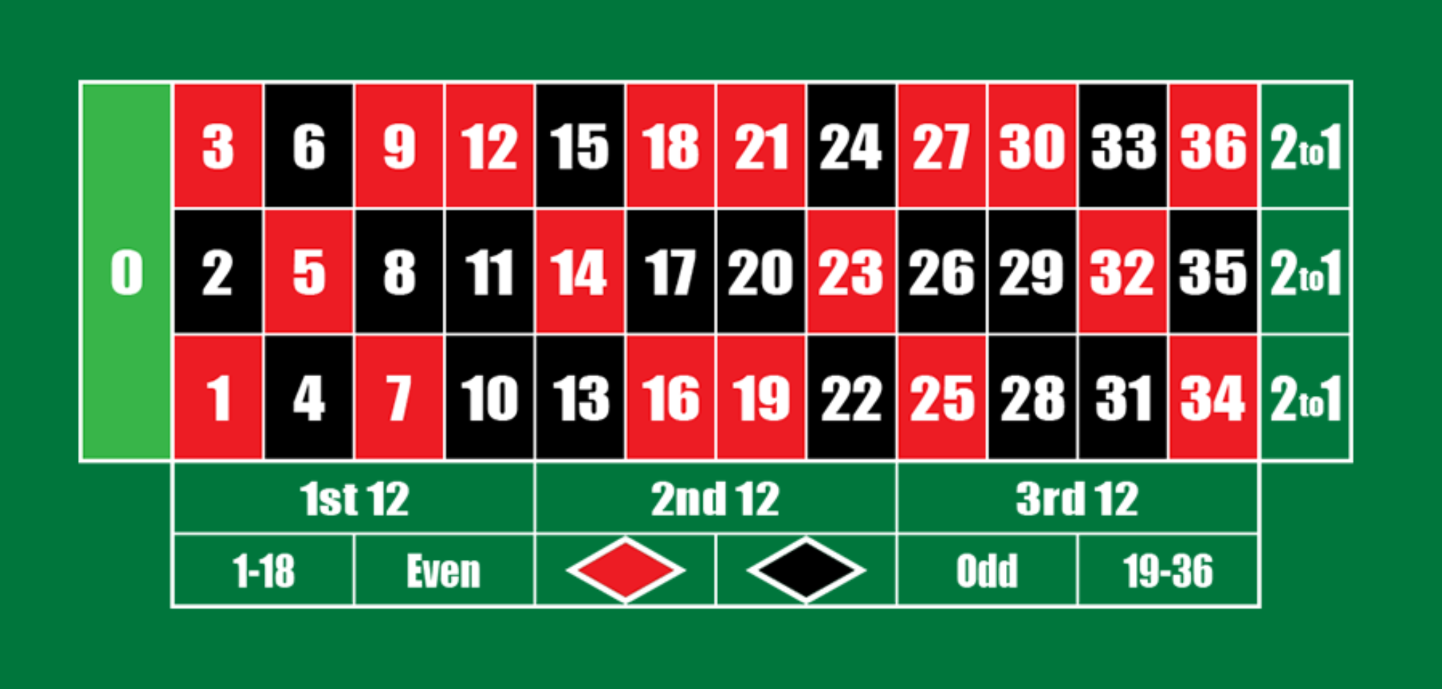
For example, lots of people choose to bet on either red/black, or on odd/even, which gives a slightly lower than 50% chance of winning your bet, and would pay out the same value as your stake if you win. The problem is that you’ve got a slightly higher than 50% chance of losing your bet.
If you also placed a bet on, say, the first 12, you’d drastically improve your chances of a win, as well as introducing the possibility that both bets win. Of course, placing a second bet means doubling your stake, and thus limiting your potential profit, and there is still a not insignificant chance that your bet will lose altogether.
Types Of Roulette Bet
If you’re not already an experienced roulette player, it may be helpful for us to give you a quick rundown of the main types of roulette bet. If you’re already a dab hand at roulette and are familiar with roulette bet types, feel free to skip this section.
Roulette bets can be split into two main categories: inside bets and outside bets. Inside bets are precise, usually involving a few numbers at most, and are consequently harder to win - but they also produce higher returns.
Outside bets are the opposite - they cover a much larger range of numbers, and are therefore much easier to win. However, the payouts will be lower.
Inside bets
| Bet | Description | Chip Placement | Payout |
|---|---|---|---|
| Straight | A bet on a single number e.g. 14 | On that number within the box | 35-1 |
| Split | A bet on two adjacent numbers, either horizontally or vertically e.g. 23/26 or 7/8 | On the edge that both numbers share | 17-1 |
| Street | A bet on three consecutive numbers in a horizontal line (appears vertical in image above) e.g. 4/5/6 | On the outer edge of the row | 11-1 |
| Corner/Square | A bet on four numbers in a square that share a corner e.g. 1/2/4/5 | On the corner where the four numbers meet | 8-1 |
| Double Street | A bet on six consecutive numbers that form two horizontal lines e.g. 4/5/6/7/8/9 | On the outer corner edge that both rows share | 5-1 |
| Basket | A three number bet that involves the 0 e.g. 0/1/2 or 0/2/3 | On the corner shared by the three relevant numbers | 11-1 |
| First Four | A bet on the first four numbers 0/1/2/3 | On the outer corner shared by 0 and 1 or 0 and 3 | 8-1 |
Outside bets
| Bet | Description | Chip Placement | Payout |
|---|---|---|---|
| Red/Black | A bet either on all red numbers or all black numbers | On the relevant colour, marked by a coloured diamond | 1-1 |
| Odd/Even | A bet either on all odds numbers or all even numbers | On the box that states ‘ODD’ or ‘EVEN’ | 1-1 |
| 1-18 or 19-36 | A bet either on all numbers between 1 and 18, or on all numbers between 19 and 36 | On the box that states ‘1-18’ or ‘19-36’ | 1-1 |
| Dozen Bet | A bet on the first dozen (numbers 1-12), second dozen (13-24) or third dozen (25-36) | On the box that states ‘1st 12’, ‘2nd 12’ or ‘3rd 12’ | 2-1 |
| Column Bet | A bet on the first, second or third column of 12 numbers (displayed as horizontal rows on the above image) | On the box that states ‘2 to 1’ at the end of the column in question | 2-1 |
This covers the most common bets you’ll find in roulette, but check out our dedicated Roulette Guide for additional information on a few particularly obscure roulette bets.
What’s The Best Way To Hedge Bet On Roulette?
You know that hedge betting in roulette involves placing multiple bets in order to maximise your chances of winning, but what are the best bets to choose for this? Due to the differing number of possibilities covered by any particular bet, there are certain ways to hedge bet in roulette that will offer a likelihood of better returns for your stake.
The house edge
It’s important to be aware that hedge betting in roulette cannot eliminate the house edge for the casino - if it did, hedge betting would almost certainly be against the rules.
You may increase your chances of a win by hedge betting, but ultimately you’re always likely to lose more than you win by playing roulette. For this reason, we wouldn’t recommend simply playing roulette, even with hedge bets, as a means to make money. However, if you’re playing roulette as required wagering for a casino offer, hedge betting can be a great way to keep your losses to a minimum (so long as hedge bets are permitted as part of your wagering technique).
Data Insight
European roulette produces a house edge of 2.7%, meaning that, over the long run, a player’s theoretical loss is 2.7% of the total amount staked. Changing the way bets are distributed across the wheel does not remove this underlying mathematical cost.
The 3/2 betting system
A popular tactic for roulette hedge betting is what’s known as the 3/2 betting system or plan.
It involves placing two different bet types; one on red/black or odd/even, and one column bet.
However, you don’t stake the same amount of money on each; you put three chips on red/black or odd/even, and two chips on the column. If you’re betting with £1 chips, you’ll have staked a total of £5.
You’re therefore covering significantly over half the board, with a chance of winning both your bets on any spin. However, even if only one of your two bets wins, you’ll still come out with a small profit of £1 on that bet.
That’s not to say that you can’t lose money with this system, however; you are, of course, leaving a portion of the board uncovered, and as we’ve established, the house edge remains.
You should be aware that if you choose to bet on either red or black, that the red/black numbers in each column aren’t always equal. For example, there are only four black numbers in column one, but eight in column two. If you choose to bet on red/black as part of your 3/2 strategy, the column you choose will alter the odds of a win.
Double Street Quad Strategy
This is a rather more complex strategy, and involves placing the following:
- 2 double street bets (covering a total of 12 numbers)
- 1 corner bet (covering another 4 numbers)
- 1 straight bet (covering one single number)
As a total of 17 numbers are covered, you’ve got just under a 50% chance of winning something on any bet, with the potential for a high payout, especially if it’s the straight bet that wins.
Of course, your stakes for every bet are pretty high, and you’re likely to win less than 50% of the time, so the risk is also higher than with a 3/2 strategy. Ideally, you’ll be looking to win big from your straight bet with a payout of 35-1, with your other bets helping to keep your funds going in the meantime.
However, it’s important not to forget that no strategy can outweigh the house edge, and you’re still overall more likely to lose money than you are to win money on roulette.
What Are The Advantages And Disadvantages Of Hedge Betting On Roulette?
Advantages
- Can cover more numbers than a single outside bet
- Increase likelihood of a winning spin
- Can produce better return compared to stake
- Can reduce risk of losses when wagering
Disadvantages
- Increases stake size
- Cannot eliminate house edge
- Could lead to over-confidence in bettor
Expert Insight
‘A useful discipline is to judge a roulette strategy by the total amount staked, rather than by how often it produces a winning spin. Frequent small wins can make a system feel successful even when the occasional losses are large enough to outweigh them.’
Are There Any Other Strategies You Can Use When Betting On Sports Or Casino To Maximise Your Profits?
Casino Offers
If you’re looking to make money from online casino, then taking advantage of casino offers is the absolute best thing you can do.
As we’ve established, even when using an optimal hedge betting strategy, the house edge will still result in the casino making a profit overall, and the player losing money.
But when you factor in casino offers, which give the player rewards such as Golden Chips, free spins or bonus funds, the balance shifts and the player can end up being the one to hold the statistical advantage (though it's important to remember that this is not a risk-free strategy).
Outplayed Diamond members get access to our full range of casino offers and guides, which can make you potentially hundreds of pounds if you follow the instructions correctly.
To find out more, check out our guide to casino offers for all the information you need to get started.
Matched Betting
On the sports side of things, Matched Betting is one of the best strategies you can use to make money, especially if you aren’t already a habitual sports bettor.
Matched Betting is a technique that involves placing bets on two opposing outcomes, the first with a bookmaker and the second with a betting exchange as a lay bet. As with casino offers, making money from Matched Betting hinges on earning and using bookie rewards like free bets in what is most often a two-step process.
1. You place a bet with your own money, known as a ‘qualifying bet’, which unlocks a reward such as a free bet. You match your qualifying bet with a lay bet at a betting exchange, typically making a small loss of a few pence.
2. You then place a second matched bet with the free bet you’ve unlocked, which is what makes you a profit.
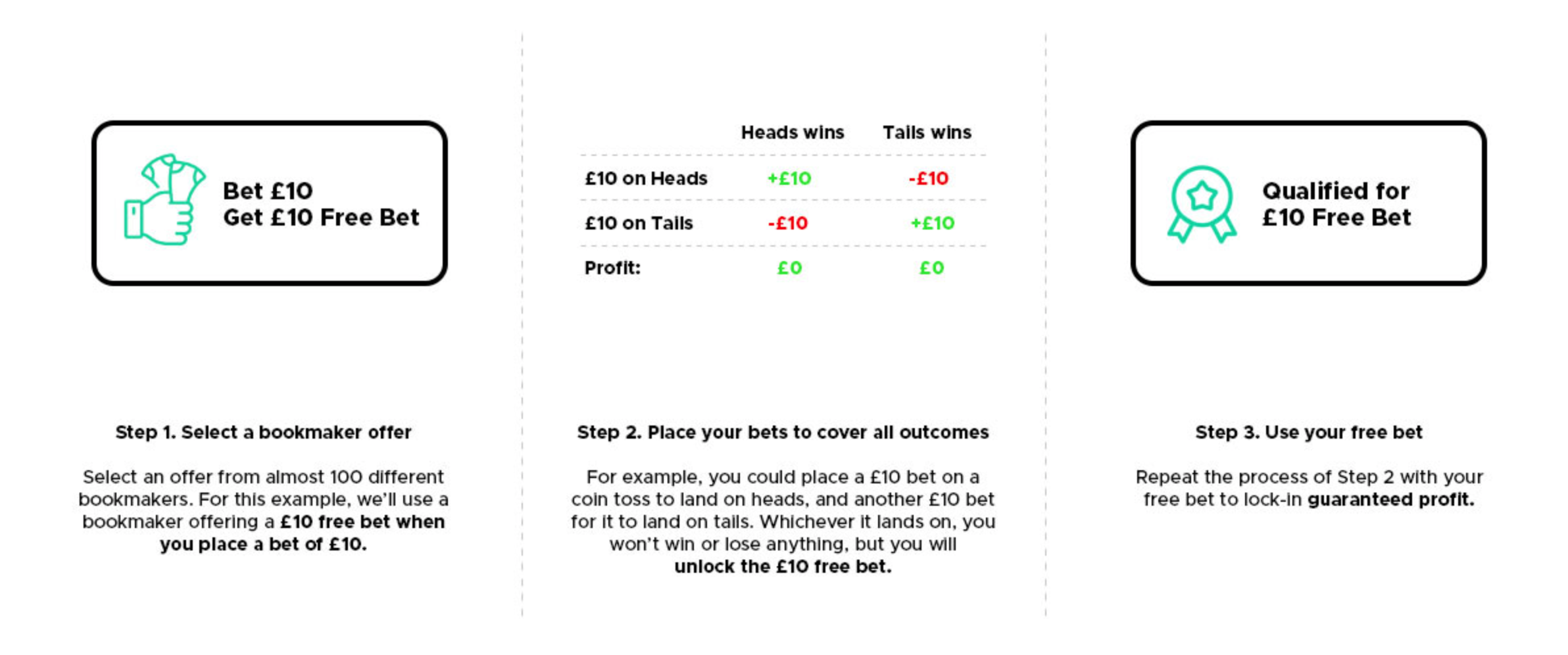
Matched Betting is perfect for newcomers to sports betting, as it’s extremely low risk and doesn’t require any existing sports knowledge or any significant bankroll.
To find out more, take a look at our Beginner’s Guide to Matched Betting for all you need to know to get started.
Arbitrage Betting
Arbitrage betting is very similar to Matched Betting, in that it involves placing two bets on opposing selections.
With arbitrage betting, though, the key is to find pairs of odds that make it possible to lock in a profit with every single set of matched bets you place.
It’s easiest to arbitrage bet between a bookmaker and a betting exchange, just as you would when Matched Betting. The difference is that arbitrage bettors look for back odds with a bookmaker that are higher than the lay odds with the exchange, which can lock in an immediate profit.
To find out more, take a look at our dedicated guide to arbitrage betting for all the details about how this strategy works.
Value Betting
If you’re a more experienced sports bettor, you’re comfortable with a higher level of risk, and you’ve got a solid bankroll already, Value Betting can be a sound strategy.
You don’t lock in a profit with your bets, as you would with Matched Betting or arbitrage betting, but you do still look for particularly favourable odds from bookies. Specifically, odds that are higher than the true probability of a win would imply.
If you confine your betting to selections with disproportionately favourable odds, there’s a statistical likelihood that you’ll profit overall, even though there’s no guarantee that any individual bet will win. In fact, if you’re betting at high odds, it’s quite likely that most of your bets will lose - but if you’ve done things right, your winning bets will produce enough return to outweigh your losses and generate profits overall.
To find out more about how Value Betting works and how you can get started, check out the dedicated Outplayed guide.
Summary
Hedge betting can be a very useful tactic if you’re playing roulette - but it’s important to remember that no strategy can eliminate the house edge, so on average you’re always likely to lose money overall.
However, that’s not to say that it’s impossible to make money from casino - you just need to find a strategy that gives you the edge, instead of the house. Casino offers are the perfect way to do this; when you factor in free spins or other rewards, it’s often possible to play with the edge in your favour.
You can also try Matched Betting on sports, a strategy that involves minimal risk and that can make you as much as £300 - £1000+ a month. To find out more, take a look at our Beginner’s Guide to Matched Betting.
Or if you’ve heard enough and you’re ready to get going, sign up for our trial to gain access to £850+ worth of signing up offers completely free of charge!
sign up nowFAQs
1. Is there a difference between hedge betting in sports and in roulette?
Yes, the two concepts work very differently, even if they’re based on a similar principle. In roulette, hedge betting means placing more than one bet at once to cover more of the board, while in sports it means placing two opposing bets to limit risk, or even lock in a profit.
2. Should I hedge bet when playing roulette?
That depends on your aims. Hedging can increase your likelihood of winning, but it also increases your stake, without eliminating the house edge. It can be a good way to complete wagering requirements that form part of casino offers, though, as long as it’s permitted by the casino in question.
3. Does hedging in roulette guarantee I’ll make money?
No, it definitely doesn’t. The house edge still exists, so on average you’d expect to lose some money from hedging in roulette.
4. Is hedging in roulette easy for beginners?
Yes, once you understand the basic principles of hedging in roulette, it isn’t difficult to do. However, fully understanding the mathematics and probabilities behind roulette takes longer, so if you’re a beginner there’s certainly more to learn.
Data Insight
A 2023 experiment involving 3,333 UK-based online gamblers found that the clearest house-edge wording produced a 57.7% rate of correct understanding. The finding shows why knowing the terminology and mathematics behind roulette matters when judging what a betting strategy actually achieves.
- Addiction Research and Theory
5. Is hedging in roulette legal?
Yes, it’s completely legal. It’s simply a fairly common strategy used by players to balance risk with potential reward, and there’s nothing illegal about it.
Updated: 1 Oct 2026