
What Sports Can You Hedge Bet On? A Sport-by-Sport Breakdown
15 min read
Stephanie Sorrell
28 Sep 2026

Quick answer: you can hedge bet on any sport in theory, so long as you can find opposing markets for your bets. However, some sports are better suited to hedging than others, especially particularly popular sports and those whose markets often offer only two outcomes (e.g. the winner of a tennis match).
Recreational gamblers aren’t always successful. In fact, the majority of bettors lose more money than they make, evidenced by the fact that, when surveyed by the Gambling Commission, it was found that almost three-quarters of active betting accounts were in a net loss position.
Any strategy you can adopt to give yourself a leg up when sports betting is therefore worthwhile, and hedge betting is a highly popular one, as it can protect you from losses and even lock in secure profits.
But can you hedge bet on any sport? And which sports are best suited to hedge betting? In this article, we’ll investigate how hedge betting can work on major British betting sports, to help you decide how to proceed with a hedge betting strategy, or whether you’d prefer to adopt an alternative strategy altogether.
What Is A Hedge In Sports Betting?
Hedge betting is a sports betting strategy designed to limit risk and potentially lock in a profit by placing one or more additional bets that oppose an existing bet.
Generally speaking, hedge betting is most successful when there is a period of time between the original bet and any hedges that oppose it, which allows the bettor to take advantage of changing odds. If the odds opposing a bet have lengthened since it was placed, the chances are good that you’ll have a favourable hedging opportunity.
An example of a hedge bet
To illustrate how this can work in practice, we’ll imagine a hedge bet placed over the course of the football season.
At the start of the season, as a Manchester United fan, you place a bet on your team to win the FA Cup. At the time, this isn’t considered particularly likely, and so you’re able to place a £100 bet at odds of 15.
To your delight, Man Utd go on to have a fantastic season and, several months after your initial bet, they make the finals against Arsenal.
Arsenal are still the favourites to win, but pundits certainly aren’t ruling out a Man Utd victory. You have faith in your team, but when you realise that you’ve got the perfect opportunity to hedge your bet, you decide it’s worth it.
The best available odds on Arsenal are now at 1.7, and having worked out your preferred position using a hedging or Dutching calculator, you decide to place a hedge bet of £300 on Arsenal to win.
Having done so, you’re now in a position to profit no matter what happens. You’re still best off with a Man Utd win, which will make you a profit of £1100, but even if Arsenal take the trophy you’ll still have an overall profit of £110.
| Outcome | Odds (at time of bet) | Stake | Return | Overall profit |
|---|---|---|---|---|
| Man Utd wins | 15 | £100 | £1500 | £1100 |
| Arsenal wins | 1.7 | £300 | £510 | £110 |
Hedging with an exchange
An alternative to hedge betting with another bookmaker is to hedge with a lay bet at a betting exchange, just as you would when Matched Betting.
The benefit of this option is that it’s incredibly easy to work out whether you have a potentially profitable hedge - if the lay odds are lower than the back odds you took, you’re in a position to lock in a profit. You can then simply use a standard Matched Betting calculator to work out your stakes.
The downside is that betting exchanges do charge commission, though it’s worth noting that Outplayed members enjoy 0% commission with both Matchbook and Smarkets.
What Sports Are Best Suited To Hedge Betting?
You can hedge a bet on pretty much any sport, so long as there are markets that allow for opposing bets. But some sports certainly offer more opportunities than others, and make it easier to find and take advantage of hedges.
Football
Football is the most popular sport in the UK, and is consequently also the most popular sport for betting on. You’ll therefore find no shortage of markets, which often makes it easier to find suitable bets for hedging.
Data Insight
Football is by far the biggest sport for remote betting in Great Britain. In the Gambling Commission’s latest full-year industry statistics, football generated £1.3 billion in gross gambling yield, compared with £766.7 million for horse racing.
Of course, the fact that a football match can end in one of three ways (Team A win, Team B win, draw) means that if you’re hedging on the match winner between bookies, you’ll need to use three bookmakers rather than just two. However, you can of course simply use a betting exchange to lay your bet if you prefer.
Alternatively, you can use markets that allow for easier two-way hedges, such as Over/Under markets. You can also employ a strategy called ‘middling’ on a Totals market, where you place two bets, such as Over 1.5 goals and Under 2.5 goals, where you can be sure that at least one bet will win, and there’s a possibility of both bets winning if there are exactly the right number of goals (2, in this case).
Tennis
Tennis is another massively popular sport for betting, and in some ways its matches are ideally suited for hedging. With no possibility of a draw, it’s easy to find opposing bets - simply bet on one player to win with one bookie, and their opponent with another.
However, it’s important to be aware that retirement rules can make life difficult. Not all bookies handle the retirement of a player due to injury in the same way, so if you’re not careful you could end up in a position where you lose both your bets. Check our retirement rules guide before betting to make sure the bookies/exchanges you use line up with each other, or alternatively bet on markets such as the outright winner to avoid issues of this nature.
Expert Insight
‘Tennis hedges need more than matching prices between bookmakers. The timing of the hedge matters because a player’s physical condition, momentum and court position can move the market sharply. A price that looks attractive can disappear within seconds, particularly during an in-play match.’
Golf
Golf is another sport that’s hugely popular with bettors, and it can work well for hedging.
It can be trickier to find opposing bets that exclude all other possibilities, though, due to the number of participants, unless you lay your bet with an exchange.
Still, it’s perfectly possible to improve your chances of coming away with a profit by hedging on your selection’s biggest challengers, even if you can’t lock in a certain profit.
Boxing
Like tennis, boxing matches have two participants and a single winner, making it pretty simple to hedge a bet on the winner of a fight. It’s best to be a boxing fan, or at least someone with good knowledge of the sport and its fighters, if you’re going to bet on boxing, though, as the success of your hedging will rely to a great extent on placing a sound initial bet.
You can also bet on, and hedge, other markets, such as Over/Under (for the total number of rounds), or whether a boxer will score a knockdown.
Horse Racing
Horse racing can be tricky to hedge, due to the number of competitors in almost all races. It’s rare that a race will feature fewer than four horses, and in many cases there are far more, meaning that covering all possibilities with a traditional hedge bet becomes extremely difficult.
That said, if you’ve bet on a particular horse in advance and it goes on to do well, with just one or two other horses looking promising at the race’s mid-point, you could consider hedging on your nearest competitors to cover all likely potential outcomes of that race.
Alternatively, you could of course lay with a betting exchange, which avoids the issue of having too many possible outcomes to cover.
Expert Insight
‘With horse racing, the biggest mistake is confusing a hedge with simply backing the obvious dangers to your original selection. A race can change dramatically after the start, so unless the hedge is structured to account for the full market, you may reduce one risk while leaving another largely untouched.’
Other Sports
So long as a sport is popular enough to be featured on multiple bookmakers, the chances are good that it’s possible to hedge a bet on it.
However, that doesn’t mean that it’s a good idea. If you plan to hedge bet on any sport, you should have a detailed knowledge of how it works and have done significant research before placing any initial bet. Hedging on any sport you don’t fully understand is never a good idea.
Considerations When Choosing A Sport For Hedge Betting
It may be possible to hedge a bet on most sports, but there are still some important considerations to bear in mind when deciding which sport you plan to hedge bet on.
Popularity
Although hedge betting isn’t as likely to result in bookmaker restrictions as other strategies (especially arbitrage betting, but also Matched Betting), it still makes sense to focus your betting on more popular sports and markets. You’re most likely to end up with a hedging opportunity if you choose a selection with over-valued odds, as the chances are higher that the odds for your choice will drop, and its opponents will rise.
But betting exclusively on highly competitive odds can attract the attention of the bookies and potentially lead to account restrictions, so it’s important to make an effort to blend in. Focusing on the most popular sports out there, as well as high profile matches, will help you blend in with the crowd.
As well as this, more popular sports tend to feature more markets, offering more hedge betting opportunities.
Number of possible outcomes
It’s important to consider how difficult it will be to cover all outcomes if you’re planning to hedge a bet, although if you use a betting exchange and there’s a straightforward lay market for your bet, it’s easy enough. It’s worth noting that more niche sports may not be available with betting exchanges, however.
Of course, in some cases, such as an outright bet on the eventual winner of a football league, there may be many potential outcomes to begin with, but only two by the time you come to hedge your bet - assuming your original selection is still in the running.
Betting rules
You should be aware of how betting rules are applied to any sport you’re betting on, as these can have a significant impact on the success of your hedge betting.
Tennis is the most obvious example of this, as bookmakers and exchanges don’t all offer the same terms regarding whether a bet is honoured or voided in the event of a player retiring due to injury (e.g. some bookmakers require that one full set is played before a bet is settled, while others require the full match to be completed).
Make sure that you understand how betting rules are applied to any sport you intend to hedge bet on (or place any other type of bet on, for that matter!) to avoid running the risk of losing money.
Likelihood of odds shift
It’s in the nature of sports betting that the odds will shift, however some sports are much more uncertain than others.
For example, it’s relatively uncommon to see a significant upset in a sport like football, but it’s very common for a horse other than the favourite to win a race.
Betting on futures can increase the chances of an odds shift before your bet settles, though, and you can also consider betting in-play, especially on sports like football, to make use of momentum swings between the two teams.
Data Insight
In-play betting is already a significant part of sports betting in Great Britain. Gambling Commission data found that 4% of adults had bet in-play on an event or sport in the previous four weeks, making it the second-most common type of betting after live football.
| Popularity | The most popular sports offer the largest number of markets, and make it easier to blend in with regular punters. |
| Number of outcomes | Sports (and markets) with too many possible outcomes can be difficult to hedge, and a hedge bet may not be able to eliminate risk. |
| Betting rules | Some sports, like tennis, are subject to finicky betting rules from bookies, which could result in losing money if you bet unawares. |
| Likelihood of odds shift | Some sports are more stable than others, and odds shifts that result in hedge betting opportunities may be more common in less stable sports. |
Other Strategies That Can Help You Profit From Sports Betting
Hedge betting can be a brilliant way to profit from sports betting, but it does involve risk, and it requires a reasonable amount of sporting knowledge and experience.
If you’re uncomfortable with the element of risk, or newer to sports betting, there are other fantastic strategies out there that will allow you to make money, some of which can lock in a profit on a sports bet, just like hedge betting, but without the initial risk.
Matched Betting
At Outplayed, we’re the experts in Matched Betting, and we consider this to be the very best place to begin if you’re new to sports betting and looking to start building some profits.
Like hedge betting, Matched Betting involves placing bets on opposing outcomes, using a betting exchange as a rule. However, Matched Betting hinges on using bookmaker offers to turn these matched bets into profit in what is typically a two-step process.
First, you place what we call a ‘qualifying bet’, which unlocks a reward such as a free bet. You match this bet with a lay bet at a betting exchange, typically making a small loss of just a few pence, known as a qualifying loss.
Then you place a second matched bet with the free bet you’ve unlocked, usually making a profit of around 70-80% of the value of your free bet.
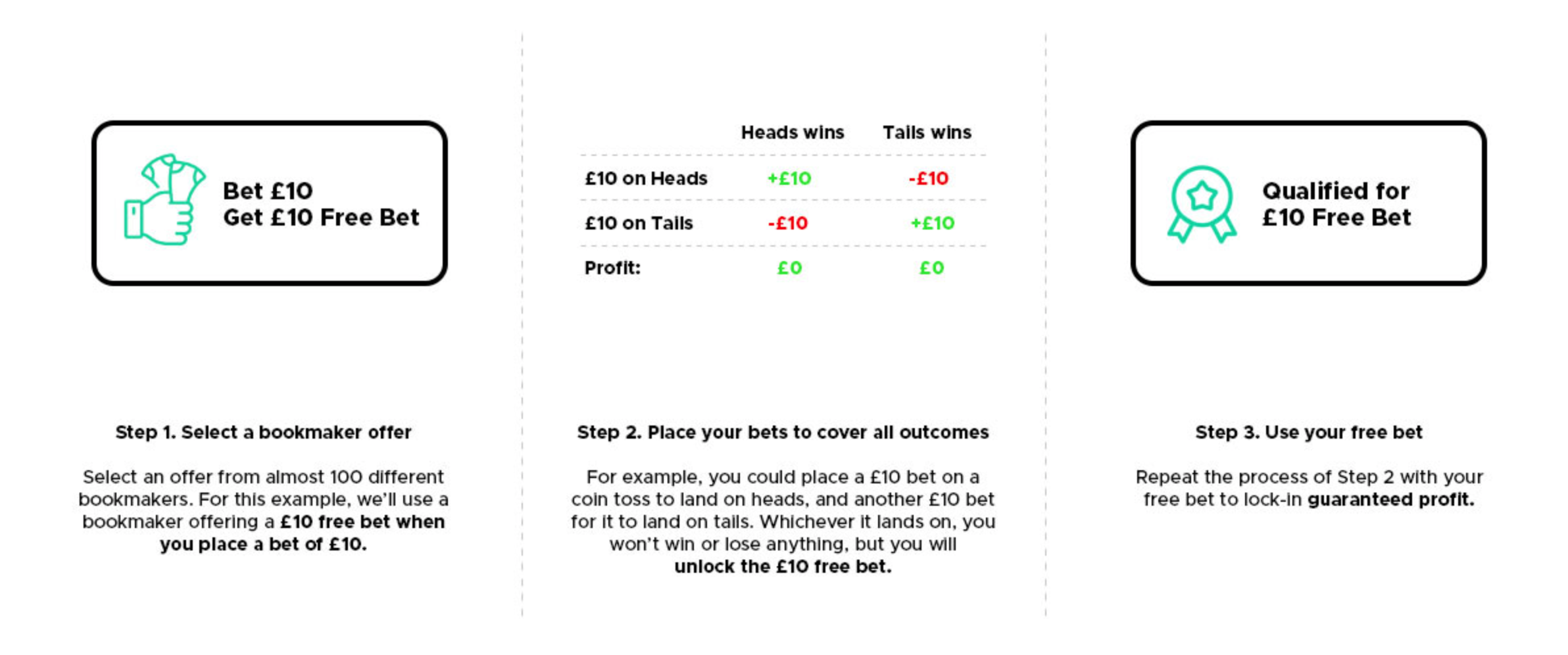
Matched Betting is a low-risk technique which makes Outplayed members as much as £300 - £1000+ per month, making it a fantastic side hustle.
To find out more, take a look at our Beginner’s Guide to Matched Betting for a full breakdown of the process and how you can get started.
Arbitrage Betting
Arbitrage betting is another very similar technique both to hedge betting and Matched Betting, as it again involves placing bets for and against the same outcome.
Instead of waiting and hoping the odds allow for a good hedge, though, or unlocking a reward with a qualifying bet, arbitrage betting involves finding pairs of odds that are so favourable you’re able to lock in a profit immediately.
In the UK, this usually involves placing a back bet with a bookmaker and a lay bet with a betting exchange, just like with a matched bet. If the odds for your back bet are higher than those for your lay bet, you’ve got an arbitrage bet, which will generate a profit no matter what happens in the event.
To find out more, take a look at our dedicated guide to arbitrage betting for all you need to know about how this strategy works.
Value Betting
Value Betting is a more advanced strategy than arbitrage betting or Matched Betting, but it can pair well with hedge betting. Because there is risk involved, we strongly advise newer bettors to build up their experience of sports betting and also their bankroll before they get started.
If you’re already in that position, though, Value Betting can make a significant contribution to your profits. Although you don’t lock in a profit with your bets, Value Betting relies on a similar principle to arbitrage betting - that of locating favourable odds from bookies. Specifically, odds that are higher than the true probability of a win would imply.
By betting exclusively on selections with disproportionately favourable odds, you’re statistically likely to end up profiting overall. It’s important to note, though, that with nothing to lock in a profit, you could lose any bet you place.
It also combines well with hedge betting, which can mitigate some of the risk of a Value Betting strategy, although we wouldn’t expect most value bettors to wish to hedge every bet.
To find out more about how Value Betting works and how you can get started, check out the dedicated Outplayed guide.
Summary
As we’ve established, you can in theory hedge bet on any sport you like - but the availability of suitable markets, betting rules, and popularity of each sport will mean that, in practice, some sports are better suited to a hedge betting strategy than others.
Whichever sport you decide to hedge bet on, you should make sure you’ve got the experience to bet wisely - and a strong enough bankroll to support your strategy.
If you’re a newer bettor, or you’re uncomfortable with the risk of hedge betting, there are safer strategies out there - and none better than Matched Betting.
To find out more, check out the Outplayed Beginner’s Guide to Matched Betting for all the information you need to get started.
Or if you’re ready to dive right in, sign up for our free trial for access to 40+ sign up offers and over £800 in potential profits.
sign up nowFAQs
1. Can you hedge any sports bet?
Yes, but how effective that hedge is can depend on the sport. Depending on the sport and the market, it may be difficult to fully cover all outcomes (unless you’re able to hedge with a betting exchange), so you might not always be able to remove the element of risk.
2. What sports are best for hedging?
There are lots of good hedging options across most sports, but those that allow for futures bets, such as the outright winner of a full football season, or the winner of a tennis tournament, may present the best hedging opportunities.
3. Is hedge betting legal?
Yes, hedge betting is completely legal, regardless of the sport you’re betting on. However, bookmakers aren’t keen on hedge bettors, so it’s wise to try to avoid standing out as a hedge bettor, and you certainly shouldn’t hedge your bet at the same bookmaker you placed your original bet with.
4. Is hedge betting beginner-friendly?
If you’re already an experienced sports bettor, you’re unlikely to find it difficult to start hedging some of your bets. However, if you’re a newcomer to sports betting altogether, hedge betting isn’t the best choice; we’d recommend starting off with Matched Betting to build up some experience and your bankroll.
5. Should you hedge every bet?
Probably not. It’s unlikely that every bet would present a hedging opportunity good enough to make it worth hedging, and if your initial betting strategy is a sound one you’d expect to do better by letting some of your bets play out. If you’re risk-averse, you’re probably better off with a Matched Betting strategy.
Updated: 1 Oct 2026