
A Complete Guide to Tennis Dutching
11 min read
Stephanie Sorrell
29 Oct 2026

Quick answer: dutching can be a very useful technique for betting on tennis, especially for matched bettors, allowing you to potentially lock in a profit without the risk of falling foul of retirement rules.
Tennis is one of the most popular sports in the world, with enormous sums of money riding on the outcome of a match - both in terms of prize money, and the amounts bettors will have staked on that match.
But turning a profit from betting on tennis is easier said than done. Ultimately, when betting recreationally without any particular strategy, the chances are that all you’ll do is end up contributing to the bookies coffers; although a relatively large number of Brits regularly bet on sports, comparatively few end up making any money.
Data Insight
A Gambling Commission survey found that 8% of adults had bet on sports and racing online or through an app in the previous four weeks.
There are strategies you can use to swing the balance in your favour, however, and dutching is one strategy that’s particularly well-suited to tennis betting.
In this article, we’ll take you through how dutching can be used on tennis matches, the best ways to use it, and other strategies you can employ to get the most out of your tennis betting.
Dutching In A Nutshell
In essence, dutching is nothing more complicated than placing more than one bet on a single market between different bookmakers.
In some cases (if you don’t cover all possible outcomes in that market) you may only improve your chances of winning at least one of the bets you place - but in others, it’s possible to cover all possible outcomes and emerge with a winning bet no matter how the match goes.
The strategy can be sub-categorised into several different types:
- Equal stakes. The bettor places the same stakes on all the selections they bet on (producing different profits depending on which outcome ends up winning).
- Equal profits. The bettor adjusts their stakes according to the odds of each selection, resulting in the same profit no matter which outcome ends up winning.
- Covering all outcomes. The bettor places bets on all possible outcomes within a market, ensuring that one of their bets is certain to win. They may decide to use either the equal stakes or equal profits type of dutching, depending on their aims and their read of the event.
- Covering some outcomes. The bettor places bets on only some of the possible outcomes within a market, for example on a few of the potential scores in one set of a tennis match. This leaves open the possibility of another selection winning, and the bettor losing their entire stake. Again, they may choose to use either the equal stakes or equal profits type of dutching.
The exact type of dutching you choose to use will depend on your aims and your tolerance of risk.
An example of a dutch bet
Let’s imagine we want to dutch a bet on a tennis match. Having had a look at the odds across various bookies for upcoming matches during the Australian Open, you notice the following odds on the Match Winner market for a match between Carlos Alcaraz and Novak Djokovic:
| Alcaraz | Djokovic | |
| Bookie A | 1.5 | |
| Bookie B | 3.3 |
You’re pretty sure you’re seeing a dutching opportunity, based on how high the respective odds are, but you double check those odds with a dutching calculator to make certain. Sure enough, the calculator tells you you have an opportunity to create an arbitrage bet by dutching on the Match Winner market, coming out in profit no matter who ends up winning.
You decide you want to place a £50 bet on Alcaraz, and use a dutching calculator to work out your stakes accordingly:
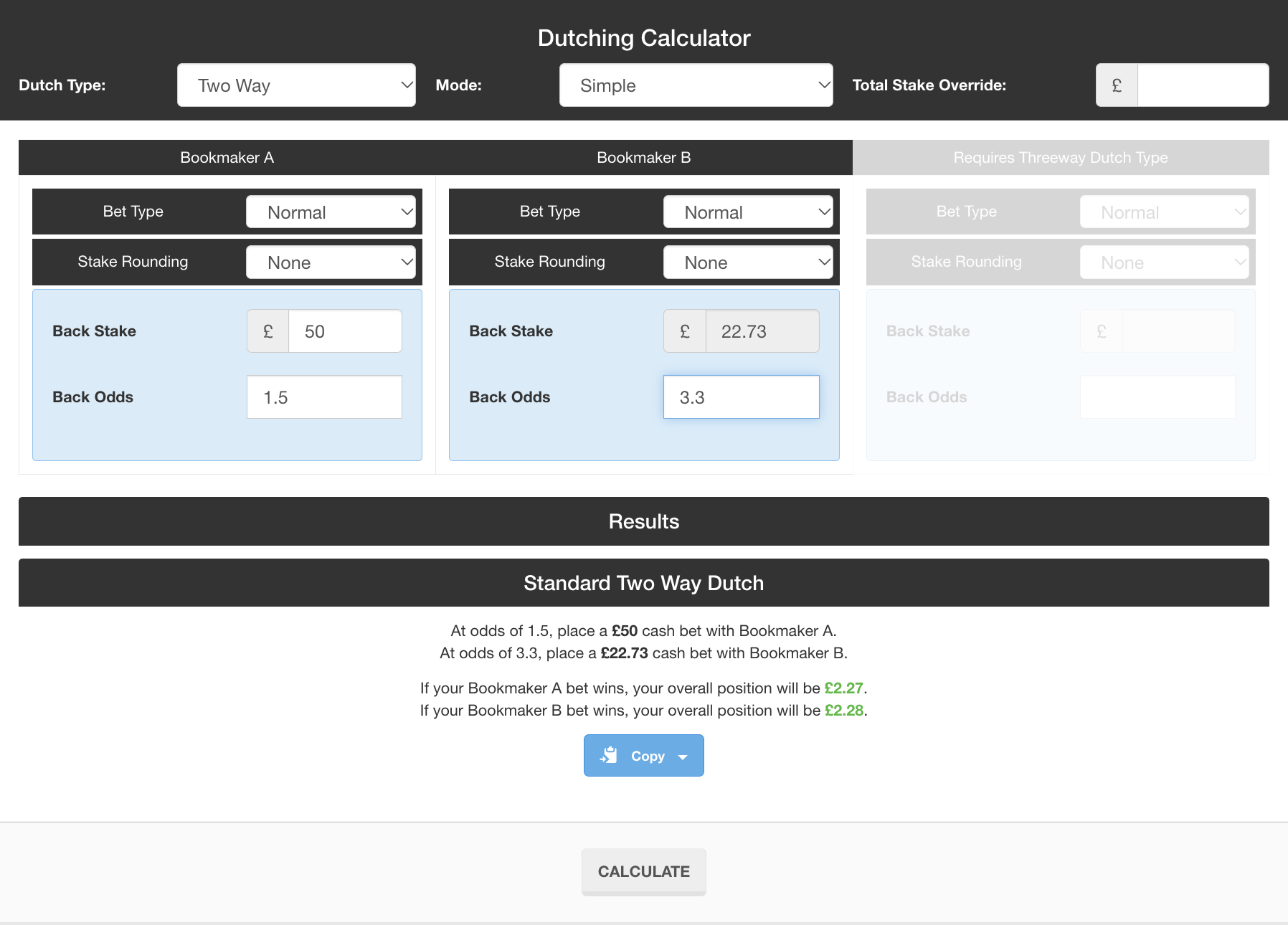
As you see above, if you place a £22.73 bet on Djokovic with Bookie B, you’re able to come out with a profit of £2.27 no matter who ends up winning the match.
This isn’t an enormous profit, given you’re staking a total of £72.73, but it comes with negligible risk, and by repeatedly placing dutched bets like this you’ll be able to build up your profits over time.
| Outcome | Odds | Stake | Return | Overall Profit |
|---|---|---|---|---|
| Alcaraz wins | 1.5 | £50 | £75 | £2.27 |
| Djokovic wins | 3.3 | £22.73 | £75.01 | £2.28 |
What’s The Best Tennis Dutching Strategy?
As part of a Matched Betting or arbitrage strategy
One of the biggest advantages of dutching on tennis is for matched bettors or arbitrage bettors, who might otherwise struggle to take advantage of tennis offers with the match winner market. This is due to tennis retirement rules, which relate to how a bet is settled if a player retires due to injury (or is defaulted - although this is extremely rare).
Some bookmakers will settle a bet normally if a player retires, so long as at least one full set was completed beforehand, while others will void a bet no matter when in a match a player retires. Betting exchanges won’t necessarily use the same terms as a bookmaker, which means that using traditional Matched Betting or arbitrage betting techniques can risk both sides of your bet losing in the event of a retirement.
Data Insight
Research covering professional tennis found that 2.11% of ATP Tour matches and 1.73% of WTA Tour matches ended in a player's retirement. That makes retirement settlement rules a genuine consideration for tennis bettors, rather than a purely theoretical complication.
- European Journal of Sport Science
Dutching between two bookmakers that use the same terms ensures you don’t run into this issue (check our guide to tennis retirements for details of which bookies fall into which group), so dutching on tennis can be a popular choice for matched bettors, allowing them to make use of any tennis offers they come across.
Dutching on other markets
If you’re betting recreationally and comfortable with a degree of risk, you might choose to dutch across a market with a larger number of possible outcomes, such as the exact score in a particular set.
You might choose to bet on a handful of the most likely scores - e.g. 6-3, 6-4 and 7-5 - in the hope that at least one of those will win. Because the odds on any particular score are pretty high, you’ll snag a decent return if any of your choices are accurate.
Of course, you’re taking the risk of losing all the money you’ve staked if none of those scores end up winning, but depending on your read of the match and players you may well feel that the risk is worth the potential reward.
For example, let’s have a look at the First Set Score market for an upcoming match between Djokovic and De Minaur:
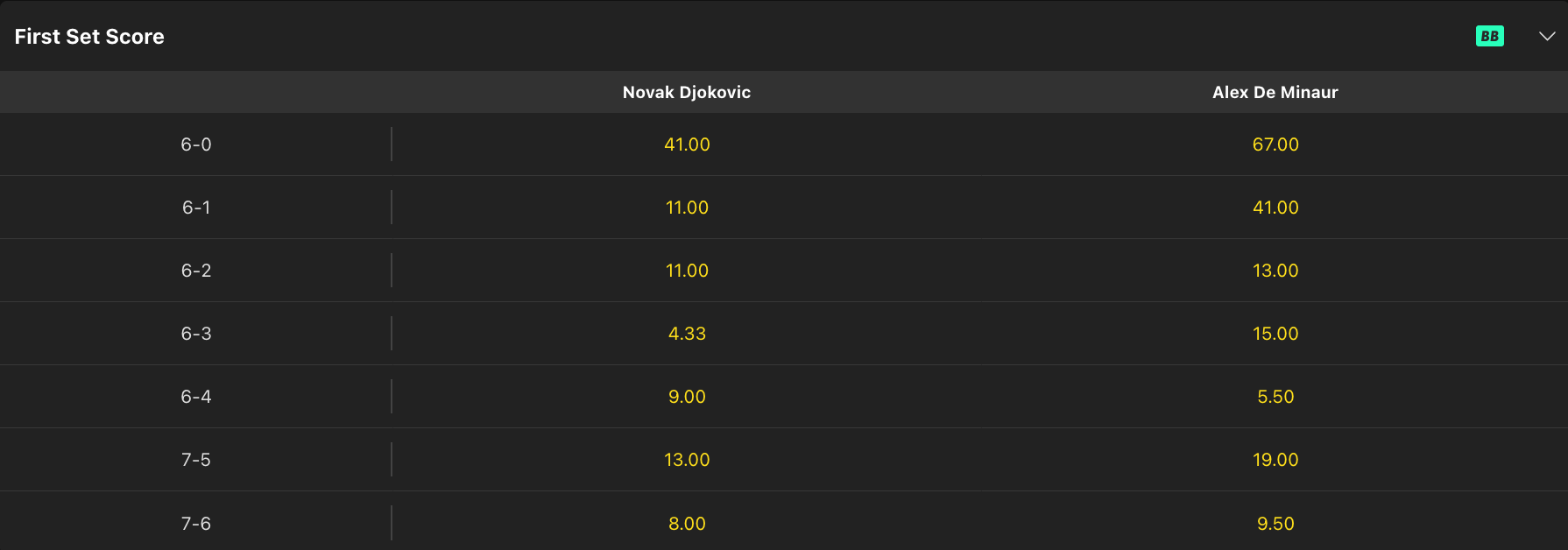
We might decide to dutch a bet on this market across the three most likely outcomes (though of course in reality we would need to use three different bookies rather than just one):
6-3 to Djokovic - 4.33
6-4 to De Minaur - 5.5
7-6 to Djokovic - 8
We can use a dutching calculator (using advanced mode if we use Outplayed’s own calculator) to work out our potential profits if we place a £10 bet on each of these outcomes:
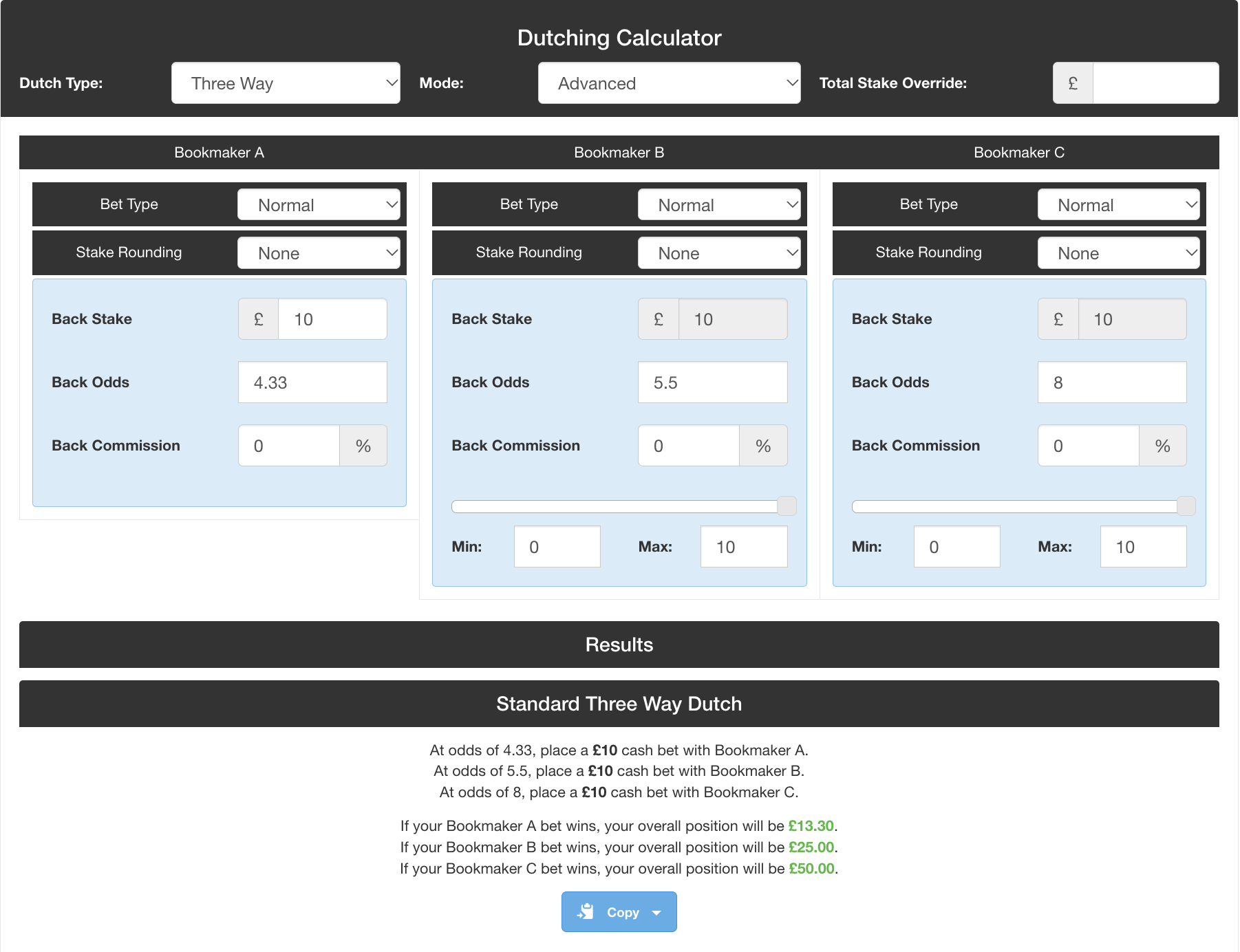
As you can see, we end up making a profit as long as any of those outcomes wins, though naturally we make the greatest profit if the outcome with the highest odds goes on to win.
It’s important to remember that just because these are the three most likely scores (at least according to the odds), that doesn’t mean we can assume that one of them will be accurate. There is still a good chance of losing all our bets, and our full stake of £30. We’d therefore recommend that you’re an experienced sports bettor with a strong bankroll before you embark on a dutching strategy that involves this degree of risk.
Expert Insight
‘The biggest mistake with tennis dutching is comparing the headline odds without checking how each bookmaker settles retirements and defaults. A small difference in settlement terms can turn what looks like a neatly balanced position into an outcome where both bets are effectively exposed.’
What Are The Risks And Downsides Of Dutching On Tennis?
While dutching on tennis can be a great way to optimise your betting, it’s important to be aware that there can be risks involved, even if you cover all outcomes.
The most important to be aware of are as follows:
- Retirement rules. As mentioned above, one of the key benefits of dutching on tennis (rather than traditional Matched Betting or arbitrage techniques) is that it’s much easier to avoid falling foul of retirement rules. However, you still need to pay attention to the terms at the bookies you use, as these can vary between bookmakers. Check our guide to retirement rules to make sure that the bookies you choose to dutch between line up.
- Losing money. If you choose not to cover all outcomes in a market - e.g. if betting on the Set Score market and covering only some of the possibilities - then you could potentially lose all the money you’ve staked.
- Difficulty of locating suitable opportunities. It can be much more difficult to locate good dutching opportunities than it is to locate a straightforward match if you’re Matched Betting. Websites like Oddschecker can help to mitigate this, however.
- Added margins. Each additional bookmaker you use means you’re paying an additional margin that goes towards their profits, making it harder to make any money yourself. If you focus mostly on the match winner market, though, you are at least only contributing to two bookies’ margins.
- Lack of beginner-friendly software. Strategies like Matched Betting are made easy for beginners with dedicated software like Outplayed’s Oddsmatcher. This kind of software isn’t really available for dutching in the UK, meaning that there’s more of a learning curve for newcomers to dutching.
- Bookmaker restrictions. Bookies don’t appreciate bettors who use strategies like dutching to limit risk and maximise their profits, and are constantly on the lookout for signs of dutching (and other smart betting strategies). That means that obvious dutching behaviour - e.g. betting on highly obscure markets because you’ve found great odds, or with oddly precise stakes - can result in the bookie catching on to what you’re up to, and potentially restricting your account, or even banning you.
Take steps to blend in and avoid being gubbed to mitigate this risk, such as sticking to high profile tennis tournaments and rounding your stakes to avoid them looking too suspicious.
Expert Insight
‘Execution speed matters more than many bettors realise, especially when betting in-play. Tennis odds can move sharply after a break, injury concern or momentum shift, so an opportunity that was profitable when identified may disappear before every leg is placed. Recheck the combined odds immediately before committing the full stake.’
Are There Any Other Strategies You Can Use When Betting On Tennis To Maximise Your Profits?
Dutching can be a great way to optimise your sports betting, but it’s not the only strategy out there - and there are other strategies that can do even more to maximise your success with tennis betting, especially when combined with dutching.
Matched Betting
As we’ve already seen, traditional Matched Betting on tennis has its downsides due to varying retirement rules. But that doesn’t mean you should ignore tennis Matched Betting altogether!
You can use dutching techniques as part of a Matched Betting strategy to lock in profits at very limited risk.
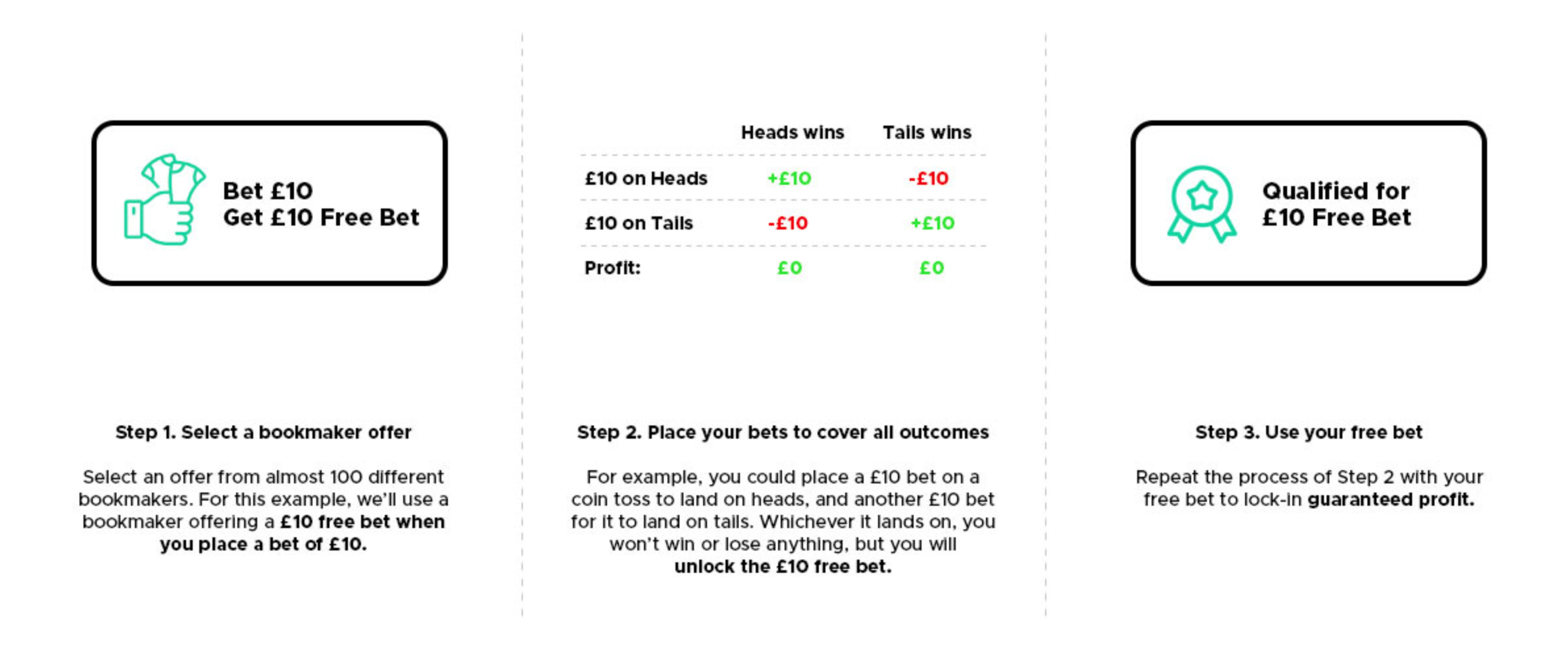
Matched Betting relies on bookmaker offers, e.g. ‘bet £10 and get a £10 free bet’. By betting on opposing outcomes (e.g. on both players in the match winner market), both on your initial qualifying bet and on your free bet, it’s possible to lock in a reasonable profit no matter the outcome of that match.
You’re most likely to encounter offers on tennis during major tournaments, such as Wimbledon or the US Open, so keep an eye out for offers in the run up to these tournaments if you’re keen to make use of them.
To find out more, check out the Outplayed Beginner’s Guide to Matched Betting for all the information you need to get started.
Arbitrage Betting
Arbitrage betting on tennis can be subject to the same risks regarding retirement rules as Matched Betting, but again you can use dutching techniques to produce successful arbitrage bets.
For most sports, arbitrage bettors will choose to create an arbitrage bet between a bookmaker and a betting exchange, which is the simplest way to arb - but it’s not the only option. In the example at the start of this article, we created an arbitrage bet using dutching techniques, producing a profit no matter who won the match.
With the match winner market in tennis, dutching is the most effective way to arb, to ensure you don’t run the risk of losing both your bets in the event of a player retiring from a match. Of course, if you bet on other markets not subject to retirement rules, you can still arb between a bookmaker and a betting exchange, which has the benefit of making it easier to identify arbing opportunities (all you need to do is find back odds that are higher than the lay odds).
To find out more, take a look at our dedicated guide to arbitrage betting for all you need to know about how this strategy works.
Value Betting
Value Betting is a more advanced and higher risk strategy, so we recommend that you only attempt it if you’re already an experienced sports bettor with a solid bankroll. Unlike Matched Betting and arbitrage, it isn’t a strategy that can be carried out using dutching techniques.
The idea of Value Betting is that you bet only on selections with disproportionately high odds - i.e. those that are higher than the true probability would imply. Statistically speaking, if you consistently bet on those excessively high odds, you’re likely to end up making a profit overall, even though any individual bet could win or lose.
To find out more about how Value Betting works and how you can get started, check out the dedicated Outplayed guide.
Summary
Dutching is a fantastic strategy to have in your back pocket if you’re a keen tennis bettor, making it possible to engage in Matched Betting or arbitrage without having to worry about retirement rules causing problems.
And if you’re looking for a good side hustle to get the most out of tennis betting, as well as betting on other sports, Matched Betting is definitely the way to go - many Outplayed members are making £300 - £1000+ from their Matched Betting activity.
To find out more, check out the Outplayed Beginner’s Guide to Matched Betting for all the information you need to get started.
Or if you’re already convinced, take out our free trial to gain access to 40+ sign up offers worth over £800!
sign up nowFAQs
1. Why is dutching a good technique for tennis betting?
Tennis retirement rules can make it difficult to avoid risk when using traditional Matched Betting techniques, with back and lay bets between a bookmaker and betting exchange. Dutching allows you to bet between two bookmakers that subscribe to the same retirement rules, avoiding the risk of losing both bets.
2. Is dutching beginner-friendly?
It’s relatively straightforward to pick up, but it’s not quite as easy to get the hang of as Matched Betting. If you’re brand new to sports betting, we’d recommend starting with Matched Betting on other sports before you tackle dutching on tennis.
3. Is dutching legal?
Yes, it’s completely legal. But that isn’t to say that bookmakers themselves are very happy about dutching, so you should take care to blend in with regular punters.
4. Can dutching get my account limited?
It’s possible, yes, if your activity is detected by the bookies. We recommend rounding your stakes and sticking to popular tournaments to help to mitigate the risk of incurring account restrictions.
5. Does dutching guarantee me a profit?
Not necessarily; if the odds aren’t good enough, you may not be able to lock in a profit. There’s also always a risk of human error when using strategies like dutching, even if you cover all outcomes, so make sure you double check your odds and stakes to ensure accurate results.
Updated: 29 Oct 2026