
What Are The Odds Of Winning Blackjack?

Quick answer: because blackjack is a game that doesn't rely solely on chance, strategy is an important factor in your odds of winning. If you play with perfect strategy, your odds of a net win on a hand of blackjack are 42.43%, or 46.46% if you ignore the possibility of the hand ending in a push.
Blackjack is a very popular card game played worldwide, particularly in casinos.
Although the rules are simple - get closer to 21 than the dealer without going over 21 - there's a fascinating amount of depth to it.
To find out about the history of blackjack, how to use Basic Blackjack Strategy to optimise your play, card counting and more, make sure to check out this How To Play Blackjack Guide.
This article will focus on some of the probabilities involved in blackjack, from how likely you are to bust if you’re dealt another card to the likelihood of winning a hand.
You’ll also find out how blackjack compares to sports betting, in terms of the bookmaker or casino margin, and why you might sometimes be better to wager on blackjack rather than sports when completing Matched Betting or casino offers, if both are an option.
It's worth mentioning that you don’t need to understand any of this to get the best possible return from blackjack.
Outside of using advanced systems like card counting, following Basic Blackjack Strategy reduces the casino’s edge as much as possible to give you the best long-term results.
At the same time, having some insight into the workings of blackjack, and how likely certain outcomes are, can help you understand why Basic Strategy works.
This can give you a greater enjoyment of the game and give you more confidence when playing blackjack.
A Note on Odds and Probability
The terms odds and probability are often used interchangeably. However, like many English words, they both have a range of meanings depending on context.
In terms of the title of this article, the word ‘odds’ will mostly be understood to be the same as probability, so it could equally have read “What is the probability of winning blackjack?” This is a fairly informal but commonly used meaning of the word 'odds', and different to the word's use in betting.
Basic Blackjack Strategy
One of the interesting features of blackjack that sets it apart from many other casino games is that it involves skill as well as luck.
You have to decide how to play the hand you’re dealt, and your choices affect your long-term returns.
The good news is that, over the years, an optimum strategy for playing blackjack has been developed. This is known as Basic Blackjack Strategy.
To make things even easier, you can use a Blackjack Calculator to tell you exactly how to play for any situation.
Following Basic Strategy takes all the guesswork out of playing blackjack since there will always be a single correct way to play your hand, no matter what upcard the dealer is showing
This maximises the Return To Player (RTP) of blackjack, which is around 99.5% assuming you always use the correct strategy. This is a very high RTP for a casino game.
Data Insight
'Research examining 4,394 hands played at a Las Vegas blackjack table found that approximately 80% of players' mistakes involved playing too conservatively. These included failing to hit, split or double down when Basic Strategy indicated that doing so was the mathematically better decision.'
The Probability of a Net Win
If you play blackjack using perfect Basic Strategy, you'll achieve an average Return To Player (RTP) of around 99.5%.
This means that for every £100 wagered, you'll get £99.50 back on average, losing just 50p.
Due to variance, you're unlikely to lose exactly 50p from wagering £100.
Sometimes you'll end up in profit and sometimes you'll lose money, but your average long-term loss will be 50p per £100 wagered.
This means that when playing with Basic Strategy, you'll almost (but not quite) break even over time. Due to that 0.5% casino edge, the longer you play, the more you'll lose on average. However, it’s possible to turn the tables on the casino by taking advantage of casino offers to give yourself the edge.
Since you pretty much break even over time when playing blackjack it's tempting to assume that the chances of winning a hand must be slightly less than 50%.
However, the situation is a little more complicated for a few reasons:
- Splitting or doubling affects how much you stake on a given hand, and your potential profit or loss. You could win one of your split hands and lose the other one, for example.
Data Insight
Research using exact mathematical calculations found that although players could split 11.8% of blackjack hands, only 2.5% of hands presented genuinely beneficial splitting opportunities under favourable game rules. This demonstrates why knowing when to split is just as important as knowing when not to.
- If you're dealt a blackjack / natural and the dealer doesn't also have a blackjack, your profit will be 1.5 times your stake, rather than equal to your stake.
- If you and the dealer tie, the wager is settled as a push and your stake is returned for no profit or loss.
- If allowed by the rules of the blackjack variant you’re playing, you might sometimes surrender and win half your stake.
A net win is where you make an overall profit from a hand of blackjack.
This takes into account all money staked on the hand after doubling and splitting and all money returned in winnings.
Calculating the probabilities of a net win, push, or loss is complicated, but gambling expert Michael Shackleford, also known as the Wizard of Odds, has worked them out and presented them here.
The mathematical technique used to calculate these probabilities is called combinatorial analysis.
This basically goes through all possible scenarios to work out how likely you are to end up in profit, break even, or lose money overall on a hand of blackjack.
Here's a table showing the probabilities:
| Outcome | Probability |
| Win | 42.43% |
| Push | 8.48% |
| Loss | 49.09% |
If your hand results in a push you make no profit or loss, so it’s interesting to look at the probabilities ignoring pushes (i.e. when you break even after the wager is settled).
Here are the probabilities without including push results:
| Outcome | Probability |
| Win | 46.36% |
| Loss | 53.64% |
You can see this mentioned in this discussion on the Wizard of Odds site.
To work out the Win probability in the second table you can divide the first table’s Win probability by the sum of the Win and Loss percentages, then multiply by 100:
Win Probability (excluding push) = (42.43 / (42.43 + 49.09)) x 100
Win Probability (excluding push) = (42.43 / 91.52) x 100 = 46.36%
Loss Probability (excluding push) = 100% - 46.36% = 53.64%
As you can see, the probability of a win is significantly lower than 50%, even though your actual long-term probability of ending up in profit is very close to 50%.
This is largely because some of those 46.36% of wins will be paid out at 1.5 times your stake, when you win with a natural / blackjack.
The probability of being dealt a blackjack depends on the number of decks used, but is around 4.75%.
Again, this information can be found here.
Doubling and splitting also affects the probability of a net win or loss.
The Probability of Going Bust
In blackjack, the aim is to beat the dealer. Here are two ways to achieve this:
- Scoring more points than the dealer without going over 21. Scoring 21 or less and the dealer scoring over 21
Drawing cards with a total value over 21 means you go bust.
One situation where you can easily work out the likelihood of going bust is if you’re drawing one more card to a hard hand.
A hard hand is any hand that doesn’t contain a flexible ace (an ace that can count as either 1 or 11 in that hand).
You can read more about hard and soft blackjack hands and flexible aces here.
To simplify the maths, the probabilities below were worked out assuming the dealer is using an infinite deck, where the proportion of each different value of cards is always the same.
For example, there are four aces in a deck of 52 cards, so aces make up 4/52 of a deck. This will always be the same proportion if you assume the deck is infinite.
Real-world casinos obviously don't use infinite decks (they tend to use a much more reasonable 4 to 8 decks).
The effect of this is that the proportion of different cards in the deck, known as the deck composition, changes as cards are dealt.
As a result, the probability that your hand busts if you have a certain total also changes.
Nevertheless, these probabilities give a reasonable guide as to how likely you are to bust depending on the total value of your hand.
The same method used to calculate dice probabilities earlier is used again - divide the number of 'desirable' outcomes by the total possible number of outcomes.
| Current Hard Hand Total | Values of Cards That Lead To Busting | Fraction of Deck That Busts Hand | Probability of Busting By Hitting One More Card |
| 21 | Any card | 52/52 | 100% |
| 20 | 10,J,Q,K,9,8,7,6,5,4,3,2 | 48/52 | 92.3% |
| 19 | 10,J,Q,K,9,8,7,6,5,4,3 | 44/52 | 84.6% |
| 18 | 10,J,Q,K,9,8,7,6,5,4 | 40/52 | 76.9% |
| 17 | 10,J,Q,K,9,8,7,6,5 | 36/52 | 69.2% |
| 16 | 10,J,Q,K,9,8,7,6 | 32/52 | 62.5% |
| 15 | 10,J,Q,K,9,8,7 | 28/52 | 53.9% |
| 14 | 10,J,Q,K,9,8 | 24/52 | 46.2% |
| 13 | 10,J,Q,K,9 | 20/52 | 38.5% |
| 12 | 10,J,Q,K | 16/52 | 30.8% |
| 11 or lower | No cards | 0/52 | 0% |
If you have a hard total of 11 or lower (for example a 6 and a 5), you can't bust by drawing one extra card.
The highest value cards are all worth 10, so if you're dealt one, you won't bust and your hand will be worth the highest possible total of 21.
If you were dealt an ace, you’d score this as 1 point to take your total to 12, rather than choosing to bust by adding 11 points.
At the other end of the table, if you're foolish enough to hit when you have a hard total of 21 (for example a 6, 7, and 8), your hand is certain to bust.
If you have a hard 14 (for example a Queen and a 4), your hand will bust if you're dealt an 8, 9, or 10 value card.
Four out of every 52 cards is an 8, four are 9s, and 16 are 10 value cards (the 10s, jacks, queens, and kings).
This means that 24 out of 52 cards (24/52) will lead to you busting, which is a probability of 24/52 or 46.2%.
Explaining Basic Blackjack Strategy
Hard hands
If you’re dealt a hard 16, there’s a 62.5% chance that you’ll bust if you take another card, so standing might appear to be the best choice. However, you also need to consider the dealer’s card.
If your hand is worth 16 points, the dealer will beat you if they end up with 17, 18, 19, 20, or 21 points, which can happy in many different ways.
As you can see from this blackjack strategy chart, you should only stand on a hard 16 if the value of the dealer’s upcard is lower than 7.
If the dealer’s card has a value over 7, or an ace, you should hit. If you have a hard 16 and are allowed to surrender, you should do this if the dealer has a 9, 10 value card or ace.
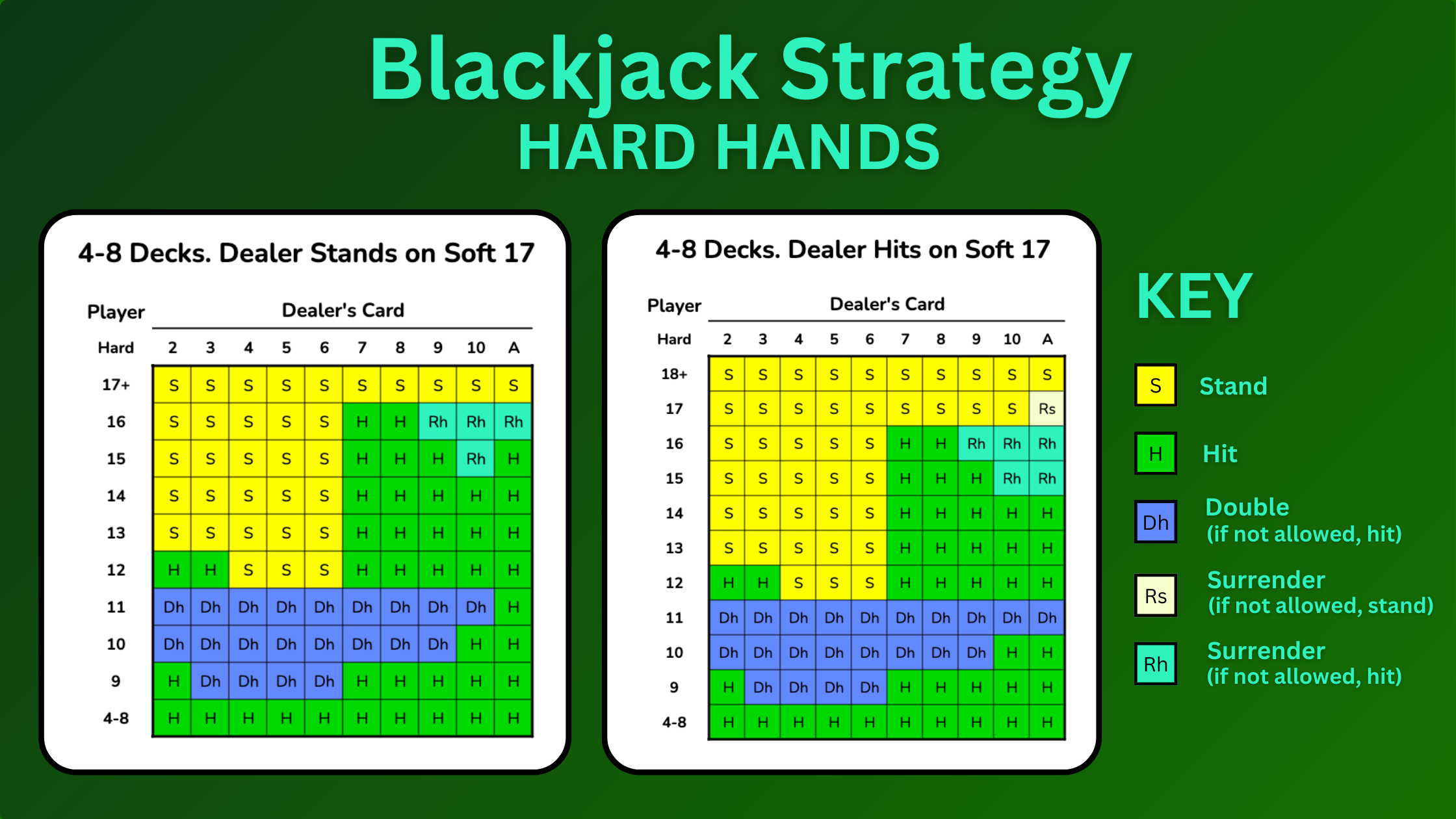
Soft hands
Soft hands (which include an ace, which can be high or low), can be more complicated, but the optimal strategy for any combination of cards can be seen in the chart below:

Pairs
Just for completeness, here are the Basic Blackjack Strategy charts for pairs:

Expert Insight
'A common mistake among blackjack players is judging a decision by its immediate outcome rather than whether it was mathematically correct. You can make the right play and still lose the hand. Consistency comes from evaluating decisions over hundreds of hands, not reacting to individual results.'
RTP In Blackjack
RTP stands for Return To Player, and refers to the amount on average that will be returned to players in winnings, expressed as a percentage. Standard blackjack has a particularly high RTP of around 99.5% (when played with optimal strategy).
This means you’ll lose 50p per £100 staked on average.
Another way to put this is that the expected value (EV) of wagering £100 on blackjack is -£0.50. In general, the EV is -0.50% of your stake.
Due to the very high RTP of blackjack (assuming you always use Basic Strategy), you’ll lose far less money in the long term than you would when gambling on sports, or on most other casino games.
Expert Insight
'Players often focus too heavily on the headline RTP when choosing a blackjack table, but the small details in the rules can make a meaningful difference. Payouts for a natural blackjack, dealer rules on soft 17, and restrictions on doubling or splitting can all change the house edge.'
Comparing Blackjack to Matched Betting
Going further, we can draw parallels between blackjack wagering and Matched Betting and see what sort of back and lay odds you’d need on a qualifying cash bet to get the same 50p loss per £100 staked.
For this, we can use a Matched Betting Calculator. To achieve a qualifying loss of 50p from a £100 bet, you’d need to get an incredibly close match between back and lay odds of something like back odds of 2 and lay odds of 2.01:

Back odds of 4 and lay odds of 4.02 give the same qualifying loss:

Let’s imagine you’re doing an offer where you need to wager £100. You’re allowed to either place it on a sports bet or wager it on blackjack (assuming blackjack counts 100% towards wagering).
There are advantages and disadvantages to placing a sports bet compared to wagering on blackjack.
Advantages of Backing and Laying a Sports Bet
- Assuming you can find a very close match quickly, this may be quicker than wagering £100 with £1 stakes on blackjack. This is especially true if you use an online odds matching tool. Increasing the blackjack stake would speed up the process but you’d be much more likely to lose more money if you were unlucky.
- You have a known qualifying loss.
Advantages of Wagering a £100 Bonus on Blackjack
- Your average loss of 50p is very small. To achieve a 50p qualifying loss on your sports bet, comparable to the average loss from wagering on blackjack, extremely close back and lay odds would be needed. These are generally difficult to find, even using an odds matcher, and are bad for your account health.
- There’s no need to have money in a betting exchange to cover the liability of your bet.
Wagering on Blackjack for Casino Offers
When completing worthwhile casino offers (those with a positive expected value), wagering on blackjack is often the best choice due to its very high Return To Player (RTP).
This reduces your average losses when wagering your own money, increasing your long-term profits.
It’s important to carefully check bonus terms to ensure blackjack is eligible for the offer, and also check the wagering contributions.
You’ll sometimes find casino offers where blackjack doesn’t contribute 100% towards wagering, and this can be as low as 10% in some cases.
If you needed to wager £100 in total and blackjack only contributed 10% towards wagering, you’d need to stake a total of £1,000 to complete wagering.
However, in cases where blackjack is eligible and counts 100% towards wagering, it’s a great choice.
If you’re interested in trying out casino offers, an Outplayed Diamond membership is the way to go. With this membership, you’ll find many high-quality guides for profitable sign-up and reload casino offers. Many of these allow you to wager on blackjack.
The Offers Team always check bonus terms carefully, so you can be confident that the slot or game recommended, whether blackjack or otherwise, will be a good choice for the offer.
Conclusion
Whether you’re gambling recreationally or doing worthwhile casino offers, understanding some of the probabilities involved in blackjack can give you an appreciation of why it’s best to play according to Basic Blackjack Strategy.
Having some insight into blackjack’s inner workings can also give you a greater enjoyment of the game.
The optimum way to play blackjack is often counter-intuitive, so seeing yourself why you should play in a certain way can give you more confidence in your play.
You can find out how to use blackjack, roulette, or online slots to make long-term profits from casinos at outplayed.com.
Blackjack Winning Odds FAQs
1. What are the odds of winning a hand in blackjack?
Using perfect Basic Blackjack Strategy, you'll win around 42.4% of all hands, lose approximately 49.1%, and push (tie) about 8.5% of the time. If you ignore pushes, the probability of winning rises to roughly 46.4%, with losses making up the remaining 53.6%.
2. Can you improve your odds in blackjack?
Yes. The most effective way is to follow Basic Blackjack Strategy, which tells you the mathematically correct decision for every possible hand. This reduces the casino's edge to around 0.5% in many standard blackjack games.
3. What are the chances of busting in blackjack?
The probability depends on your current hand total. For example, hitting on a hard 16 gives you roughly a 62.5% chance of busting, while a hard 12 only busts around 30.8% of the time if you take one more card.
4. Does blackjack offer better odds than roulette or slots?
Generally, yes. Blackjack offers one of the highest Return to Player (RTP) percentages of any casino game when played with Basic Strategy, often around 99.5%. Most roulette variants and slot games have a larger house edge, meaning higher expected losses over time.
5. Does card counting guarantee you'll win?
No. Card counting can provide a statistical advantage in certain live blackjack games, but it doesn't guarantee profits and requires significant skill, favourable game conditions and disciplined bankroll management. It also isn't effective in many online blackjack games that reshuffle frequently.
6. Why does the casino still have an edge in blackjack?
Even when you make every mathematically correct decision, the dealer acts after you. This means if you bust, you automatically lose your hand regardless of whether the dealer later busts as well, giving the casino a small long-term advantage.
7. Do more decks reduce your chances of winning?
In general, yes. Single-deck blackjack usually offers slightly better odds for players than six- or eight-deck games because the house edge is lower. However, the specific table rules often have a greater impact than the number of decks alone.
8. Should you always follow Basic Blackjack Strategy?
If your goal is to maximise your long-term return, yes. Basic Strategy is based on mathematical probabilities rather than intuition and consistently provides the lowest possible house edge for the rules of the game you're playing.
9. Can blackjack be profitable in the long run?
For recreational players, blackjack remains a negative expected value game because of the house edge. However, using casino promotions, bonuses and other advantage-play techniques can create situations where the overall expected value becomes positive, provided the promotion terms are favourable.
10. Why is blackjack popular for casino bonus wagering?
Because blackjack typically has a much higher RTP than most casino games, it can minimise expected losses while completing wagering requirements. Always check the bonus terms first, as some casinos reduce blackjack's contribution towards wagering or exclude it altogether.
Updated: 17 Nov 2026
The Author

Simon has helped thousands of members profit from Matched Betting using both his passion for writing and desire to understand how things work. He has used his mathematical and analytical skills to create several guides, calculators, betting and casino tools to make the process of Matched Betting easier for newcomers and experienced members alike.