
Dutching vs Matched Betting: Exploring The Differences
9 min read
Stephanie Sorrell
29 Oct 2026

Quick answer: both strategies involve placing multiple bets across a single market, but they don’t always have the same outcomes. Dutching can sometimes lock in a profit, but can also involve risk, whereas Matched Betting is very low risk, should always lock in a profit, and is generally more approachable for beginners.
If you’re looking for ways to improve the outcomes of your sports betting, you’re not alone. Most bettors end up losing more than they win, so unsurprisingly most people are keen to find ways to make their betting more consistent.
Dutching and Matched Betting are both popular sports betting strategies, and they have a lot in common. But they’re far from identical, and which you choose to pursue could have a significant impact on the level of risk involved in your betting and on the eventual profits you make.
So what exactly are the differences? Which strategy is better suited to beginners? And how much money can you make with each?
In this article, we’ll take you through the answers to all these questions, to help you decide which is the best strategy for you.
What Is Dutching?
Dutching is the practice of placing multiple bets on different selections within a single market, across different bookmakers.
In some cases, you may only increase your chances of a win (e.g. if you bet on just a handful of runners within a horse race), but in other cases it’s possible to cover all outcomes, locking in a profit no matter the outcome. The latter is an example of an arbitrage bet, and dutching can be a profitable part of an arbitrage strategy.
The difficult part of dutching is tracking down favourable odds across multiple bookies. Software like Outplayed’s Oddsmatcher, as well as odds checking sites like Oddschecker, can make this easier, though, and experienced sports bettors are likely to have a good idea of which events and markets to scour for possible dutching opportunities.
An example of a dutch bet
To illustrate how dutching works in practice, we’ll talk you through an example of a dutch bet. In this case, we’ll be covering all outcomes on a tennis match in order to produce an arbitrage bet.
Tennis is a popular sport for dutching, as the match winner market has only two possible outcomes, and it can also be a difficult sport for traditional Matched Betting or arbitrage betting due to varying retirement rules between bookmakers and betting exchanges. Dutching allows you to avoid this problem, so long as you ensure that the retirement rules at both bookies line up.
You notice that a bookmaker, which we’ll call Bookie A, has particularly good odds of 2.1 on Alex de Minaur for his upcoming tennis match against Felix Auger Aliassime.
You decide to see what the best odds are on Auger Aliassime, hoping you might find a dutching opportunity. Sure enough, Bookie B (which fortunately falls into the same group as Bookie A when it comes to retirement rules), is offering odds of 2 on Auger Aliassime, which means you’ve got a chance to lock in a profit by dutching this bet.
You use a dutching calculator to work out your optimal stake on Auger Aliassime, having decided to bet £100 on de Minaur.
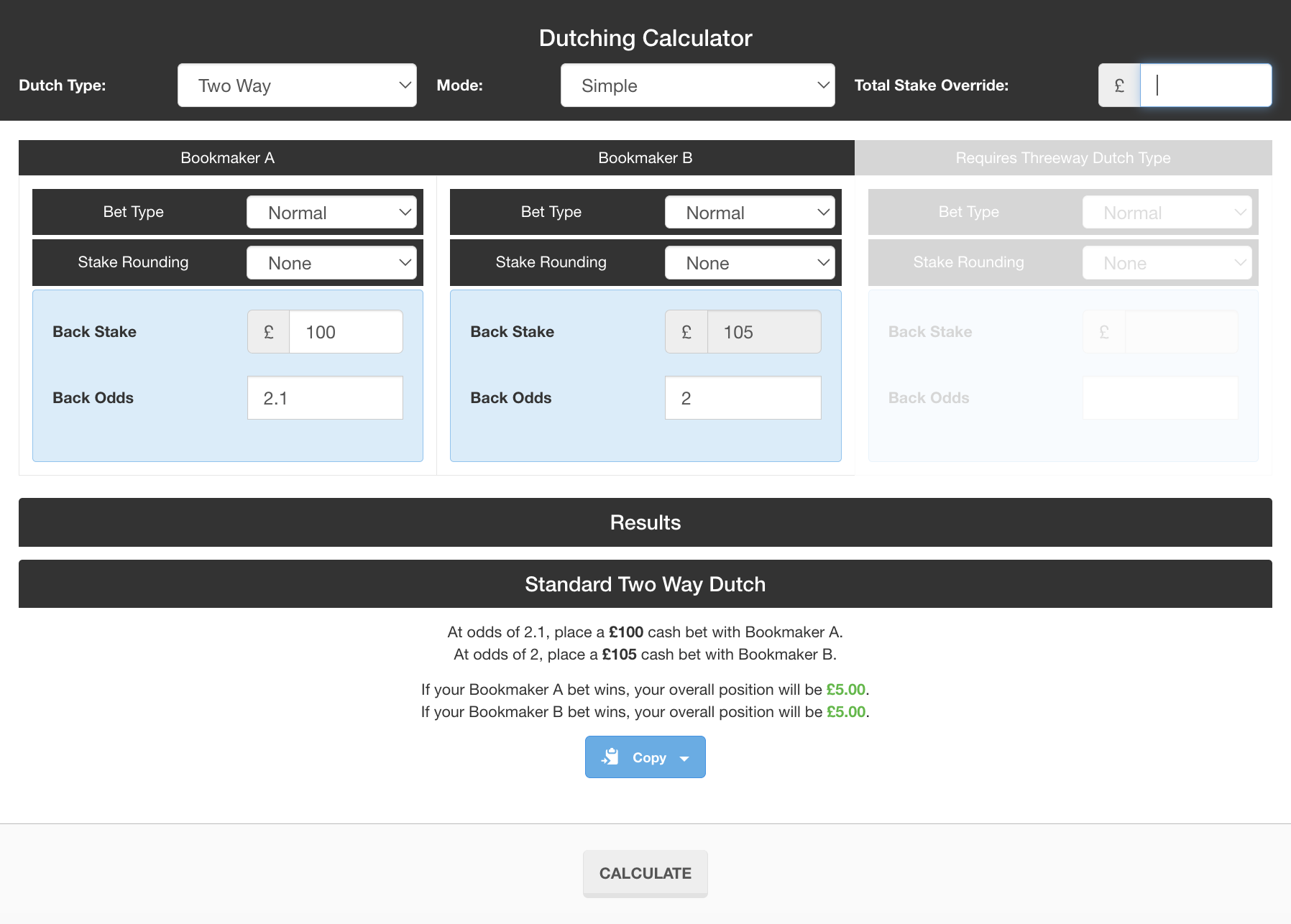
As you can see, the calculator advises you to place a £105 bet on Auger Aliassime with Bookie B, and works out you’ll make a £5 profit no matter who ends up winning the match.
This isn’t a massive profit, given the size of your stakes, but repeating this process over lots of bets can bank you great profits in the long term.
| Outcome | Odds | Stake | Return | Overall profit |
|---|---|---|---|---|
| De Minaur wins | 2.1 | £100 | £210 | £5 |
| Auger Aliassime wins | 2 | £105 | £210 | £5 |
What is Matched Betting?
Matched Betting works in a fairly similar way to dutching, but it’s designed to take advantage of bookmaker offers while heavily limiting the risk a bettor exposes themselves to.
For a full explanation of exactly how Matched Betting works, check out our detailed guide - for now, we’ll walk you through the fundamental principles.
With Matched Betting, you place your bets in what is typically a two stage process. First, you place what’s called a ‘qualifying bet’, which you use to unlock a reward such as a free bet with a bookmaker. You match this bet with a lay bet at a betting exchange (which is a bet against the outcome you’ve just backed with the bookie), and you typically make a very small loss, known as a qualifying loss.
Then you repeat the process with the free bet you’ve unlocked, usually making a profit of 70-80% of the value of your free bet.
Data Insight
Nearly 6 in 10 respondents who had seen a free bet offer went on to use it. The Gambling Commission's research found that free bets were among the most frequently received and used gambling promotions, illustrating why bookmakers are willing to give out these rewards.
An example of a matched bet
To illustrate how a matched bet would work in practice, we’ll take you through an example, imagining that we’re taking up a bookie on the following offer: Bet £10, Get a £10 Free Bet.
Having opted in to the offer with the bookie, the first thing we need to do is find a suitable match with odds as close as possible between the bookie and a betting exchange. This can be done manually, but it’s easiest with software like Outplayed’s Oddsmatcher, which displays the closest odds available between bookies and betting exchanges, as you can see below.
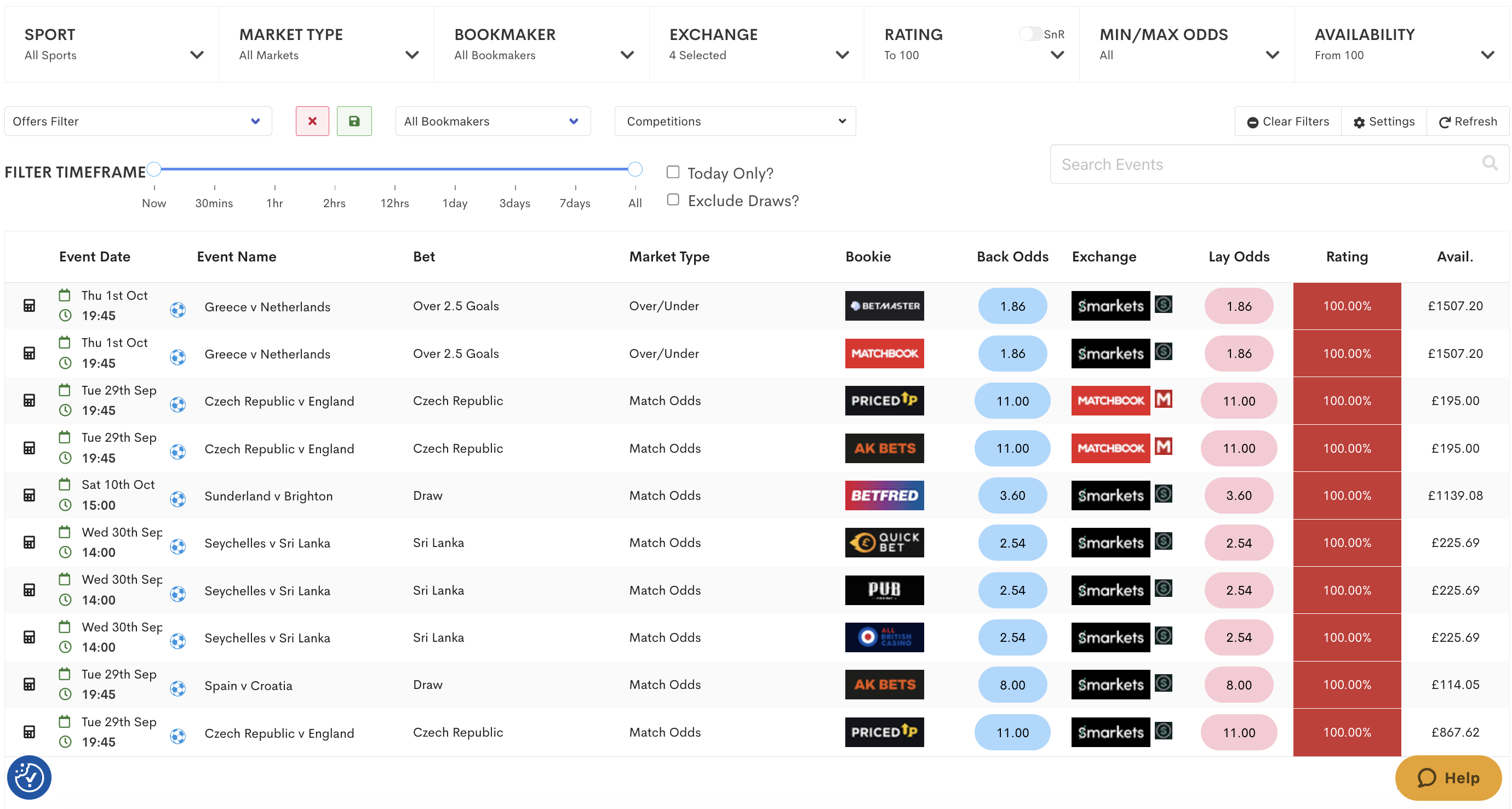
In this case, let’s imagine we’ve found a great match on the Premier League, for a football match between Brighton and Arsenal, with back odds of 3.1 on a draw with the bookie, and lay odds of 3.15 at the betting exchange.
You use a Matched Betting calculator to work out your ideal stakes, as shown below:
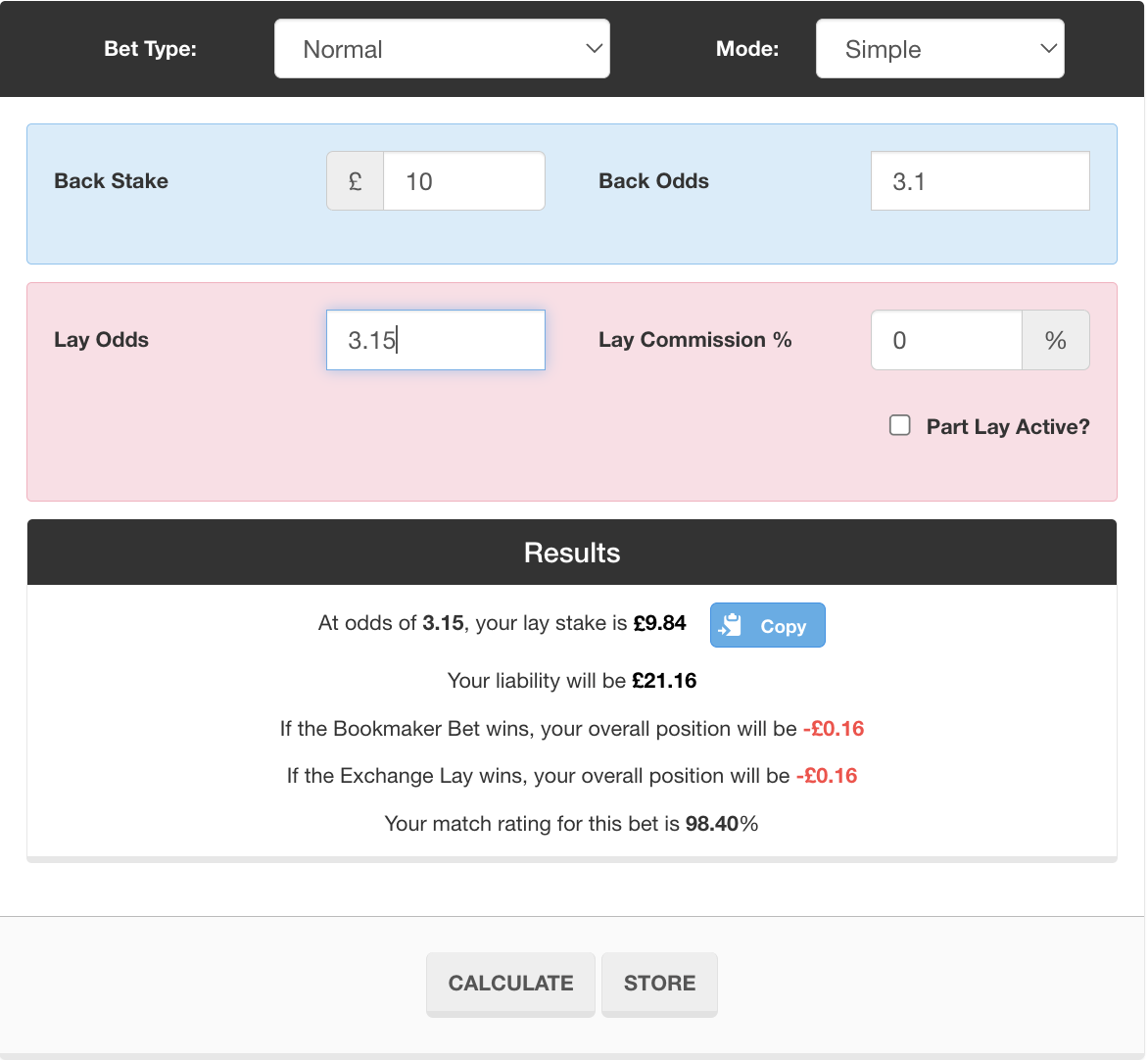
Following the results shown on the calculator, you place your back bet of £10 with the bookie, and then bet £9.84 with the betting exchange as a lay bet against a draw with the betting exchange, knowing that you’ll make a small loss of 16p on your qualifying bet.
When your bet settles, you receive your £10 free bet from the bookie, and use the Oddsmatcher again to search for a good match at high odds, to make the most of your free bet.
The Oddsmatcher brings up a great match for an upcoming horse race at Ascot, with back odds of 7.5 and lay odds of 7.8, which will allow you to lock in a solid profit from your free bet. You check the Matched Betting calculator again to work out your stakes:
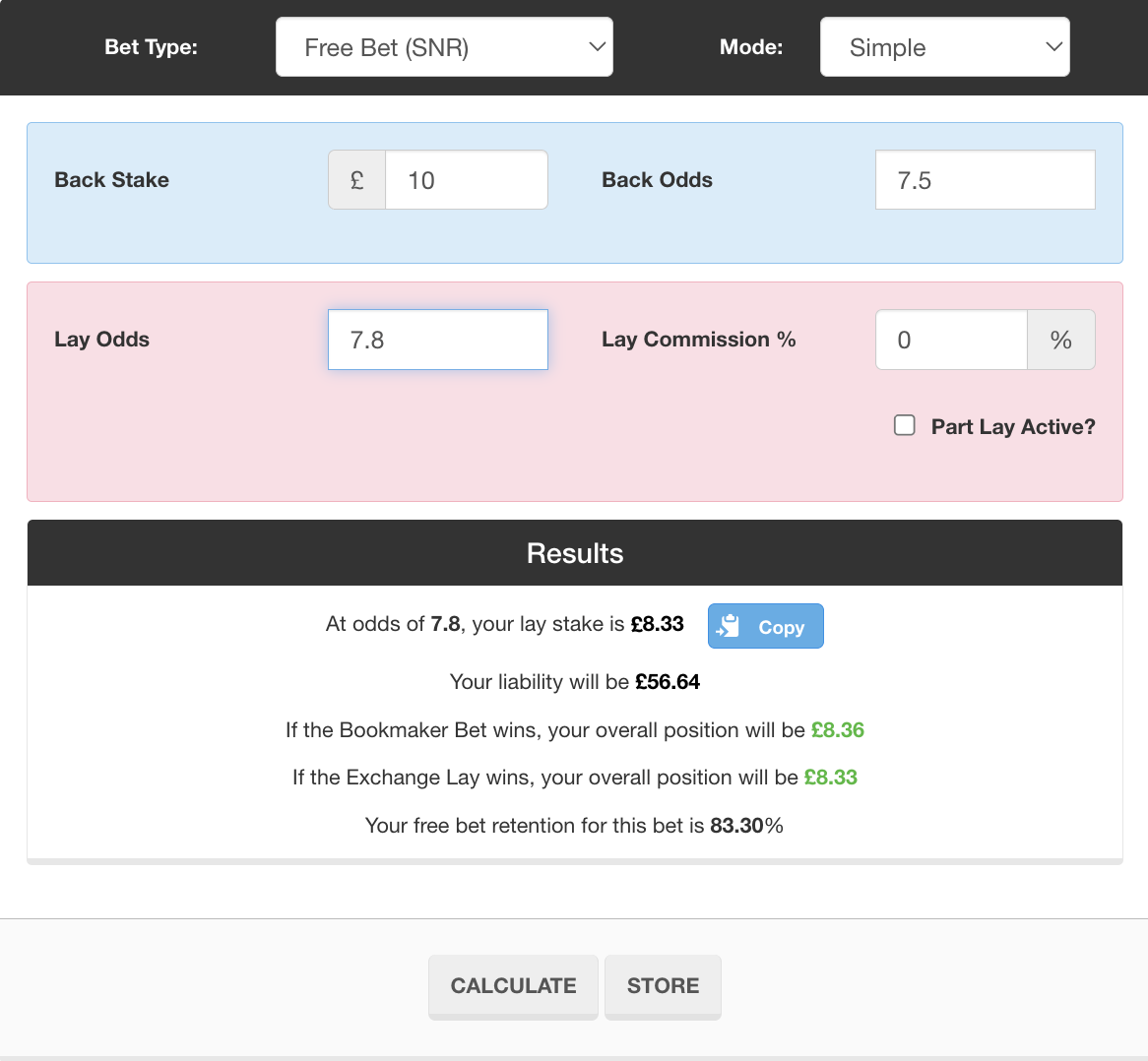
As you can see, following the calculator’s recommendations you’ll need to lay £8.33 against your selection with the betting exchange, resulting in a profit of at least £8.33 from your free bet.
Taking into account your qualifying loss, your overall profit will be £8.17 from this offer.
What Are The Differences Between Matched Betting And Dutching?
There can be quite a lot of overlap between the two strategies, but there are some important differences as well. The most significant are:
- Completing an offer should always produce a profit when Matched Betting (so long as you don’t make a mistake), but some forms of dutching still involve risk, and could result in a loss
- Matched Betting involves laying your bet at a betting exchange, whereas dutching involves placing your bets at different bookies
- Matched Betting is well-suited to beginners, as it doesn’t require any sports knowledge, but dutching is better suited to those with at least some experience of sports betting
- Matched Betting is usually designed to create the same profit no matter the outcome of an event, but dutching will often produce differing levels of profit depending on what happens
- With Matched Betting, it’s easy to use odds matching software to find good matches. This can be harder with dutching, as there’s less software available in the UK that’s specifically designed with this strategy in mind, and good matches aren’t as obvious to the untrained eye
Expert Insight
‘A crucial mistake with dutching is assuming that covering several outcomes automatically makes a bet low-risk. The real test is whether your combined stakes are lower than the return on every covered outcome, after accounting for changing odds, commission and any settlement conditions.’
Advantages and disadvantages of Matched Betting and Dutching
Matched Betting
| Advantages | Disadvantages |
|---|---|
| Almost zero risk involved | Limited by number of available offers |
| Ideal for beginners | Stakes often limited by bookie terms |
| Can be certain of profits regardless of outcome | Betting exclusively on offers can rouse bookie suspicions, and result in bookie restrictions |
| No experience of sports betting needed | High liability may be required at the betting exchange when betting at high odds |
| Quick and easy to get started | Limited liquidity at the betting exchange can restrict possible bets |
| Easy to find good matches |
Dutching
| Advantages | Disadvantages |
|---|---|
| No theoretical limit to the bets you can place | Can be more challenging for beginners |
| Stakes aren’t typically limited if you aren’t dutching as part of an offer | More difficult to locate good matches |
| No liability considerations, meaning your funds can go further | Dutch bets may still involve risk, and you could lose money |
| Liquidity at the betting exchange isn’t a consideration | Outcomes are less certain, so you may not be sure of your profits in advance |
| For some bets, you can profit regardless of the outcome | Some experience of sports betting is preferable |
| For some bets, almost zero risk will be involved |
Data Insight
A study of football betting markets identified 545 arbitrage portfolios across competing bookmakers. The researchers found that differences in bookmakers' pricing could create arbitrage opportunities, but that bookmaker practices often prevented bettors from exploiting them in practice.
Can I Make More Money With Dutching Or Matched Betting?
The answer to this question will entirely depend on how much of your time and energy you dedicate to either strategy.
In theory, the upper limit to the profits you can make from dutching should be higher, because Matched Betting is restricted by the finite number of offers available from bookmakers at any particular time.
However, in practice we would expect most people picking up a sports betting strategy for the first time to make more money with Matched Betting, because it’s more beginner-friendly, and easier to execute.
Making significant returns from dutching will generally require the bettor to accept a higher degree of risk, and so this strategy is better suited to bettors who already have a good amount of experience of sports betting, as well as a strong bankroll.
Of course, there’s no real reason you have to pick just one strategy, which brings us on to…
Can I Combine Dutching And Matched Betting?
Yes - including dutching in your Matched Betting strategy can be a really smart way to get the best out of each technique.
There are certain situations where traditional Matched Betting techniques (i.e. laying your bet with a betting exchange) aren’t as effective, or can leave you open to risk, and dutching can be the ideal way to solve this problem.
Those situations include:
- Betting on tennis. As we touched on earlier, bookmakers and betting exchanges aren’t all consistent in their terms regarding a player’s retirement from a tennis match. Some bookies/exchanges will honour your bet as long as a full set is completed, while others require the full match to be completed, meaning your bet is considered void if a player retires at all.
It may therefore not be possible to fully cover all outcomes if the bookie you want to bet with has different terms to the betting exchange. Instead, you could dutch your bet with another bookie who uses the same terms, ensuring that you’re covered in all eventualities.
- High liability. When betting at high odds, it may be difficult to match your bet if you don’t have enough funds in the betting exchange in question. You may also just be unwilling to tie up so much of your bankroll for a single bet.
If so, you can dutch your bet instead, as this means that only your stakes with each bookie are tied up - a comparatively small amount.
- Limited liquidity. For less popular events, or those that are some way in the future, you might struggle to find enough liquidity at a betting exchange to lay your bet.
You could decide to wait to lay your bet, or to bet on another event, but dutching allows you to bet on the market you’d picked out right away, ensuring your bet is fully matched.
We recommend using a dutching calculator like Outplayed’s to calculate your stakes if using dutching as part of your Matched Betting strategy, to make sure your maths is accurate and your stakes are optimal.
Expert Insight
‘When combining dutching with Matched Betting, treat each opportunity as a separate calculation rather than assuming one strategy will compensate for the other. Track qualifying losses, expected returns and the cash tied up in unsettled bets, so you can judge whether your bankroll can support the next opportunity.’
Summary
Dutching and Matched Betting are both useful strategies for sports bettors to employ, but when put together you get the best of both worlds!
If you have to pick just one, though, we’d recommend Matched Betting as the best starting point for most people, as it combines solid profit potential with minimal risk, and it’s particularly beginner-friendly.
To find out more, check out the Outplayed Beginner’s Guide to Matched Betting for all the information you need to get started.
Or if you’re already sold on the idea and raring to go, take out our free trial to gain immediate access to 40+ sign up offers worth over £800 in profits!
sign up nowFAQs
1. Is Matched Betting beginner-friendly?
Absolutely! You can get started with no sports knowledge and minimal bankroll, and make your first profits with very little risk.
2. Is dutching beginner-friendly?
Not to the same extent as Matched Betting, although it isn’t too hard to get the hang of. We’d recommend that newcomers to sports betting start with Matched Betting.
3. Are Matched Betting and dutching both legal?
Yes, both techniques are completely legal. However, as both reduce your level of risk, bookmakers aren’t keen on customers who employ these strategies.
4. Can Matched Betting and dutching get my account restricted?
If your betting patterns are obvious, then yes you may find your accounts are restricted by the bookie. Bookmakers analyse the betting patterns of all their customers to assess which might be using strategies like Matched Betting, Value Betting or dutching, as these strategies make it harder for them to make money.
5. How can I avoid having my account restricted?
To make restrictions less likely, try to blend in with regular punters by betting on popular markets, staking round numbers, and occasionally throwing in a mug bet. For more guidance, take a look at our top tips to avoid being gubbed.
Updated: 29 Oct 2026