
A Guide to Horse Racing Dutching
11 min read
Stephanie Sorrell
29 Oct 2026
Quick answer: Dutching can be a useful strategy for betting on horse racing, but it’s important to be aware that it’s much harder to cover all outcomes, and so you’re likely to retain an element of risk. Matched Betting is a safer strategy if you’re a risk-averse bettor.
Betting on horse racing has a long history, and it remains hugely popular, with bookies taking £766.7m in gross gambling yield in the 2024-2025 financial year, according to the Gambling Commission.
Yet actually making money from horse racing bets is really quite rare, and bettors turn to all sorts of strategies to improve their fortunes.
One of those strategies is dutching, which can be used to potentially improve your chances of winning a bet, or in some cases to lock in a profit.
But how exactly does it work when applied to horse racing, and is it the best option out there for most sports bettors? In this article, we’ll take you through everything you need to know about horse racing dutching strategies, and the risks and pitfalls to be aware of.
Data Insight
Horse race betting participation was 7% in the Gambling Commission’s April–July 2025 survey, up significantly from 4% in January–April. The Commission attributed the increase to the period coinciding with several major horse-racing events.
Dutching In A Nutshell
At its heart, dutching is nothing more complicated than placing more than one bet within a single market across different bookmakers. If you cover only some of the possible outcomes, you simply improve your chances of winning at least one bet, but if you’re able to cover all outcomes you may be able to lock in a profit, if the odds are good enough.
When dutching on horse racing, you’re very unlikely to be able to cover all outcomes due to the sheer size of the field in most races. This means that, in most cases, dutching will involve improving your chances of a win, but not removing all risk or locking in a profit.
An example of a dutch bet
To illustrate how dutching typically works in horse racing, we’ll imagine that we’re betting on a race and dutching our bets across several runners.
We decide we want to dutch a bet on the following horse race - the screenshot below shows the odds available with Bet365 for the most likely horses to win. In reality, we’d need to place our bets across multiple bookies, but we’ll use the odds shown here for ease.

Based on the odds shown, we decide to dutch our bets across the three horses that appear to be most likely to win:
| Horse | Odds |
|---|---|
| Plan C | 5.5 |
| Del Corso | 5.5 |
| Edwin Hubble | 6 |
We enter these details into a dutching calculator, with stakes of £10 per bet, which produces the following results:
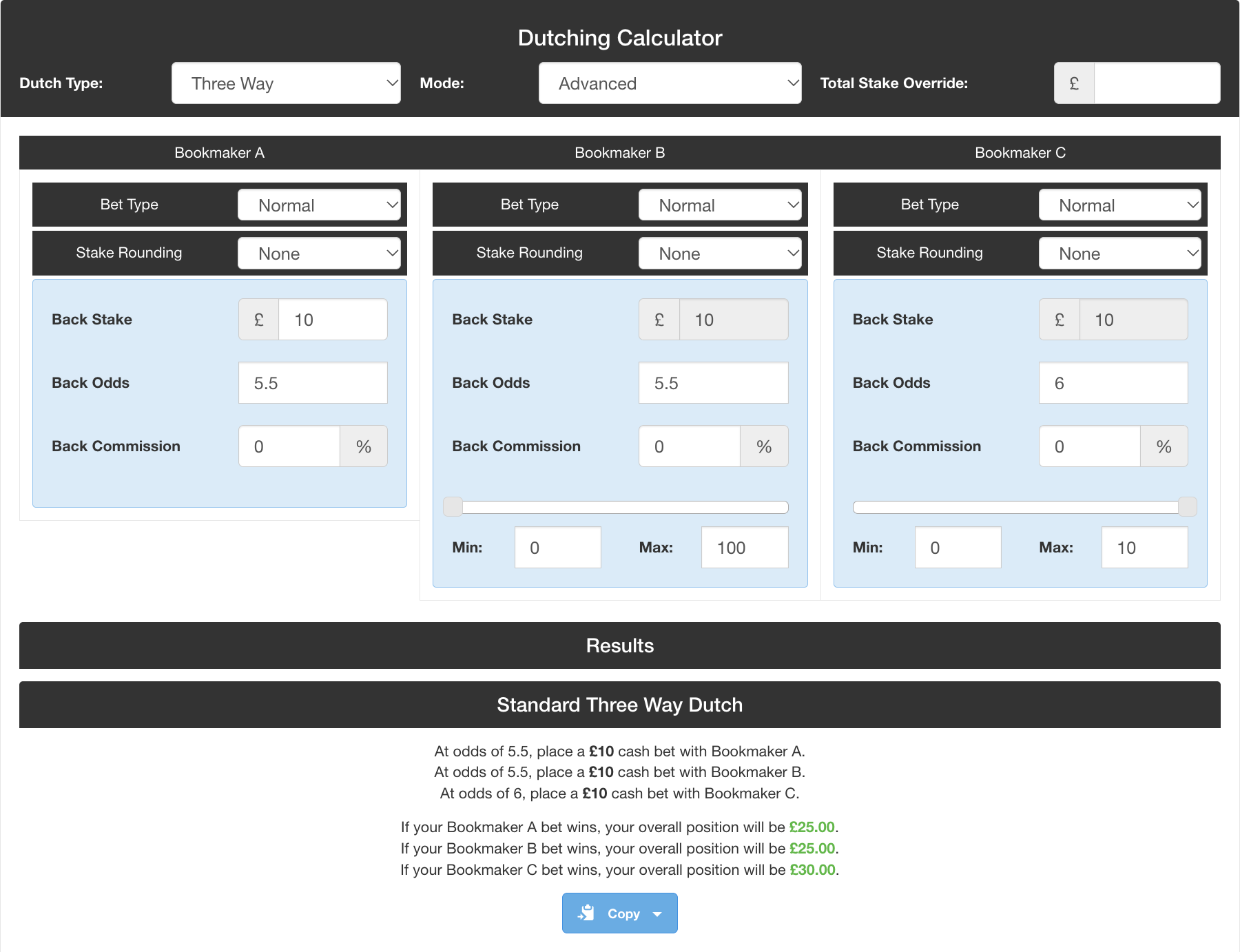
As you can see, so long as one of your picks ends up winning, you’ll end up making a decent profit of at least £25. Of course, it is still quite possible that another horse will end up winning, in which case you’d lose your full £30 stake.
| Winning horse | Odds | Stake | Return | Overall Profit |
|---|---|---|---|---|
| Plan C | 5.5 | £10 | £55 | £25 |
| Del Corso | 5.5 | £10 | £55 | £25 |
| Edwin Hubble | 6 | £10 | £60 | £30 |
| Another horse | N/A | N/A | N/A | -£30 |
What’s The Best Way To Dutch Bet On Horse Racing?
Although horse racing offers somewhat more limited possibilities for dutching than other sports, there are a few different horse racing dutching systems you can use for your dutching strategy.
Covering the favourites
This is the method we employed in our example above, and it’s likely to be the method of choice for most dutch bettors.
By covering a handful of the horses considered most likely to win a race, you improve your chances of winning one of your bets without reducing your profits too heavily.
Of course, horse racing is a volatile sport, and it’s not uncommon for a long shot to end up winning a race, so the risk involved in this method isn’t insignificant.
Still, for a recreational sports bettor, this option isn’t horrendously risky, and doesn’t require too much time or effort from the bettor.
Expert Insight
‘The shortest-priced runners aren’t necessarily the best horses to include in a dutch. What matters is whether the odds give you enough return for the probability you’re assigning to that runner. A wider shortlist can sometimes be more sensible if the additional selections are genuinely mispriced.’
Covering the entire field
This is a much more difficult method to execute successfully, and requires a significant degree of time and effort. That said, for experienced racing bettors, it may be possible to dutch your bet across an entire race and still come out in profit.
This strategy relies on the bettor being able to identify positive expected value, to have an excellent bankroll, and to act swiftly and decisively.
The bettor will usually place their bets in the couple of hours before a race begins, taking advantage of the rapidly changing odds. Whenever they judge a runner to be available at positive expected value - i.e. disproportionately high odds - they will jump in and place a stake on it.
The aim is to end up with the entire field covered, but with odds and stakes that allow the bettor to come out in profit no matter which runner ends up winning. However, this is much easier said than done, and it’s possible that they might be forced to leave one or more runners uncovered if the odds never shift enough in their favour.
This strategy is very much best left to the experts, as it involves significant risk. Your total stake can end up being very high, and there’s a reasonable chance that you might either make it impossible to come out in profit, or have to leave a runner uncovered and risk losing all your bets.
Data Insight
In 2025, 60.3% of UK horse races had eight or more runners, while 15.1% had fewer than six. The relatively large proportion of races with eight-plus runners helps explain why covering an entire horse-racing field can require considerably more stakes than dutching smaller markets.
Dutching on the place market
A lower risk option is to dutch on the place market. This has the advantage of increasing the chances of at least one of your bets winning - and the possibility of more than one winning, if two or more of your runners manage to place.
The downside of this method is that your returns will be comparatively smaller, and, assuming you aren’t covering the entire field, there is still a chance of losing all your bets.
Extra place races can be a good choice for this method of dutching, as the likelihood of a horse placing is increased without the odds decreasing.
Expert Insight
‘With place betting, the headline number of places isn’t the only thing to check. Place terms, deductions, non-runners and dead-heat rules can all affect the eventual return, so a seemingly attractive extra-place opportunity can be less valuable once the full settlement conditions are taken into account.’
What Are The Risks Of Dutching On Horse Racing?
Dutching has its merits, but it also has some significant downsides and risks, especially when used on horse racing. The most significant are as follows:
- Risk of losing money. This is the most obvious, and it also poses the greatest threat to your bankroll. Because you can rarely cover all outcomes when dutching on horse racing, the chances of losing money on a race are quite high - and dutching increases the amount you could lose given that you’re placing stakes on multiple runners.
- Difficulty of identifying good opportunities. It can be harder to tell if you’re seeing a good dutching opportunity when dutching on horse racing, compared to, say, on an arbitrage bet between a bookmaker and a betting exchange. You may decide to bet on a few favourites in a race, but how can you be sure you’re getting good value? Without performing research on the true probabilities of each runner winning, you’re not doing much better than simply taking a punt.
- Added margins. The more runners you bet on, the higher your chance that one of them will win - but the more you’re contributing to the bookies’ profits. Each bookie includes their profit margin in the odds they offer, so by betting across multiple bookies you’re paying that margin several times over.
- Lack of beginner-friendly software. Strategies like Matched Betting are made easy for beginners with dedicated software like Outplayed’s Oddsmatcher. This kind of software isn’t really available for dutching in the UK, meaning that there’s more of a learning curve for newcomers to dutching.
- Bookmaker restrictions. Bookies don’t appreciate bettors who use strategies like dutching to limit risk and maximise their profits, and are constantly on the lookout for signs of dutching (and other smart betting strategies). That means that obvious dutching behaviour - e.g. betting on highly obscure markets because you’ve found great odds, or with oddly precise stakes - can result in the bookie catching on to what you’re up to, and potentially restricting your account, or even banning you.
Take steps to blend in and avoid being gubbed to mitigate this risk, such as sticking to UK races, especially during major festivals, and rounding your stakes (or using equal stakes dutching) to avoid them looking too suspicious.
Are There Any Other Strategies You Can Use When Betting On Horse Racing To Maximise Your Profits?
Horse racing is enormously popular in the UK, and it’s well suited to most smart betting strategies. While dutching is a useful technique to understand, there’s a good chance you’ll find one of the following to be more effective for betting on horse racing.
Matched Betting
Similar to dutching, Matched Betting involves placing more than one bet on a single market. With Matched Betting, though, one bet will be a back bet (for an outcome) with a bookmaker, while the second will be a lay bet (against that same outcome) with a betting exchange, which ensures that one of the two will win.
The trick to making money from Matched Betting is taking advantage of bookmaker offers, which they dispense liberally in order to tempt new customers and retain existing ones - and with so many horse races going on every day in the UK, you’re likely to find plenty of bookie offers on horse racing.
Usually, Matched Betting works as a two step process, corresponding with the normal format of a bookie offer, which tends to be along the lines of ‘Bet £10 Get A £10 Free Bet’.
First, you must bet £10 of your own money with the bookie in what is known as a ‘qualifying bet’. You match this bet with a lay bet at a betting exchange, and usually make a small loss of a few pence at this stage.
Then, once your qualifying bet has settled, you’ll be awarded your free bet, which is where you make your profit. You repeat the process of placing and matching your bet, which should result in your making a profit of about 70-80% of your free bet - so £7-£8 for a £10 free bet.
Horse racing can be particularly useful when it comes to using your free bet, as you’ll almost always find runners at relatively high odds - and you’ll typically find it easier to make a good profit from your free bet if it’s placed at high odds.
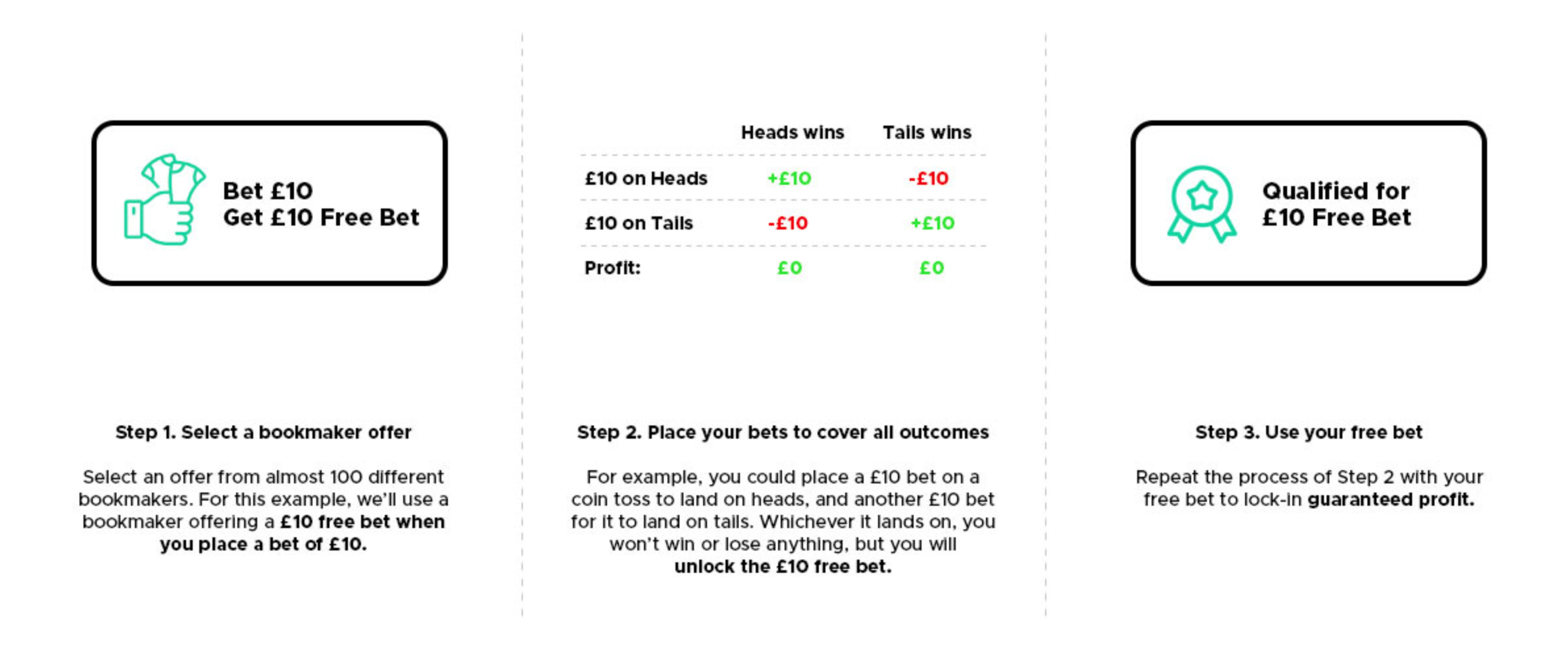
Because Matched Betting is designed to produce the same result no matter the outcome of an event, it’s an extremely low-risk strategy that can make you as much as £300-£1000 per month.
To find out more, take a look at our Beginner’s Guide to Matched Betting for a full breakdown of the process and how you can get started.
Arbitrage Betting
Arbitrage betting is another very similar technique, which involves placing bets for and against the same outcome. In fact, it’s possible to create an arbitrage bet that locks in a profit by dutching between different bookmakers - though this is rarely possible on horse racing, as it requires you to cover all outcomes in an event.
Arbitrage betting hinges on finding disproportionately favourable odds that produce a profit with every single bet.
This is easiest when you place a back bet with a bookmaker and a lay bet with a betting exchange, like with Matched Betting. All you need to do is find odds for your back bet that are higher than the lay odds; if this is the case, you’ve got an arbitrage bet, which will generate you a profit regardless of the outcome of the event. And with so many horse races going on every day, you have a good chance of finding arbitrage opportunities.
Tools like Outplayed’s Oddsmatcher make this a really easy process, making arbitrage a popular strategy even with relative newcomers to sports betting.
To find out more, take a look at our dedicated guide to arbitrage betting for all you need to know about how this strategy works.
Value Betting
Value Betting is a more advanced strategy than arbitrage betting or Matched Betting, and it’s best suited to experienced sports bettors, who have built up a strong bankroll.
If that applies to you, Value Betting can provide a massive boost to your profits. Like arbitrage betting, it relies on locating favourable odds from bookies. Specifically, odds that are higher than the true probability of a win would imply.
Value bettors only place bets on selections with these disproportionately favourable odds, which means that they’re statistically likely to end up profiting overall, even though they aren’t locking in a profit on any individual bet, as is the case with Matched Betting or arbitrage.
Again, Value Betting can be a highly effective strategy on horse racing, as it’s a volatile market with odds changing all the time, especially in the hour or so before a race begins. This makes it possible to slip in a bet at disproportionately high odds before the bookmaker manages to update them.
To find out more about how Value Betting works and how you can get started, check out the dedicated Outplayed guide.
Summary
Dutching is a very useful technique to understand, and it can do a lot to improve your chances of having a winning bet when used on horse racing.
However, it’s rarely possible to lock in a profit when dutching on horse racing, so for newer sports bettors or anyone who’s keen to minimise risk, other strategies like Matched Betting or arbitrage betting may be more appealing.
To find out more about how you can lock in profits from bookmaker offers, check out the Outplayed Beginner’s Guide to Matched Betting for all the information you need to get started.
Or if you’re already convinced and want to get going right away, take out our free trial to gain access to 40+ sign up offers worth over £800!
sign up nowFAQs
1. Does dutching allow me to lock in a profit on horse racing?
It’s theoretically possible, but with horse racing it’s pretty unlikely. Instead, most people use dutching techniques to improve their chances of a win, without eliminating the risk of losing their bet.
2. Is dutching the best betting strategy for horse racing?
It depends on your aims, but in our opinion there are better strategies out there. For the risk-averse, Matched Betting can be a much more successful strategy, while Value Betting is likely to be the best option for experienced sports bettors comfortable with risk.
3. Should I dutch all my horse racing bets?
Not necessarily! You should ideally only dutch a bet on horse racing if you can establish that the risk involved is worth the potential reward. If you aren’t sure of this, we’d suggest an alternative strategy, like Matched Betting.
4. Is dutching beginner-friendly?
It’s not hugely complicated, but there is a bit of a learning curve, and when dutching on horse racing it does tend to involve some risk. If you’re a newcomer to sports betting, you’ll probably find that Matched Betting is a better place to start.
5. Is dutching legal?
Yes, dutching is a completely legal strategy - all you’re doing is placing bets at the odds listed by the bookmaker. However, as we know the bookies themselves are keen on dutching, so you should try to blend in with regular punters by focusing on popular events and using rounded stakes.
Updated: 29 Oct 2026