
How Much Money Can You Make With Dutching?
12 min read
Stephanie Sorrell
29 Oct 2026

Quick answer: there’s no theoretical limit to the amount of profit you can make from dutching, but you may find it less profitable than other strategies like Matched Betting or Value Betting. For the best results, use dutching as only part of your strategy, alongside Matched Betting or Value Betting, depending on your tolerance of risk.
There are plenty of reasons people bet on sports:
- Enhancement (e.g. because it’s fun or exciting)
- As a coping mechanism
- Escapism (imagining life with a big win)
- As an enjoyable challenge
- As a social activity
But ultimately, the biggest aim for most people is to come out with more money than they started with.
Data Insight
The Gambling Commission’s 2025 survey found that 57% of adults who gambled in Great Britain cited making money as a reason for gambling at least sometimes, while 84% said they gambled ‘for the chance to win big money’.
That’s somewhat easier said than done, however; most active gamblers with UK bookies have been found to have made a net loss overall.
There are strategies that can improve your chances of coming out with profit, but how much can you really make? In this article, we’ll assess how much money you can make from dutching, and how it stacks up against other popular sports betting strategies.
How Does Dutching Make Money?
Dutching operates on the principle of betting on multiple selections on the same market (across different bookmakers) in order to improve your chances of a win, or even lock in a profit.
If you cover all outcomes as part of a dutch bet (e.g. by placing one bet on each player in a tennis match) you may be able to lock in a profit if the odds you find on each selection are good enough. If so, this particular dutch bet would also be an arbitrage bet.
In other cases, you might have to settle for a small loss by covering all outcomes. On its own, this is best avoided, naturally - but if you place a dutch bet as part of a Matched Betting strategy, this could form your qualifying bet and still be worth doing.
You don’t necessarily cover all outcomes when dutching, however. If you’re betting on a market with lots of possible outcomes, e.g. a horse race, you might choose to bet just on a handful of the favourites. So long as the odds are favourable enough, you’ll put yourself in a position to profit no matter which of your choices wins (though you will of course lose your entire stake if none of those runners wins).
For a full breakdown of exactly each type of dutch bet works, check out our dedicated guide to dutching - for now, we’ll just use one example to illustrate how a dutch bet might work in practice.
An example of a dutch bet
Let’s imagine we want to place a dutch bet on tennis (something that can be advantageous when Matched Betting or arbitrage betting, as retirement rules often make a bet on the match winner problematic).
You spot an upcoming match between Taylor Fritz and Carlos Alcaraz with particularly good odds on each player with different bookmakers, and you realise you’ve found an opportunity to lock in a profit by dutching your bet. Having double checked that the retirement rules across both bookmakers line up, you decide to go ahead and dutch your bet.
With Bookmaker A, you’ve found decimal odds of 1.75 on Carlos Alzaraz, while Bookmaker B is offering odds of 2.5 on Taylor Fritz. You enter these details into a dutching calculator for a £100 bet on Carlos Alcaraz to check what your optimal stake would be.
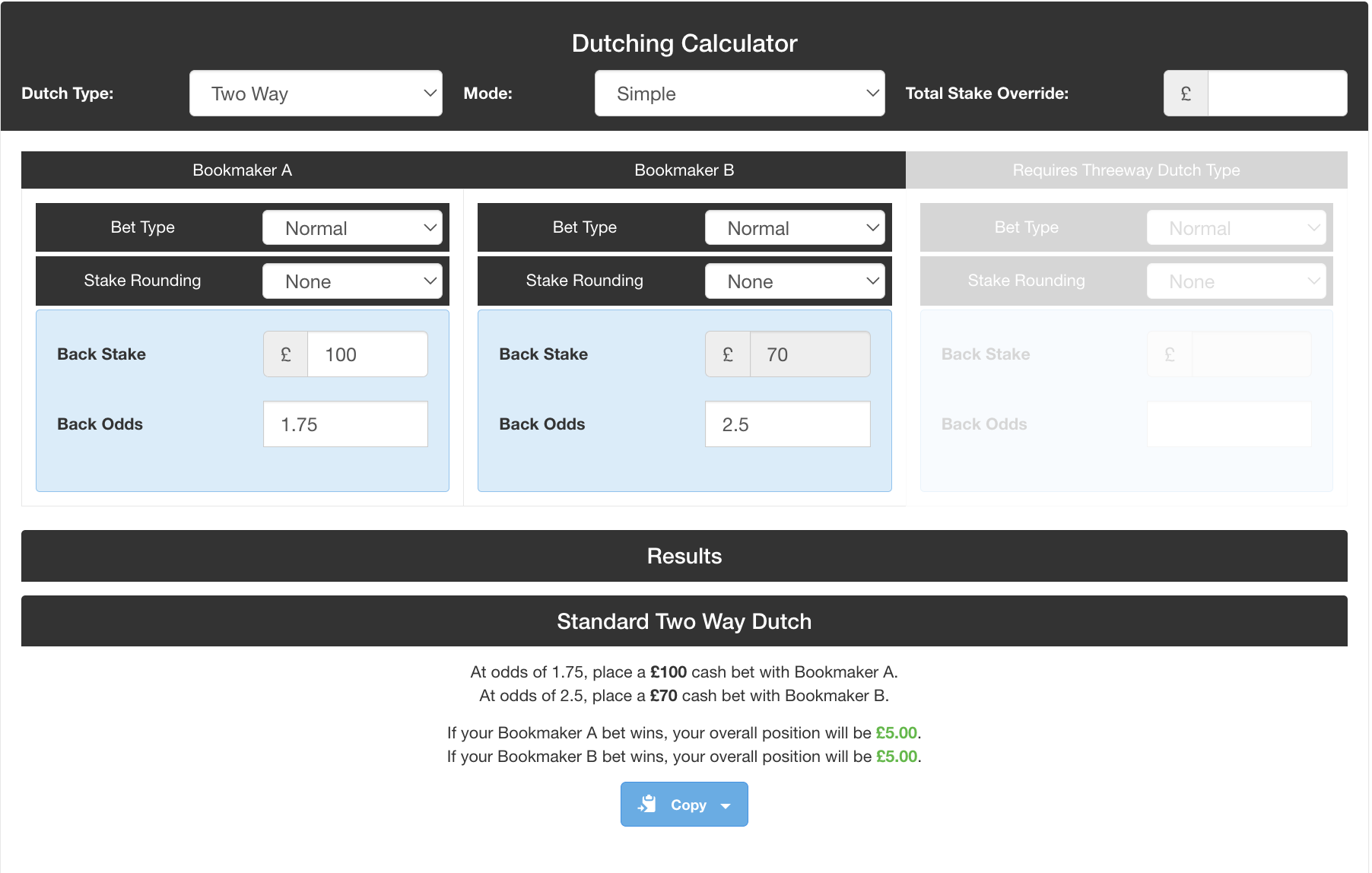
The calculator tells you to place a £70 bet on Taylor Fritz with Bookmaker B in order to produce a £5 profit no matter who ends up winning the match. This may not sound like a huge amount, given the size of the bets, but small profits can really add up if you’re pursuing an arbitrage strategy with your dutched bets.
| Outcome | Odds | Stake | Return | Overall profit |
|---|---|---|---|---|
| Alcaraz wins | 1.75 | £100 | £175 | £5 |
| Fritz wins | 2.5 | £70 | £175 | £5 |
How Much Money Can Dutching Really Make You?
It’s difficult to give a single answer to this question, as it depends on both the approach you adopt and the amount of time and effort you devote to your strategy.
Covering all outcomes - arbitrage
If you decide to dutch your bets by covering all outcomes, with the aim of locking in a profit with every dutched bet, your profits per bet are likely to be pretty small, as we saw in the above example. However, these small profits will add up over time, making a solid contribution to your bankroll.
The difficulty comes from locating good opportunities to create an arbitrage bet with dutching. On its own, aiming to make profits through arbitrage dutch bets isn’t likely to make you all that much money. You’re likely to find that you’re more successful if you include bookmaker-exchange arbitrage bets as well as dutch bets.
Expert Insight
‘The biggest mistake people make when assessing dutching profitability is focusing on the return from a single bet rather than the performance of the strategy over time. Track your net profit after all stakes, losing bets and costs to see whether your approach is genuinely sustainable.’
Covering all outcomes - Matched Betting
Employing dutching as part of a Matched Betting strategy can be much more profitable, although again we wouldn’t recommend using dutching techniques alone to pursue Matched Betting.
But in some circumstances - if there’s limited liability at the betting exchange, or if you’re betting on the match winner in tennis - a dutch bet can be the best option for either a qualifying bet or a free bet in Matched Betting.
Matched Betting can make you £300-£1000+ in profits each month - and while dutching alone isn’t likely to make you this much on its own, it can certainly contribute to your total profits when used selectively as part of your Matched Betting.
Covering only some outcomes
Obviously, if you aren’t covering all outcomes with your dutching, you’re accepting a degree of risk - but that doesn’t mean this strategy can’t be successful.
You’ll need to incorporate some Value Betting techniques into your dutching if you choose this route, assessing the best value selections before choosing which to bet on, to ensure you both maximise your chances of winning and gain real value from your bets.
If you choose this option, your profit levels are likely to vary wildly, and you could lose money, so we’d only recommend adopting this strategy if you’re an experienced sports bettor with a solid bankroll.
And if that’s the case, we’d strongly recommend considering standard Value Betting techniques as well, which are fairly likely to produce higher profits than dutching.
Expert Insight
‘When dutching only a selection of outcomes, the real question is whether the potential return justifies the chance of losing every stake. A useful discipline is to calculate how often your selections would need to win to break even, then compare that threshold with your own probability estimates.’
What Are The Best Strategies To Maximise Your Dutching Profits?
For a full breakdown of the strategies you can use to make money from dutching, check out our complete guide to Dutching Betting Strategies - for now, we’ll just give you a brief summary of the strategies you might choose to use when dutching.
Dutching as part of a Matched Betting strategy
Dutching can be a very handy technique to add in to your Matched Betting strategy, allowing you to make the most of situations where traditional Matched Betting techniques may be less advantageous.
For example:
- Betting on tennis matches where retirement rules make it difficult to match your bet normally
- Betting on a market where there’s limited liquidity available at the betting exchange
- Betting when you don’t have enough funds at the betting exchange to cover the high liability of a matched bet
Arbitrage betting with dutching
Similarly, if you’re aiming to make money through arbitrage, you can consider adding in some dutch bets to widen your arbitrage opportunities.
You’re likely to find that situations where a dutch bet can be useful when arbing are roughly the same as those for Matched Betting. The downside is that it’s trickier to locate good matches compared to using a betting exchange, but if you track down two bookies with particularly good odds, dutching can result in a solid profit from an arb.
That said, in most cases you’ll probably find that using a betting exchange produces a better result, so we wouldn’t advise dutching religiously as an arbitrage strategy.
Dutching on horse racing
Betting on multiple horses in a single race across different bookies can increase your chances of a win (though it does also increase your stake size).
Choose your selections carefully, and make sure to work out what your overall profits will be, taking into account all your stakes, to ensure that you’ll actually make some money no matter which horse you back wins.
Also, don’t forget that this technique does involve risk, as you won’t be able to cover all horses within a race while still turning a profit (unless you’re spectacularly fortunate), so it’s quite possible for you to lose your full stake if another runner ends up winning.
Dutching on football
You can use a similar tactic with markets like the Correct Score market, covering the most likely exact scores to improve your chances of winning. The most common scores are:
- 0-0
- 0-1
- 1-0
- 1-1
- 2-1
- 1-2
- 2-0
- 0-2
By placing bets on all the above scores, it’s often possible to come out in profit no matter which ends up winning, so long as one of them is correct. Do make sure to check your maths carefully if you use this strategy, though, to make certain that you are able to turn a profit.
And again, this tactic involves risk, so be careful not to stake more than you can afford to lose.
Are There Any Other Strategies You Can Use When Sports Betting To Make More Money?
Dutching is a useful trick to have up your sleeve, but there are other strategies that can be more profitable. Depending on your risk tolerance, your experience of sports betting, and the amount of time and effort you’re able to invest, one of the following may be the best strategy out there for you.
Matched Betting
Matched Betting is what Outplayed’s market-leading software was designed for, so unsurprisingly we’re huge advocates of this strategy.
Like dutching, it involves betting on different selections within a single market, but with Matched Betting every bet you place is matched with a lay bet at a betting exchange, ensuring that one bet wins no matter what happens in the event.
By taking advantage of bookie offers, it’s possible to lock in a profit from Matched Betting using a two step process:
1. Choose an offer (typically something like ‘Bet £10 and get a £10 free bet), and place a matched bet with your own money to earn your reward - this is known as a qualifying bet. You’ll usually make a small loss of a few pence on this bet.
2. When your qualifying bet settles, you’ll receive your free bet. Repeat the process of placing and matching your bet, and you should be able to lock in a profit of around 70-80% of the value of that free bet - so £7-£8 of a £10 free bet.
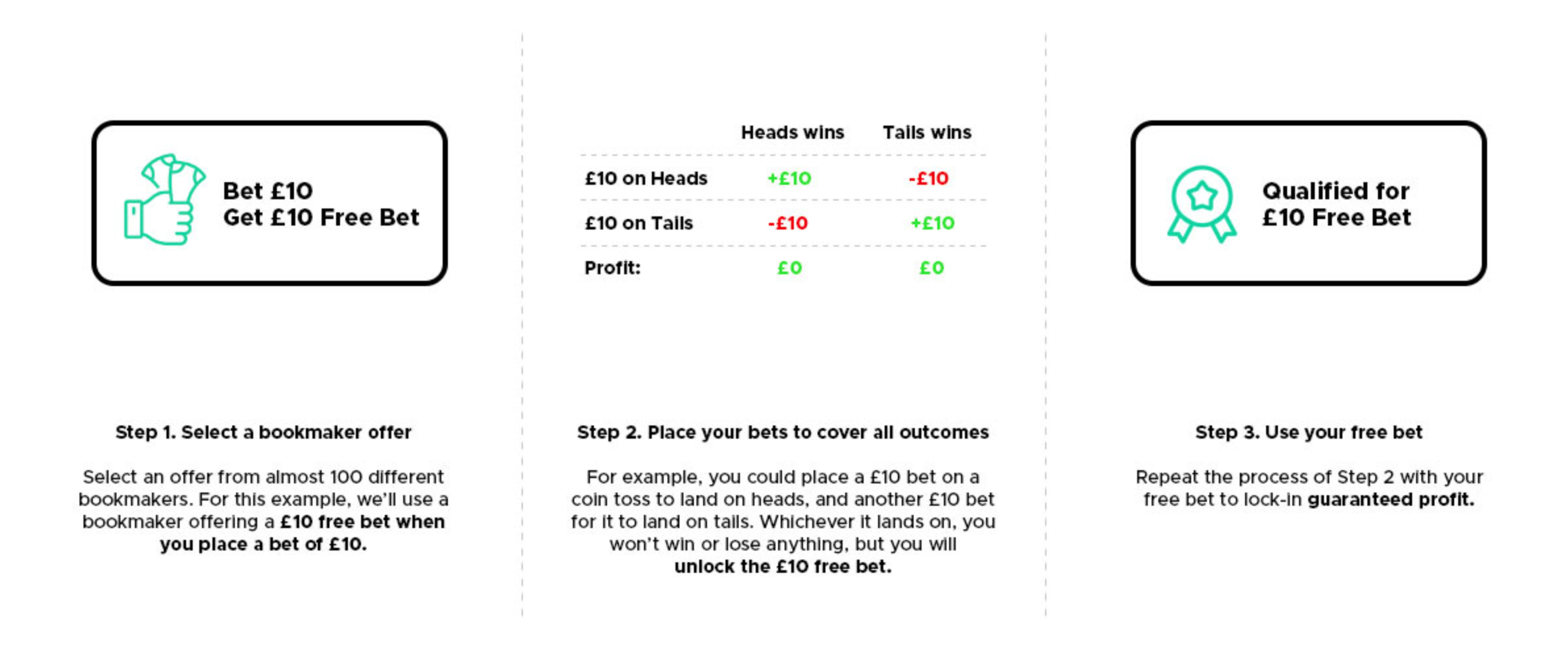
With a little time and dedication, you can potentially make hundreds of pounds every month from Matched Betting, while exposing yourself to minimal risk, making this strategy ideal for beginners or risk-averse sports bettors.
To find out more, check out the Outplayed Beginner’s Guide to Matched Betting.
Arbitrage Betting
Arbitrage betting is a similar technique, which we’ve already touched on in this article.
If you’re interested in committing to arbitrage betting, we’d strongly recommend looking at bookmaker-exchange arbing, as it’s much easier to find good arbitrage opportunities.
Although you don’t tend to make high profits from any individual arbitrage bet - often only a couple of pounds each time - these profits add up over time and can be a fantastic addition to your profits.
To find out more, take a look at our dedicated guide to arbitrage betting for all you need to know about how this strategy works.
Value Betting
Value Betting is a more advanced technique that relies on betting at disproportionately high odds. As you aren’t matching your bet, this strategy does involve risk, but if you have the experience and the bankroll for it, Value Betting can be one of the best strategies out there.
Value Betting involves finding and betting on selections with what we call ‘positive expected value’. If this is the case, that means the odds are higher than the true probability of a win would imply, and you are statistically expected to make a profit if you consistently bet only on those selections.
While any individual bet could lose, over time this strategy is likely to result in your making profits, which can be very significant.
To find out more about how this strategy works, check out our guide to Value Betting for a full breakdown of the process.
Benefits And Downsides Of Dutching
| Benefits | Downsides and Risks |
|---|---|
| Can lock in profits in the same way as arbitrage betting | More difficult to locate pairs of odds that can produce profit if arbitrage betting |
| Can increase the likelihood of winning a bet | Odds are rarely good enough to produce a better result than a lay bet at a betting exchange |
| Can be used as part of a Matched Betting strategy where traditional techniques are less effective | Often involves very precise stake sizes, which can look suspicious to bookies |
| Can be a good alternative to matching a bet if liquidity is low at the exchange | Less software is available in the UK for dutching compared to Matched Betting or Value Betting |
| Doesn’t require any liability, so doesn’t tie up as much of your bankroll |
Data Insight
A Gambling Commission analysis found that 13.1% of participants who had gambled in the past four weeks reported at least one potential adverse consequence. Of these, 50.9% experienced consequences across at least two areas: financial resources, relationships or health. This underlines why betting strategies should be approached with clear financial limits.
Summary
Dutching can be a very handy strategy to understand if you’re looking to make money from sports betting, and it can certainly contribute to your profits.
However, it’s not the only strategy out there, and others, Matched Betting and Value Betting especially, may well do more to boost your coffers.
To find out more, take a look at our guides to Matched Betting and Value Betting for all the information you need to get started.
Or if you’re already raring to go, take out our free trial to gain access to 40+ sign up offers worth over £800 in potential profits.
sign up nowFAQs
1. Is dutching beginner-friendly?
It’s not bad as a strategy for beginners, but Matched Betting is generally easier to execute, so we recommend that newcomers to sports betting start there.
2. Is dutching legal?
Yes, it’s completely legal, although bookmakers aren’t huge fans of it as it can encroach on their profits.
3. Can dutching get my account restricted?
It’s possible, yes, especially if you stand out as a dutch bettor. We recommend rounding your stakes and trying to blend in with regular punters by betting on popular events where possible.
4. Is dutching risk-free?
No, some forms of dutching still leave you open to significant risk, if you aren’t covering all possible outcomes. And even when you do cover all outcomes, it’s still possible that you could make a mistake - so be sure to double check your maths before placing your bets.
5. Can I lose money dutching?
Yes, especially if you aren’t covering all outcomes it’s certainly possible to lose money. If you’re concerned about the risk of losses, we’d recommend starting with Matched Betting, which keeps risk to a minimum.
Updated: 29 Oct 2026