
What Sports Can You Use For Dutching? A Sport-by-Sport Breakdown
12 min read
Stephanie Sorrell
29 Oct 2026

Quick answer: you can in theory dutch a bet on any sport, but some are particularly well suited to dutching. It may be better to dutch your bets on tennis, for example, than to use traditional arbitrage or Matched Betting techniques. On horse racing, however, dutching will rarely allow you to cover all outcomes, so for the risk-averse it can be safer to use Matched Betting or arbitrage techniques.
Dutching is a handy technique to have in your back pocket if you’re a recreational sports bettor, or even a matched bettor or value bettor wanting to occasionally branch out a little.
But if you’ve never dutched a bet before, you might be understandably intimidated by the process. How exactly does a dutch bet work? Which type of dutch bet should I use? And can I dutch a bet on any sport at all?
In this article, we’ll address all these questions, and take you through how dutching can work on the most popular sports for betting in the UK. We’ll also suggest some alternative strategies that might be more successful for certain sports, so you’ve got all the information you need to fully optimise your sports betting.
What Is Dutching?
Dutching is a sports betting strategy that involves betting on multiple selections within a single market, across different bookmakers.
The strategy can be sub-categorised into several different types:
- Equal stakes. The bettor places the same stakes on all the selections they bet on (which will result in a different level of profit depending on which outcome ends up winning).
- Equal profits. The bettor adjusts their stakes according to the odds of each selection, resulting in the same profit no matter which outcome ends up winning.
- Covering all outcomes. The bettor places bets on all possible outcomes within a market, ensuring that one of their bets is certain to win. They may decide to use either the equal stakes or equal profits type of dutching when doing this.
- Covering some outcomes. The bettor places bets on only some of the possible outcomes within a market, for example on just a few of the favourites in a horse race. This leaves open the possibility of another selection winning, and the bettor losing their entire stake. Again, they may choose to use either the equal stakes or equal profits type of dutching.
Depending on the type of dutch bet you place, it may be possible to lock in a profit no matter the outcome. If you don’t cover all outcomes, though, you may only be able to increase your chances of winning, without eliminating risk.
An example of a dutch bet
We’ll look at an example of a dutch bet, to help you understand how the strategy might work in practice. In this example, we’ll bet on an imaginary football match, covering all outcomes and aiming to produce equal profit no matter what happens in the match.
On an upcoming Premier League match between Sunderland and Brighton, you find the following odds available on the match winner market across three different bookies:
| Outcome | Odds | |
| Bookie A | Sunderland win | 3.1 |
| Bookie B | Draw | 3.75 |
| Bookie C | Brighton win | 2.62 |
Having double checked the odds in a dutching calculator, you realise you’re seeing an opportunity to dutch your bet and lock in a profit no matter the outcome of the match.
You decide to work out your optimal stakes, based on a £100 bet on Sunderland to win, and the calculator produces the following results:
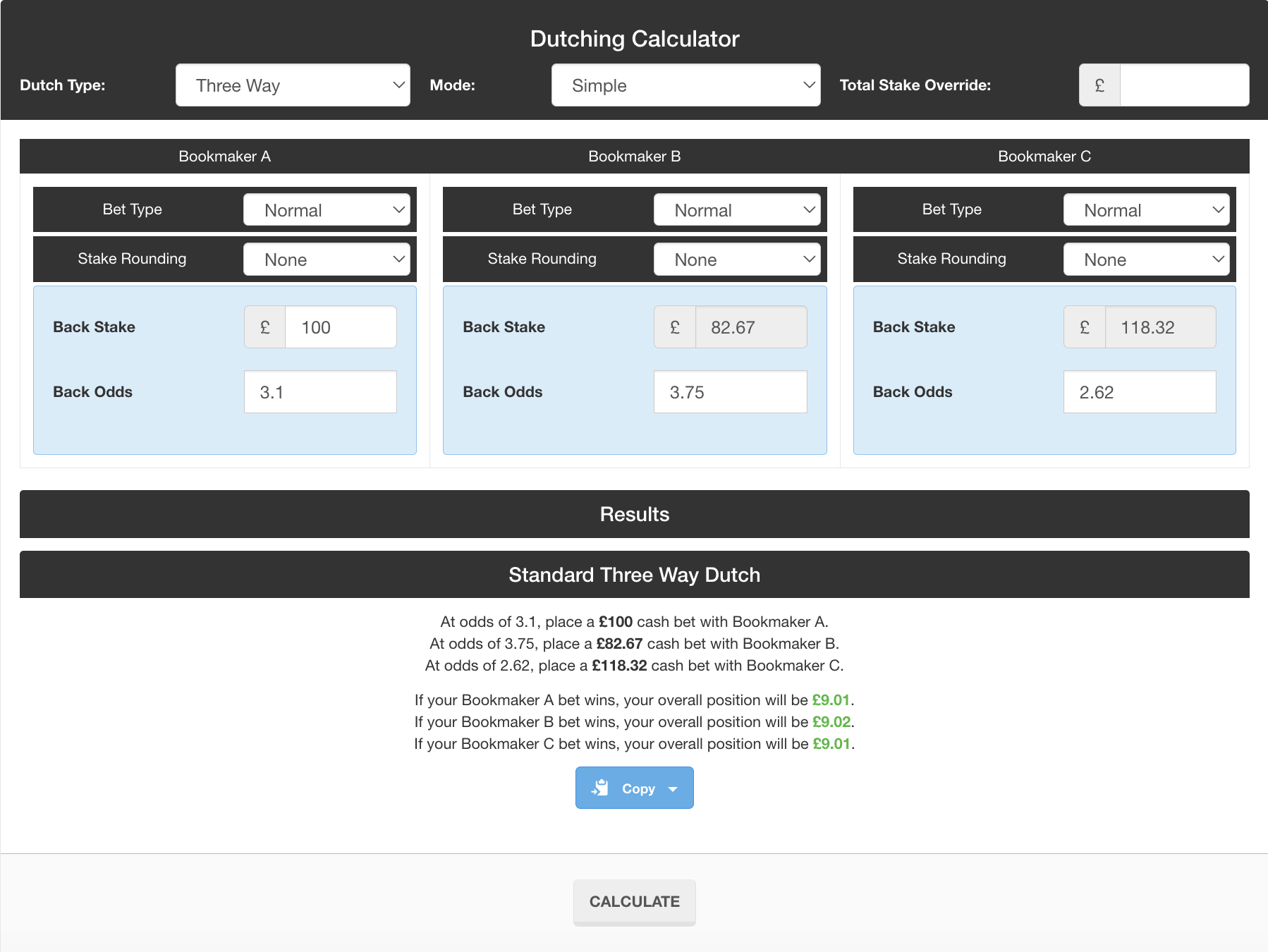
As you see above, with a £100 stake on a Sunderland win, an £82.67 stake on a draw, and a £118.32 stake on a Brighton win, you can lock in a profit of £9.01 no matter which ends up as the final outcome.
| Outcome | Odds | Stake | Return | Overall profit |
|---|---|---|---|---|
| Sunderland win | 3.1 | £100 | £310 | £9.01 |
| Draw | 3.75 | £82.67 | £310 | £9.01 |
| Brighton win | 2.62 | £118.32 | £310 | £9.01 |
What Sports Are Best Suited To Dutching?
It’s possible to dutch bets on any sport, but depending on the type of dutch bet you choose to place, you may find some work better than others.
Football
The match winner market is of course the most popular in football, but as it has three possible outcomes, it’s often difficult to find good enough odds to make a dutch bet profitable.
However, you could bet on two-way markets, like Both Teams To Score, in order to produce a simpler dutch bet. Alternatively, you could cover only some outcomes on the Correct Score market; check out our dedicated Football Dutching Guide for further details on how this can work.
One other benefit of football is its popularity - with so many bets being placed on football matches, you may find it easier to blend in with regular punters by dutching your bets on football, limiting the risk of attracting bookie attention and having restrictions imposed on your account.
Data Insight
The Gambling Commission recorded £2.4 billion in gross gambling yield from remote betting in the 2025–26 financial year. Football accounted for £1.2 billion of that total, compared with £769.3 million from horse racing, highlighting the scale of football within Britain’s regulated online betting market.
Tennis
Tennis is one sport where dutching can be a hugely favourable tactic, as the match winner market has only two outcomes (Player A wins, or Player B wins).
Matched bettors often opt to dutch their bets on tennis, because the retirement rules bookies include in their terms don’t always line up with those of betting exchanges, meaning that a standard matched bet could leave the player losing both their back and lay bets in the event of a player retiring from a match.
Dutching solves this problem, so long as both bookies you use have the same terms regarding retirement (check out our dedicated guide to tennis retirement rules for more information about how this works).
Expert Insight
‘With tennis, the key isn’t simply finding two attractive prices. You need to compare the settlement rules alongside the odds, particularly around retirements and abandoned matches. A small difference in bookmaker terms can completely change the expected outcome, so the market rules deserve the same attention as the numbers.’
Golf
With golf, dutch bettors tend to choose not to cover all outcomes, but to select a few golfers whose chances they fancy and place their bets only on those.
Of course, given the size of the field in most golfing tournaments, you’re still leaving yourself open to a high degree of risk - if a golfer you haven’t backed ends up winning, you’ll be down your full stake.
However, dutching across several golfers increases your chances of a win, and may be a good risk management strategy for recreational bettors.
Darts
Like tennis, darts matches have only two outcomes on the match winner market, making this an ideal sport for easy dutching. Darts doesn’t always attract as much volume at betting exchanges as other sports, so you might also find dutching a good alternative to a standard lay bet if you’re trying to complete a Matched Betting offer on darts.
Horse Racing
It’s rare for it to be possible to cover all outcomes with dutching techniques in horse racing, due to the high number of runners in most races. Dutch bettors therefore tend to select a few runners, usually the favourites, to bet on in horse races.
This improves their chances of a win, especially if the odds make it possible to cover all the runners that look to have a good chance of winning while still turning a profit. This does, of course, leave the bettor open to risk, so you should never bet more than you can afford to lose when engaging in dutching on horse racing.
Data Insight
In 2025, average field sizes were 8.90 runners on the Flat and 7.84 over Jumps. That means even an average race presents substantially more potential winners than a two-way tennis or darts market, illustrating why covering every outcome through dutching can be difficult.
Other Sports
Dutching your bets on other sports will largely follow the same pattern as in the above sports; on markets with just two or three possible outcomes, you can cover all outcomes and potentially lock in a profit if the odds are good enough.
If there are a large number of possible outcomes, however, you’re unlikely to be able to cover them all. If you decide to dutch a bet in these circumstances, you’ll improve your chances of a win, but you can’t remove the risk of another selection winning, which would result in you losing your entire stake.
Considerations When Choosing A Sport For Dutching
| Number of outcomes | Depending on the market you choose, you may or may not be able to cover all outcomes when dutching a particular sport. If you’re uncomfortable with any significant risk, you may wish to avoid dutching sports like horse racing or golf. |
| Popularity | Although there’s nothing to say a sport has to be popular for you to dutch it, your betting patterns will look less suspicious to the bookie if you’re betting on popular sports. On the other hand, you may find it easier to dutch a less popular sport than to find a lay market for it on a betting exchange. |
| Betting rules | Tennis is the prime example of a sport where betting rules (i.e. the retirement rules mentioned earlier) can make dutching the best strategy. However, this can apply to other sports as well, so be sure to check the rules of the sport you plan to dutch a bet on. |
| Predictability | In some ways, a sport with frequent unexpected outcomes (e.g. horse racing) can be great, making a win at high odds more possible. On the other hand, sports like football, which are generally easier to predict, may make it easier to choose the best selections to dutch on. |
Expert Insight
‘The number of selections you need to cover is only part of the equation. As you add outcomes, small differences between available prices can materially affect the overall return, so a market that looks suitable at first glance may become unattractive once every stake is calculated at the prices actually available.’
Other Strategies That Can Help You Profit From Sports Betting
Dutching can be a very useful addition to your skillset as a sports bettor, but it’s not the only strategy out there - and some others can do more to help you get the most out of your betting.
Depending on your tolerance of risk, your bankroll, and your ambition, one of the following strategies may be better suited to your needs than dutching.
Matched Betting
We’ve already mentioned that dutching can be a useful technique to deploy as part of a Matched Betting strategy - but if you aren’t already a dab hand at Matched Betting, you may be wondering how exactly it works and why you’d want to try it.
Similar to dutching, Matched Betting involves placing more than one bet on a single market. With Matched Betting, though, one bet will be a back bet (for an outcome) with a bookmaker, while the second will be a lay bet (against that same outcome) with a betting exchange, which ensures that one of the two will win.
The trick to making money from Matched Betting is taking advantage of bookmaker offers, which they dispense liberally in order to tempt new customers and retain existing ones.
Usually, Matched Betting works as a two step process, corresponding with the normal format of a bookie offer, which tends to be along the lines of ‘Bet £10 Get A £10 Free Bet’.
First, you must bet £10 of your own money with the bookie in what is known as a ‘qualifying bet’. You match this bet with a lay bet at a betting exchange, and usually make a small loss of a few pence at this stage.
Then, once your qualifying bet has settled, you’ll be awarded your free bet, which is where you make your profit. You repeat the process of placing and matching your bet, which should result in your making a profit of about 70-80% of your free bet - so £7-£8 for a £10 free bet.
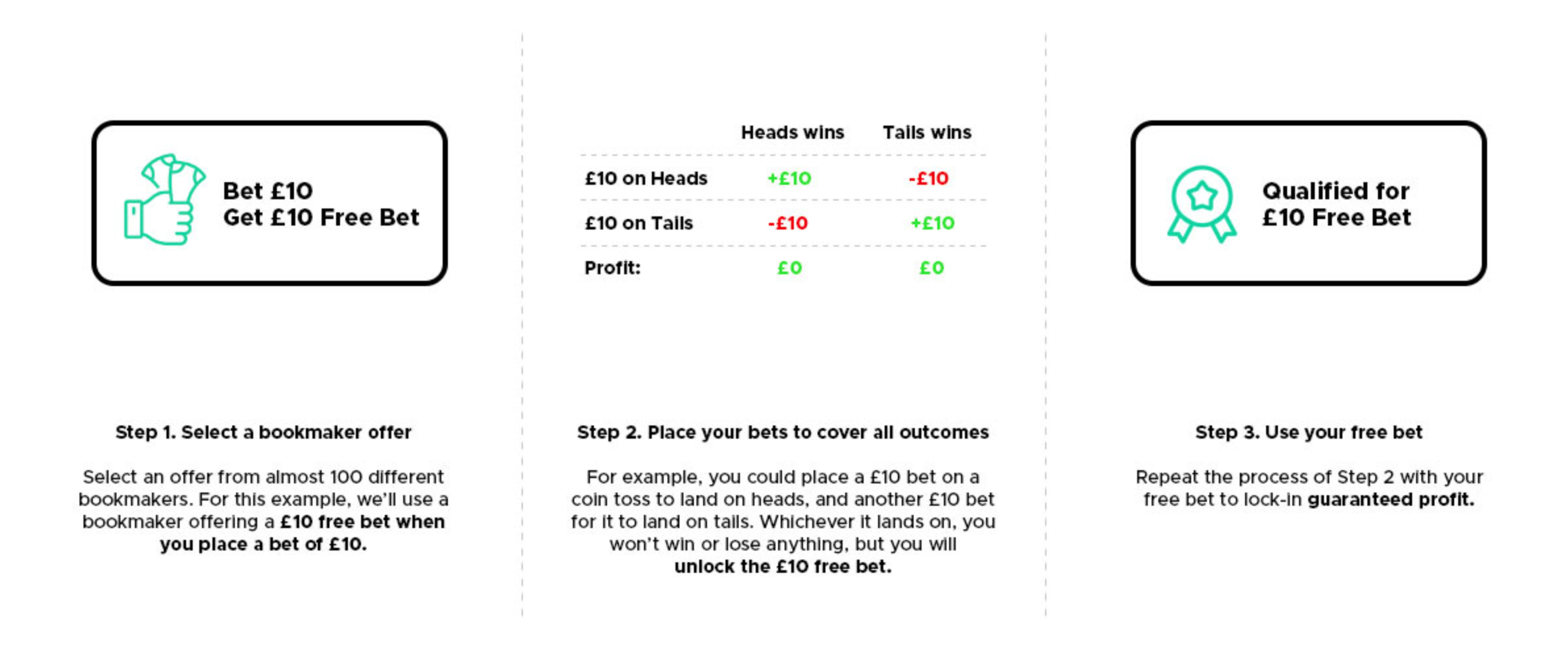
Because Matched Betting should produce the same result no matter the outcome of an event, it’s an extremely low-risk strategy that can make you as much as £300-£1000 per month.
To find out more, take a look at our Beginner’s Guide to Matched Betting for a full breakdown of the process and how you can get started.
Arbitrage Betting
Arbitrage betting is another very similar technique (another where dutching can be used to contribute to your strategy), which involves placing bets for and against the same outcome.
Successful arbitrage betting hinges on finding pairs of disproportionately favourable odds that produce a profit with every single bet.
This is easiest when you place a back bet with a bookmaker and a lay bet with a betting exchange, like with Matched Betting. All you need to do is find odds for your back bet that are higher than the lay odds; if this is the case, you’ve got an arbitrage bet, which will generate you a profit regardless of the outcome of the event.
Tools like Outplayed’s Oddsmatcher make this a really easy process, making arbitrage a popular strategy even with relative newcomers to sports betting.
It’s also possible to dutch your bet between bookmakers to create an arbitrage bet, but it can be harder to track down sufficiently favourable odds to lock in a profit.
To find out more, take a look at our dedicated guide to arbitrage betting for all you need to know about how this strategy works.
Value Betting
Value Betting is a more advanced strategy than arbitrage betting or Matched Betting, and it’s best suited to experienced sports bettors, who have built up a strong bankroll.
If that applies to you, Value Betting can provide a massive boost to your profits. Like arbitrage betting, it relies on locating favourable odds from bookies. Specifically, odds that are higher than the true probability of a win would imply.
Value bettors only place bets on selections with these disproportionately favourable odds, which means that they’re statistically likely to end up profiting overall, even though they aren’t locking in a profit on any individual bet, as is the case with Matched Betting or arbitrage.
To find out more about how Value Betting works and how you can get started, check out the dedicated Outplayed guide.
Summary
Dutching can in theory be profitable when used on any sport, but some sports will undoubtedly work better than others. For the risk-averse, sports with limited outcomes like football or tennis may be preferable, while those with more tolerance for risk may be keen to dutch their bets on sports like horse racing or golf.
The best results, though, will come when dutching is considered as only one aspect of an overall betting strategy. Strategies like Matched Betting or Value Betting can do far more to improve a bettor’s results than just dutching, and Matched Betting especially is better suited to beginners.
To find out more, take a look at the Outplayed Beginner’s Guide to Matched Betting for all the information you need to get started.
Or if you’re already convinced and ready to get going, sign up for our free trial to gain access to 40+ bookmaker sign up offers, worth £800+ in potential profit.
sign up nowFAQs
1. Can you dutch your bets on any sport?
Pretty much! So long as you can find more than one bookmaker offering the same market, it’s theoretically possible. It might not be possible to dutch profitably, though, so don’t assume that a dutch bet is worthwhile just because it’s possible.
2. Does dutching guarantee you a profit?
No - if you don’t cover all outcomes there’s a good chance you won’t make any money at all. And even if you do, it’s still possible to make a mistake, although the level of risk is very low if you cover all outcomes on a market.
3. Is dutching more profitable than Matched Betting?
Most people will probably find that Matched Betting is more profitable, because it’s easier to execute, even though there’s a limit to the number of offers you can complete. Dedicated dutchers willing to devote a significant amount of time and energy to their strategy may be able to make more from dutching than Matched Betting, though.
4. Is dutching beginner-friendly?
It’s not too difficult to get the hang of, but we’d say that Matched Betting is a much better starting place for newcomers to sports betting.
5. Is dutching legal?
Yes, dutching is completely legal. Bookmakers don’t like dutch bettors, though (or any other bettor who uses strategy to reduce risk and improve profit), so you should be careful to blend in with regular punters to avoid incurring bookie restrictions.
Updated: 29 Oct 2026