
How Much Money Can You Make From Hedge Betting?
12 min read
Stephanie Sorrell
23 Sep 2026

Quick answer: it all depends on how much time and effort you’re able to put towards your betting - as well as how large a bankroll you have available. The more money and time you invest in hedge betting, the more you’re likely to get out of it.
Hedge betting can sound intimidating to new bettors, perhaps due the connected concept of hedging in finance, which is definitely best left to the pros.
But including hedging in a sports betting strategy can be a sound idea, allowing you to limit your exposure and sometimes even lock in a profit regardless of the outcome of an event.
So how much money can you actually make through hedge betting techniques, and is it worth your while?
In this article, we’ll look at how to make money hedge betting, the kinds of profits you can expect to generate as a hedge bettor, as well as other strategies you can adopt to maximise your profits while minimising any risk.
How Does Hedge Betting Make Money?
Hedge betting is best used as part of a sports betting strategy, when changes to the odds for an event make it possible to place one or more bets that oppose your original bet and either lock in a profit or at least mitigate losses.
It’s similar to both Arbitrage Betting and Matched Betting in its use of opposing bets across a single market. All three strategies involve placing two or more opposing bets, ideally covering all possible outcomes within a single market (although this may not always be the case with hedge betting). But rather than placing those opposing bets at the same time, hedge betting makes use of changing odds over a period of time.
In many cases, it’s possible to lock in a profit no matter what happens, which is how hedge betting can make you money. In other cases, you may only be able to mitigate your losses if your original bet doesn’t come through.
An example of a hedge bet
In the run up to the EFL final between Manchester City and Arsenal, you decide to place a bet on Arsenal to win the cup, although they’re currently the underdogs. You find odds of 4 on Arsenal with a bookie, and place a bet of £100 on your team to win.
As the match grows closer, opinion shifts, and pundits start to think rather more of Arsenal’s chances.
The match itself comes, and by half time Arsenal are up 1-0. You’re feeling excited, but also nervous. A one goal lead isn’t that much, and Manchester City could still snatch victory from the jaws of defeat.
And so you look at the possibility of hedging your bet. As Arsenal are ahead, the available odds for Manchester City to take the cup are much higher than they were before the match, and you’re able to place a hedge of £100 at odds of 2.5.
Now, you know that whichever team takes the cup, you’ll end up with a profit. You’re still best off if Arsenal win the competition, with an overall profit of £200 (a return of £400 minus your stakes of £100 on each team). But even if Manchester City takes the cup, you’ll still have an overall profit of £50.
| Outcome | Stake | Odds | Return | Overall profit |
|---|---|---|---|---|
| Arsenal win | £100 | 4 | £400 | £200 |
| Manchester City win | £100 | 2.5 | £250 | £50 |
Hedging with a betting exchange
When you talk about hedge betting, people often think immediately of hedging a bet with another bookmaker. But you can also hedge a bet by placing a lay bet against it at a betting exchange, just as you would with a matched bet.
This is often the simplest way to hedge a bet, especially as you can be confident that your hedge will precisely oppose your original bet. It can also be easier to identify a good hedging opportunity; as long as the lay odds are lower than the odds at which you placed your original bet, you’ll know that you stand to make a locked in profit.
Data Insight
Betting exchanges remain a relatively specialised part of the betting market. The Gambling Commission found that 2% of adults had used a betting exchange in the previous four weeks in its 2023 survey, compared to 9% who had engaged in any kind of betting, showing that exchange-based betting is far less widespread than conventional betting.
How Much Money Can Hedge Betting Really Make You?
Now for the question that everyone’s most interested in - just how much money can hedge betting make you?
Well, unfortunately there’s no single answer to that. Apart from anything, hedge betting is better viewed as one technique used as part of an overall smart sports betting strategy. Few would recommend hedging every single bet you make, so it can’t truly be assessed as a standalone strategy.
As well as this, the amounts that can be locked in with a savvy hedge bet depend entirely on how much money you’ve staked in the first place. In the example above, we imagined a £100 bet, and our hedge allowed us to make either £50 or £200 in profit.
But if that initial bet had been £1000, then our overall profits would have been £500 or £2000, so long as we had enough cash available to place a £1000 hedge bet.
When you look at hedge betting this way, it becomes obvious that your hedge betting profits will depend largely on how much money you’re able to put into your hedge betting (and to be clear, you should absolutely never bet more than you can afford to lose).
Your success will also depend on how much time you have available. Hedging opportunities crop up all the time, but you need to be alert and ready to catch them.
Expert Insight
‘The biggest mistake is measuring a hedge by its headline profit rather than by the price you’re accepting to achieve it. A hedge can turn a strong original position into a poor trade if the market has moved too far, so always compare the guaranteed outcome with simply letting the original bet run.’
It’s also important to be aware that not every bet is hedgable. And in many cases, the best available outcome when hedging your bet might be to limit the loss you stand to make.
To look again at our example from the previous section, what would have happened if it had been Manchester City to go 1-0 up, instead of Arsenal?
With the Mancunians in the lead, having been the favourites from the start, we might see odds of 1.3 on Manchester City at half time. At these odds, it isn’t possible to lock in a profit - but you could limit the damage by placing a hedge bet of £275 on Manchester City to lift the cup.
If Manchester City do indeed win, you’ll still lose money - but only £17.50, rather than the £100 you’d otherwise be at risk of losing. And if Arsenal pull off an unexpected victory, you’ll make a profit of £25. This might not sound like much, compared to the £300 you’d win without hedging your bet, but at least you don’t have to worry about losing your £100.
| Outcome | Stake | Odds | Return | Overall profit |
|---|---|---|---|---|
| Arsenal win | £100 | 4 | £400 | £25 |
| Manchester City win | £275 | 1.3 | £357.50 | -£17.50 |
You can see, therefore, the risk that a hedge betting strategy carries. You have no way to know when you place your initial bet whether you’ll find yourself locking in a reasonable profit or simply accepting a smaller loss than you’d otherwise suffer.
We therefore recommend thinking of hedge betting not as a strategy that can make you a certain amount of money, but as a technique to be employed as part of your existing sports betting to help you make the most of the opportunities you see.
What Are The Best Strategies To Maximise Your Hedge Betting Profits?
As we’ve seen, success when hedging is not guaranteed. But there are certain strategies you can use, which can make it easier to find hedges, improve your chances of profiting them, and maximise any profits you do make.
- Futures and outrights. Because hedge betting relies on changing odds over time, betting on long term markets (such as the player or team to win a season or tournament) can be a great strategy to allow for hedging possibilities.
- In-play betting. Odds change with great rapidity when an event is in progress, so it’s possible to capitalise on those swinging odds with a hedge bet. I
Data Insight
In-play betting is already a significant part of the UK betting landscape. The Gambling Survey for Great Britain found that 4% of adults had bet in-play during the previous four weeks in 2023, highlighting how widespread betting on events after they have started has become.
- Partial hedging. Depending on your read of a particular match or event, you may decide to hedge only a portion of your original bet, limiting your exposure but hanging on to more of your potential profit.
Expert Insight
‘A hedge shouldn’t be triggered simply because the odds have moved in your favour. The better question is whether the new price gives you a better risk-adjusted position than the one you already hold. Sometimes the most profitable decision is to leave the original bet untouched and accept the remaining exposure.’
- Accumulator hedging. This is a fairly risky strategy, as it relies on several legs of your acca winning before you can hedge your bet. However, if you imagine you’ve placed a 4 leg acca, and your first three bets all win, you’ll be in a position to hedge the final leg and lock in a profit.
Are There Any Other Strategies You Can Use When Sports Betting To Make More Money?
There are some other fantastic strategies out there that will allow you to make money, some of which will allow you to lock in a profit on a sports bet, just like hedge betting, but without the initial risk.
Matched Betting
At Outplayed, we’re the experts in Matched Betting, so it’s no surprise that we consider it to be the very best strategy out there, especially for beginners.
Matched Betting involves placing bets both for and against the same outcome, similarly to hedge betting. However, Matched Betting hinges on using bookmaker offers to turn these matched bets into profit in what is typically a two-step process.
First, you place what’s known as a ‘qualifying bet’, which you use to unlock a reward such as a free bet. You match this bet with a lay bet at a betting exchange, which typically makes you a small loss of a few pence, known as a qualifying loss.
Then you repeat the process with the free bet you’ve unlocked, usually making a profit of 70-80% of the value of your free bet.
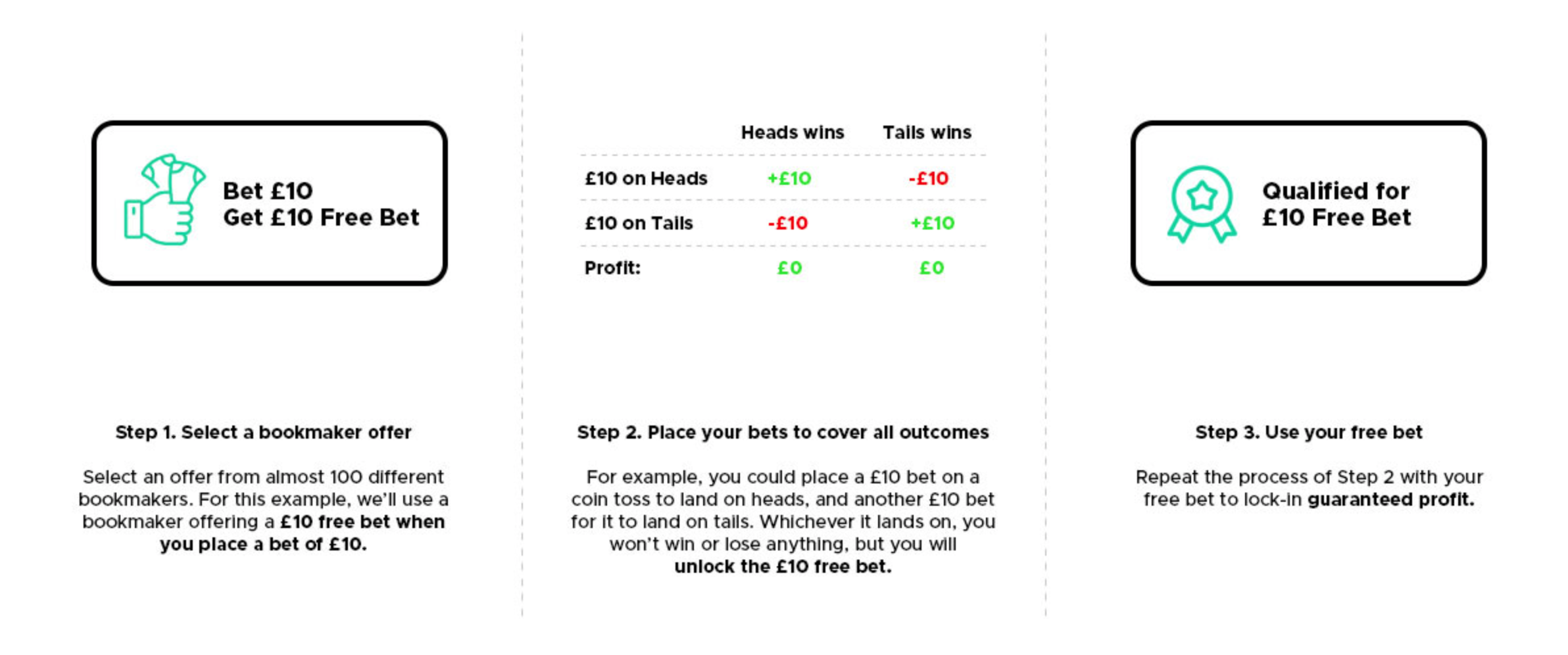
Matched bettors can make hundreds of pounds a month from this technique, with minimal risk of any losses, making it one of the best side hustles out there.
To find out more, take a look at our Beginner’s Guide to Matched Betting for a full breakdown of the process and how you can get started.
Arbitrage Betting
Arbitrage betting is another very similar technique to hedge betting, which again involves placing bets for and against the same outcome.
The trick to arbitrage comes in finding pairs of disproportionately favourable odds that allow you to lock in a profit with every single bet.
Most commonly in the UK, this involves placing a back bet with a bookmaker and a lay bet with a betting exchange. If the odds for your back bet are higher than those for your lay bet, you’ve got an arbitrage bet, which will result in a profit regardless of the outcome of the event.
To find out more, take a look at our dedicated guide to arbitrage betting for all you need to know about how this strategy works.
Value Betting
Value Betting is a more advanced strategy than arbitrage betting or Matched Betting, but it can pair well with hedge betting. Because it does involve risk, we recommend that bettors build up both their experience of sports betting and a strong bankroll before they get started.
Once you’re in that position, though, Value Betting can provide a massive boost to your profits. It relies on a similar principle to arbitrage betting - that of locating favourable odds from bookies. Specifically, odds that are higher than the true probability of a win would imply.
By betting exclusively on selections with disproportionately favourable odds, you’re statistically likely to end up profiting overall, even though you aren’t locking in a profit on any individual bet.
It also combines well with hedge betting, although we wouldn’t expect most value bettors to wish to hedge every bet.
To find out more about how Value Betting works and how you can get started, check out the dedicated Outplayed guide.
Benefits And Downsides Of Hedge Betting
Although hedge betting has some significant benefits, it’s important to be aware of the downsides and risks it holds as well. The most important considerations are as follows:
Benefits
- Potential to lock in profits. The most obvious advantage of a hedge bet is its potential to lock in a profit. This won’t always be possible, but in some cases it can be possible to lock in a fairly significant profit regardless of the outcome of an event.
- Mitigates losses. In cases where you can’t lock in a profit, you can at least minimise the consequences if your bet loses, ensuring your level of exposure is at an acceptable level.
- Peace of mind. If you’ve hedged a bet, you’ve removed much of the stress that goes with it. If you know your outcome will be, at worst, only a small loss, you don’t have to be over-concerned about how the event goes.
Downsides and Risks
- No guarantee of hedging opportunity. When you place your initial bet, you can’t know that you’ll have a good opportunity to hedge it. If no good opportunity comes along and your selection goes on to lose, you’ve simply lost your stake.
- Risk can remain. In some situations, such as a horse race, it may be unfeasible to cover all outcomes. You might hedge your initial bet by covering one, two, or even three other horses, and yet still lose all those bets if another runner unexpectedly wins.
- Reduced profits. By hedging your bet, you reduce the profit potential from your original bet, which could impact the success of your overall betting strategy, especially if you’re Value Betting.
- Added margins. By placing two separate bets, you end up contributing to the bookie’s margins twice, reducing the value of your bets. And even if you use a betting exchange to lay your bet, you’ll pay a commission on your winnings (unless you’re an Outplayed member with a 0% commission rate with Smarkets or Matchbook, that is!).
- Time and effort. If you’re considering hedging a bet, you can’t just place it and forget about it - you need to spend time keeping an eye on the odds and watching for a good hedging opportunity. You’ll also need to perform considerable research in advance of your initial bet, to give yourself the best chance of finding a bet that can be hedged in the future.
- Not beginner-friendly. Hedge betting is best suited to experienced bettors with a significant bankroll, whose knowledge and expertise allow them to judge accurately which bets to make, which to hedge, and how to get the most out of a hedge betting strategy. Beginners are far more likely to panic and hedge unnecessarily, or to place ill-advised initial bets, both of which will heavily impact their profits.
Summary
It’s understandable that prospective hedge bettors would want to know exactly how much money can be made from hedge betting - but that just isn’t how the strategy works.
Hedge betting is best used as just one part of a sports betting strategy, and while it can certainly help to lock in profits or to mitigate losses, it’s typically only one part of the equation for successful bettors.
If you’re looking for more certain profits, we’d strongly recommend giving Matched Betting a go. It’s ideal for beginners, and can make you £300-£1000+ a month in profits if you put enough time and effort in.
To get started, sign up for our free trial to gain access to over 40 sign up offers worth £800+ in potential profits.
sign up nowFAQs
1. Is hedge betting safe?
Hedge betting can be considered ‘safer’ than standard sports betting, in that it mitigates risk and can sometimes lock in a profit, but it’s certainly not risk free. As it relies on odds changing in a favourable manner, it’s quite possible that no good hedge betting opportunity will occur after you place your initial bet, meaning you could easily lose money if that bet loses.
Yes, hedge betting is completely legal. Bookmakers aren’t keen on hedging, as it can threaten their profitability, but there’s nothing illegal about it.
3. Can I hedge my bet with the same bookmaker as my initial bet?
You definitely shouldn’t! Betting on opposing outcomes with a single bookmaker will stand out to them as potential hedging behaviour, and could lead to you incurring bookie restrictions. Always use a different bookie or a betting exchange when hedging a bet.
4. Is hedging a bet the same as placing an arbitrage bet?
It’s a very similar process, but it’s not quite the same. Arbitrage betting involves finding pairs of favourable odds that allow you to lock in a profit by placing both opposing bets at the same time. Usually, hedge betting relies on odds changing over time, creating an opportunity for you to mitigate potential losses or lock in a profit.
5. What do I do if I don’t get a chance to hedge my bet?
Most people will simply let that bet play out and hope for a win - presumably they did have confidence in the selection when they originally made their bet. However, if you’re really unhappy with your bet you can consider cashing it out, assuming the bookie in question will allow it. This is definitely a last resort, though, as bookies take a heavy cut on cashed out bets.
Updated: 1 Oct 2026