
Is It Safe To Arb As Part Of Your Matched Betting Strategy?

Quick answer: while arbitrage betting does increase your risk of being restricted by bookmakers, it can still form a useful part of a Matched Betting strategy. By making use of price boosts, and restricting arbs to accounts that have already been gubbed, you can get the most out of arbitrage alongside Matched Betting while minimising the risk of bookie restrictions.
There comes a point in the journey of most matched bettors when they go to place a qualifying bet and realise that they’ve found a matched bet that could actually make them a profit, due to the back odds being higher than the lay odds.
This is known as an arbitrage bet, and it really does allow the bettor to lock in a profit with a single matched bet, without having to make use of an offer or price boost.
However, arbitrage bets are also well known for attracting the attention of bookies, and most Matched Betting guides advise bettors to steer clear of arbitrage bets, aka ‘arbs’, in order to preserve the health of your bookie accounts.
Still, the prospect of locking in a profit with a single bet, without relying on offers, is bound to be highly attractive to any matched bettor. Many will find themselves wondering if there’s any way they could safely include a level of arbitrage in their Matched Betting strategy.
In this article, we’ll explore to what extent it’s possible, and how you can add arbing into your Matched Betting while minimising the risks it poses.
Arbitrage Betting In A Nutshell
If you’re reading this article, you probably already have a good idea of how arbing works, so we won’t go into too much detail here. If you want a full rundown of the mechanics of arbitrage betting, though, check out our dedicated guide to arbing.
For now, we’ll just give you a brief sketch of the basics of arbitrage, and how it can generate profits.
The key principle of arbitrage is that it relies on finding favourable odds that cover two or more opposing bets on a single market within one event, so that no matter what happens one of your bets will win, making enough money to generate a profit in spite of the losses from your other bet(s).
Data Insight
Research published in the International Journal of Sport Finance found that one in every three trades analysed in a Super Rugby betting market provided an arbitrage opportunity, with differing bookmaker odds contributing to the observed market inefficiency.
- International Journal of Sport Finance
The most popular form of arbitrage betting in the UK is bookmaker-exchange arbitrage, where your bet works just like a standard qualifying bet when you’re Matched Betting.
You place a back bet (for a certain outcome) with a bookmaker, and a lay bet (against the same outcome) with a betting exchange. But rather than making a small qualifying loss, so long as the back odds are higher than the lay odds, you’ll emerge with a profit.
An example of an arbitrage bet
You spot particularly good odds for a horse race with the bookmaker BestOdds: odds of 2.3 on Asia Force with BestOdds on the 16:45 Carlisle, and wonder if you might have found a potential arb.
Sure enough, when you compare with the betting exchange Smarkets, you see that the odds there are quite a bit lower, at 2.1, meaning that you’ve found an arbitrage opportunity.
You use a Matched Betting or arbitrage calculator to work out your optimal stakes to lock in the greatest possible profit regardless of whether Asia Force does or doesn’t win.
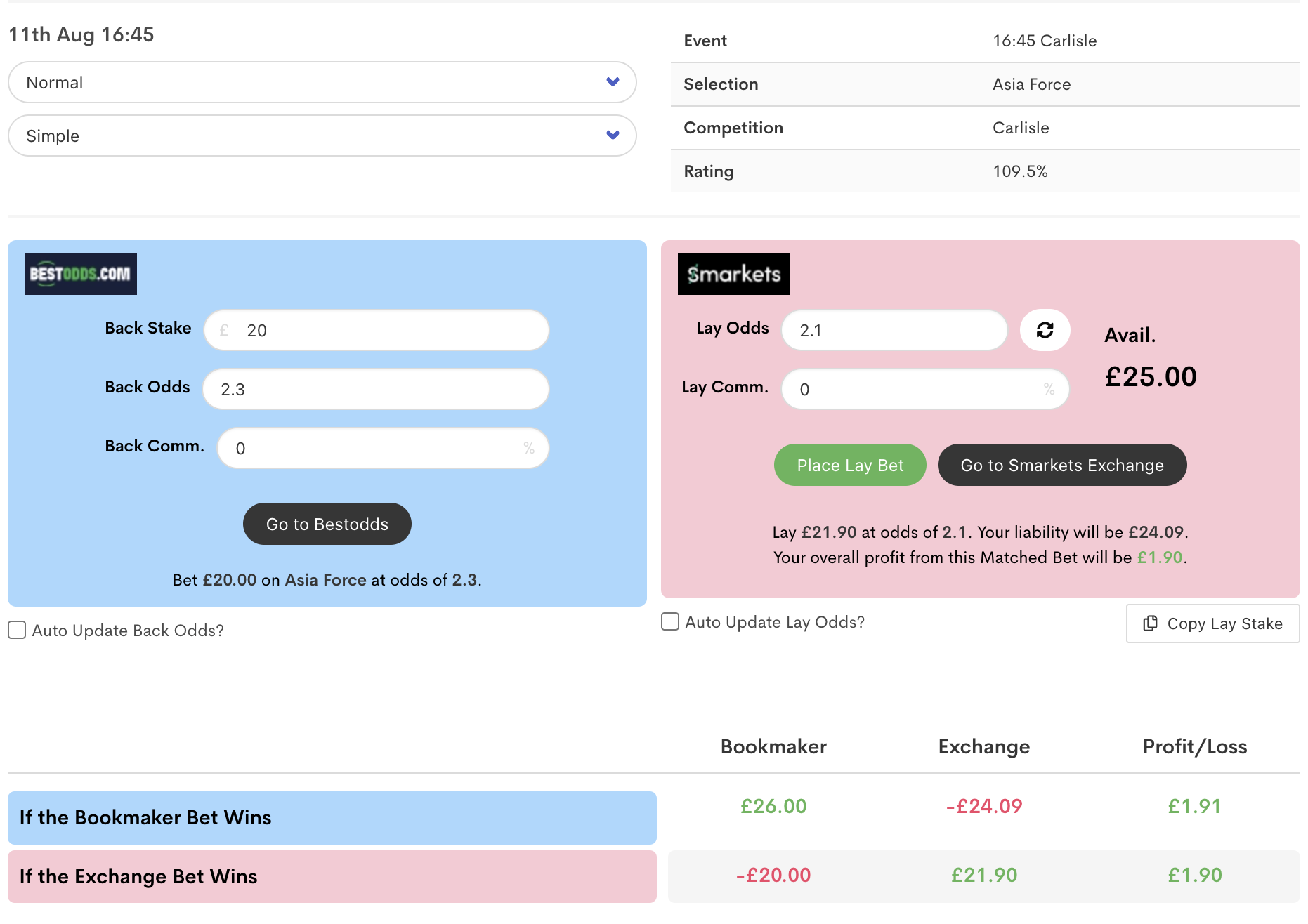
As you can see from the screenshot above, if you place a back stake of £20 on Asia Force with BestOdds, your optimal lay stake is £21.90 with Smarkets, which will result in liability of £24.09.
Whether your selection wins or loses, you stand to make a profit of £1.90 when your bets settle.
This isn’t a huge profit, of course, but an arbitrage betting strategy involves building profits over time, with lots of small profits adding up in the long term.
Other arbitrage models
Bookmaker-exchange arbitrage is the easiest model of arbitrage to complete, especially for matched bettors who are used to placing matched bets of this nature.
But it is also possible to arb between two bookmakers, known as bookmaker-bookmaker arbitrage. This is a form of Dutching, and if you’re able to locate sufficiently favourable odds, it can be just as profitable as bookmaker-exchange arbitrage.
The problem can be locating those odds, as standard odds matching software isn’t designed for dutching - but if you do spot a good bookmaker-bookmaker arbitrage opportunity, you can use a Dutching Calculator to work out the optimal odds for your bets.
It’s also possible to arb between two exchanges, in exchange-exchange arbitrage. However, we strongly advise against this, as betting exchanges, which are very happy to accommodate matched bettors and standard arbers, do not appreciate exchange-exchange arbing and may take action by limiting your account or removing your 0% commission rate.
What’s The Difference Between Matched Betting And Arbitrage Betting?
Matched Betting and arbitrage betting have a lot in common, but there are some crucial differences to be aware of.
1. Reliance on offers. As you’ll be aware as a matched bettor, you need offers to complete if you’re Matched Betting, whether you’re doing a standard bet & get or a more complicated racing refund. Arbitrage betting, however, doesn’t require any offers at all, just favourable odds, which can crop up at any time. Matched Betting is inherently limited by the number of offers available, whereas there aren’t any real limits to the number of arbitrage bets you can complete.
2. Size of profit. Typically, each offer you complete when Matched Betting will hold more significant profit than you’re likely to achieve with a single arbitrage bet.
3. Speed of completion. Because Matched Betting mostly involves placing first a qualifying bet and then a free bet, it’s usually quicker to complete an arbitrage bet, which locks in its profit with a single matched bet.
4. Risk of bookie restrictions. Both strategies do carry a risk of bookies imposing restrictions on your account, but the risk is somewhat lower with Matched Betting, as bookies make their offers available with the specific intention of encouraging bettors to take advantage of them. You should be careful to blend in with regular punters to preserve your account health with both strategies, however.
5. Necessity of favourable odds. Ideally, both matched bettors and arbitrage bettors will want to find favourable odds for their betting. However, it’s possible for matched bettors to make profits even with relatively poor matches, if the free bet they receive as a reward is generous enough - the profits just won’t be quite so high. Arbers, however, cannot make a profit at all if the odds they find aren’t good enough.
Expert Insight
The biggest practical difference between the two strategies is often consistency rather than the size of any single profit. Matched betting gives you a defined opportunity through an offer, whereas an arb can disappear before you act. That makes disciplined opportunity selection more valuable than simply chasing volume.
Summary
| Matched Betting | Arbitrage Betting |
|---|---|
| Relies on offers | No offers needed |
| Somewhat larger profits per offer | Small profits with each bet |
| Takes a little longer to complete a full offer | Quick to complete |
| Medium risk of bookie restrictions | High risk of bookie restrictions |
| Can still profit with mediocre odds matches | Requires extremely favourable odds |
What Are The Risks Of Arbitrage Betting?
Having established how arbitrage differs from Matched Betting, we can now take a look at why arbitrage might be considered a less ‘safe’ strategy than Matched Betting.
Although arbitrage betting carries very little risk of actually losing money with each bet, an arbitrage betting strategy does hold some risks, of which you should be aware before you start placing arb bets.
- Human error. As with Matched Betting, human error is one of the biggest risks when it comes to placing any individual arbitrage bet. Arbitrage opportunities rarely hang around for long, so arbers have to move fast to get their bets in to take advantage of any opportunities they see.
Data Insight
A 2025 Princeton University study of live NBA betting found that arbitrage opportunities typically lasted around 13 seconds under favourable conditions and were present for just 4.52% of total observed game time.
However, you shouldn’t let the need for speed take precedence over accuracy. Use tools like an arbitrage calculator to make sure you get your stakes right, enter the details of your bet correctly, and double check your stakes as you enter them. It’s far better to miss out on an arbing opportunity than to risk losing money due to a silly mistake.
- Palpable errors. Palpable errors, or ‘palps’, are errors at the bookie’s end rather than yours. A palpable error refers to odds so high that they’re obviously an error (due to an issue with the bookie’s software, for example), and the bookie will typically void bets made at those odds.
So, if you come across an especially favourable arbing opportunity, it’s wise to stop and ask yourself if the odds you’re seeing might be too good to be true. As a general rule, a match with a rating of 110% or higher on the Oddsmatcher is likely to be due to a palp, and is best avoided.
- Limited liquidity. If you’re using a betting exchange, always check how much available liquidity there is for your lay odds. If liquidity is low, you’ll be limited as to the amount you can stake with the bookmaker, and it’s also more likely that someone else will nab the favourable lay odds before you can finish placing your bets.
To minimise the likelihood of running into problems caused by low liquidity, try to bet somewhat in advance of an event, rather than immediately beforehand or in-play, when odds and liquidity will be changing all the time. We’d also recommend double checking that there’s enough liquidity immediately before placing your back bet, which will keep the chances of it disappearing while you’re mid-bet to a minimum.
Expert Insight
The headline arb percentage can be misleading if you ignore how much capital the opportunity actually requires. A smaller percentage return that can be repeated efficiently may be more useful than a larger-looking edge that ties up substantial bookmaker balances or exchange liability for little additional profit.
- Bookmaker restrictions. We’ve touched on the risk of bookie restrictions already, but these are the biggest obstacle to arbitrage betting so they’re worth mentioning again. Bookies do tend to be aware of when their odds have been over-priced, so it isn’t all that difficult for them to detect bettors who unerringly bet on those odds.
To blend in better with regular bettors, try to stick to popular events, and throw in some mug bets (just make sure to match them to avoid losing more than a few pence per bet). We’ve also gone into more detail in the next section as to the strategies you can use to incorporate arbitrage into your Matched Betting while minimising any risk to your profits from bookie restrictions.
| Risk | How to mitigate it |
|---|---|
| Human error | Take advantage of available tools, and double check your maths before you place your bets |
| Palpable errors | Steer clear of excessively-favourable odds, and arb matches of 110% or more |
| Limited liquidity | Avoid in-play betting, and double check the available liquidity immediately before placing your bets |
| Bookie restrictions | Bet on popular events, and place a few ‘mug’ matched bets to blend in |
What Can You Do To Make Arbitrage As Safe As Possible?
It’s wise to be wary about including arbitrage betting in your Matched Betting strategy. As we’ve seen in the previous section, arbitrage betting carries a particularly high risk of incurring bookie restrictions, and it would be a disaster for your Matched Betting strategy if you were to lose access to a profitable account due to a couple of ill-advised arbs.
However, that doesn’t mean it’s impossible to include arbitrage in your Matched Betting; you should simply ensure you go about it sensibly, taking reasonable precautions to limit the risk you expose yourself to.
Price Boosts
The very safest way to incorporate arbitrage into a Matched Betting strategy is with price boosts. Bookies regularly offer price boosts on a range of sports and events, and these are often generous enough to create an arbitrage opportunity.
If you can find lower lay odds at the exchange than the boosted back odds at the bookmaker, you can make a single matched bet and lock in an immediate profit - sometimes quite a significant one.
Because bookies feature price boosts specifically in order to entice bettors, it’s far less suspicious to place a bet with a price boost than it is to place a standard arbitrage bet, so your accounts are much less likely to be limited as a result.
That said, bookies will still notice if you bet on nothing but price boosts, so you should mix in a few mug bets to preserve the health of your accounts.
Gubbed Accounts
Another good way to arb in relative safety is by making use of gubbed accounts.
If a bookie has already gubbed you - i.e. removed your ability to take part in offers - then that account can be the perfect way to add in some arbitrage to your betting.
As you’ve already lost access to offers, there’s no real risk to arbing on a gubbed account, as its profitability will already be very limited.
It is possible that the bookie might heavily stake restrict you if they detect your arbing, but if your account would otherwise have lain dormant then this isn’t any great loss.
Sharbing
If you live in the middle of a town or city, sharbing can be a great way to arb safely.
Sharbing, or shop arbing, involves placing your back bet in person at a betting shop, then laying your bet with an exchange online.
Because you can bet in reasonable anonymity at a shop, your betting patterns are much harder to track, and you’re much less likely to be spotted by the bookie.
Shops can also be slower to update their odds, which means it may be easier to find arbitrage opportunities.
Obviously, this involves rather more effort than simply betting online from your sofa, but if you have several shops close to your home, it can be a profitable and safe way to include arbitrage in your Matched Betting strategy.
Are There Any Tools That Can Help Make Arbitrage Safe And Profitable?
There are quite a few tools out there that can make a huge difference to the success, security and efficiency of your arbitrage betting.
Most basic are sites like Oddschecker, which compares odds from the most popular bookies and a handful of betting exchanges, to show you which are the most generous. It won’t track down arbitrage opportunities on your behalf, but it will give you an idea of where you might find them.
Below, you’ll see a screenshot of Oddschecker’s results for an upcoming EFL match, with the best available odds for each win market selection highlighted in green.
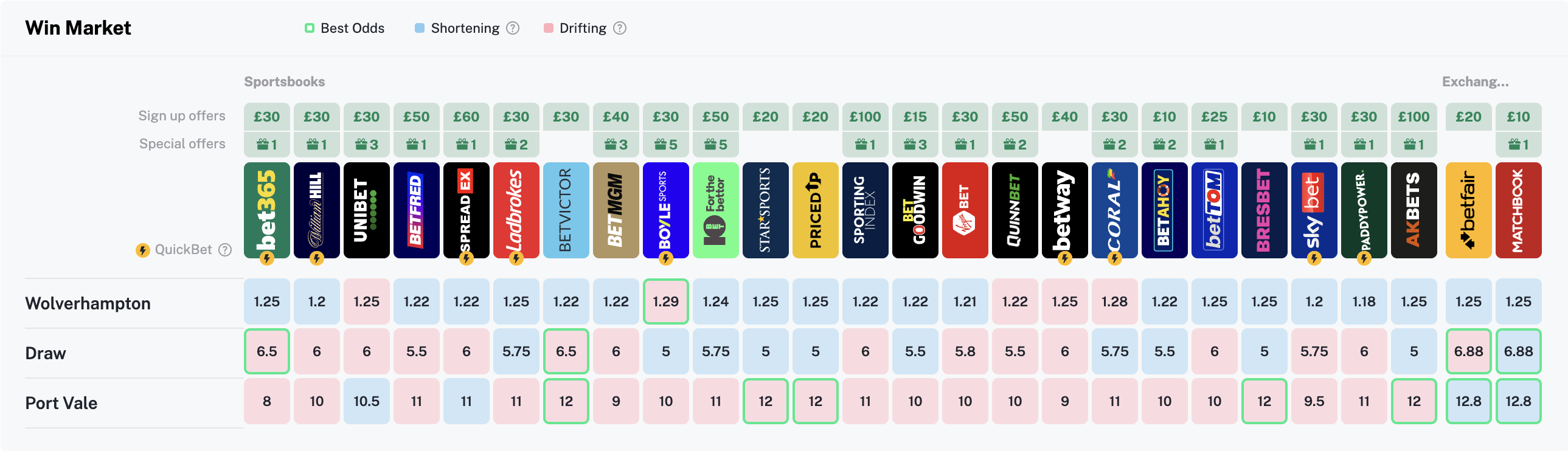
Even with Oddschecker, though, you’ll spend a lot of time searching for good arbing opportunities, which limits the profitability of your strategy.
Far better would be a tool that locates good arbitrage opportunities on your behalf, so all you have to do is place your bets.
And that’s where Outplayed’s Oddsmatcher comes in. Available with all membership tiers, the Oddsmatcher constantly scans British bookies and betting exchanges for close matches between back and lay odds. Although it’s primarily designed for Matched Betting, it can equally be used for arbitrage betting.
Each match it displays is given a percentage rating, indicating how close a match it is. Anything over 100% is an arbitrage opportunity, with the potential to make you a profit. You should be wary of matches over 110%, though, as there’s a good chance they’ll turn out to be due to a palpable error.
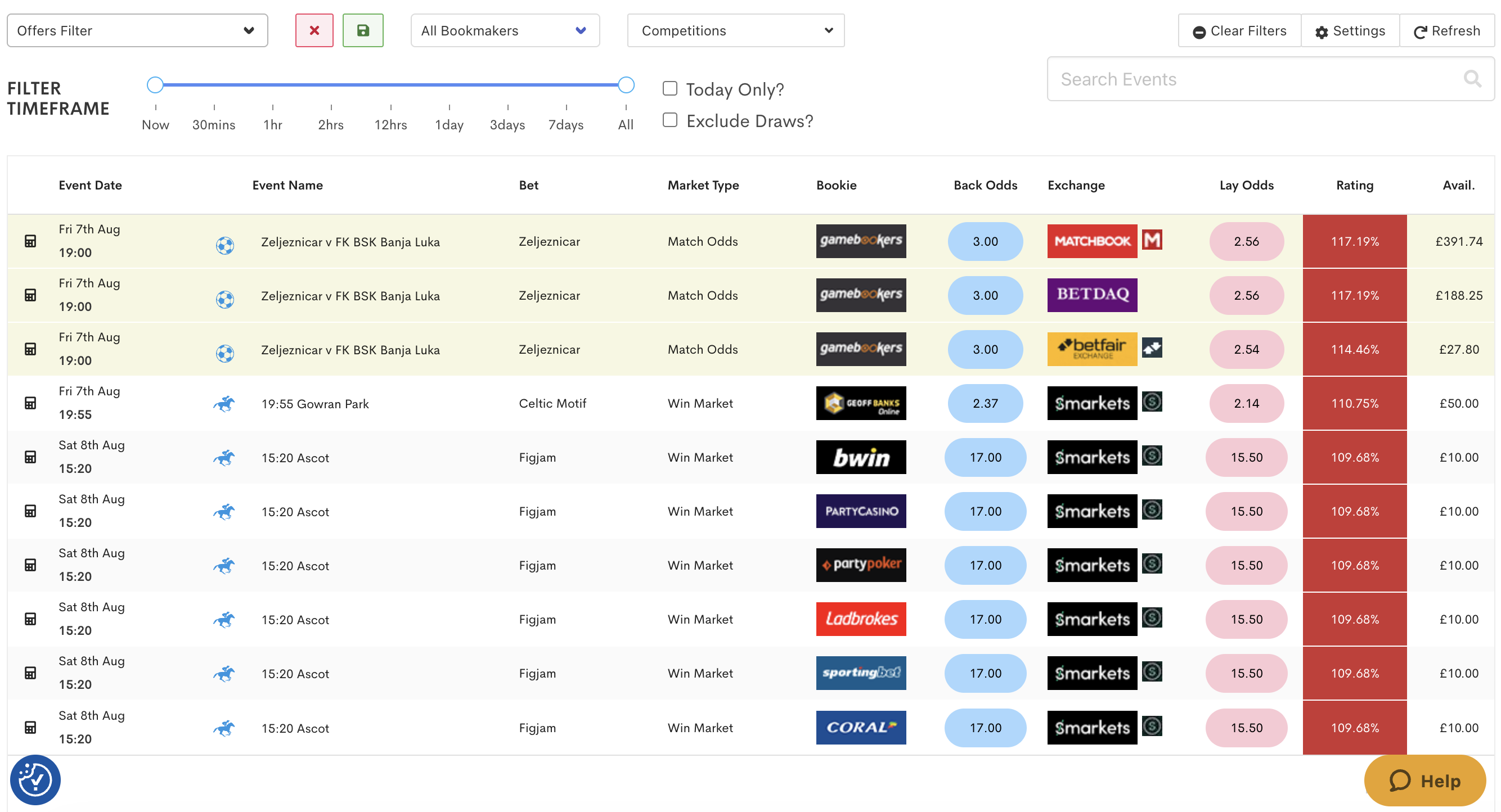
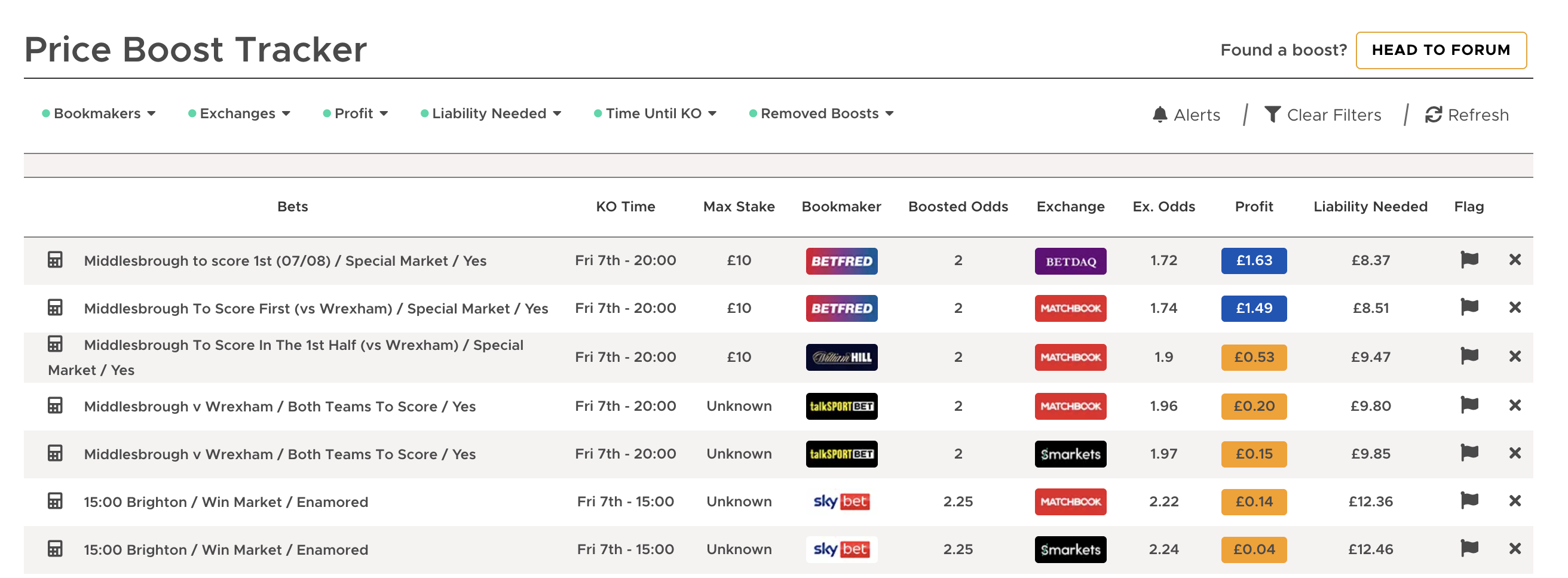
For Diamond members, the Price Boost Tracker is another fantastic tool that makes it a breeze to locate good price boosts that allow you to lock in an arbitrage bet - and one that’s far less likely to attract bookie attention than a standard arbitrage bet.
It’s updated all the time as price boosts are added by bookies, and it shows the current lay odds available with the main British exchanges, so you can see how much profit you stand to make (the profit shown is for a £10 bet, as price boost stakes are often limited to £10).
Summary
There’s no denying that arbitrage betting does carry some risks, and matched bettors should think carefully about how best to incorporate arbitrage betting into their strategy.
However, arbitrage betting has the potential to significantly improve your profits, especially if you’ve got gubbed accounts that aren’t currently making you any money.
And if you’re new to both arbitrage betting and Matched Betting, and you’re wondering how you can find out more, take a look at the Outplayed Beginner’s Guide to Matched Betting for all the information you need to get started.
Alternatively, if you’re raring to go and ready to get started, take out the Outplayed free trial to gain access to £850+ profit from over 40 sign up offers, completely free of charge.
sign up nowFAQs
1. Should I focus on Matched Betting or arbitrage betting?
As a general rule, we’d recommend focusing most of your efforts on Matched Betting, which tends to hold the greatest profit, especially at the start of your career when you’re completing sign up offers. However, it can be really helpful to throw in some arbitrage bets as you find them, especially on gubbed accounts, to help to tide you over when fewer offers are available.
2. Can bookmakers detect every arbitrage bet?
No - they have no way to be certain that any particular bet is an arb. However, they may suspect you of arbing if you place a bet on particularly favourable odds, especially if it’s on a less popular market, or on a sport you don’t typically bet on, and it can be quite easy for them to spot patterns of betting indicative of arbing.
3. Is arbitrage betting legal?
Absolutely - bookies may not like arbitrage betting, but it’s completely legal. After all, you’re simply taking a bookie up on the odds they have on offer.
4. Will arbitrage betting get my account limited?
Gubbings and account restrictions are a risk of arbitrage betting, especially if you exclusively bet on arbs. However, you can minimise this risk by betting on popular events, utilising price boosts, and mixing in mug bets to blend in better with regular punters.
5. How much money can arbitrage make me?
Usually, you won’t make a huge profit on any individual arbitrage bet - it’s fairly rare to make more than 10% of your back stake as profit. However, over time these small profits can add up to a significant amount, especially if you combine arbitrage betting with Matched Betting.
Updated: 11 Sep 2026
The Author
Stephanie is a published author and, having taken up Matched Betting fairly recently, she knows exactly how beginners feel when they first start Matched Betting. She loves breaking down complex subjects in straightforward terms to make them accessible to newcomers, and to speed them on their way to making their first profits.