
What Is Value Betting In Football?
11 min read
Stephanie Sorrell
30 Jul 2026

Quick answer: Value Betting involves placing bets at higher odds than the true probability of a win, resulting in a statistically profitable strategy in the long-term. In football, a Value Betting strategy would involve finding bets with positive expected value on football markets.
Football Value Betting Background
Ball games bearing some resemblance to modern football have been in existence for centuries, but the game (roughly) as we know it was standardised in the mid-19th century with the founding of the Football Association.
Since then, football has grown to become the most popular sport worldwide, with an estimated 250 million players active in over 200 countries and territories.
Betting on football has been popular for just as long - although for a long time it was dominated by bookies of dubious legitimacy. Nowadays, it’s perfectly legal, and a huge betting market in the UK and overseas.
Football Betting Stats
- Football generates £1.3b in Gross Gambling Yield (GGY) annually - Gambling Commission
- There are an estimated 250m active football bettors worldwide - GetStats.org.uk
- Roughly 23% of football fans in the UK bet on the sport - YouGov
- 14% of football bettors consistently stake at least £100 each month on sports bets - YouGov
The chief beneficiary of all that betting, though, is the bookies, who make vast fortunes from hopeful punters.
However, there is a statistically sound way to make money from football, which is known as Value Betting. This technique, employed by both professional sports bettors and experienced recreational bettors, involves finding and placing bets at higher odds than the likelihood of a win would imply - meaning that, in the long run, you can expect to end up in profit.
In this article, we’ll explain what Value Betting is, how it works in football, and the strategies and tools you can use to make a profit through Value Betting on football yourself.
Value Betting In Football
We know that Value Betting involves betting at higher odds than the real likelihood of a win would imply - but how exactly does that work?
Well, a bet with higher odds than the true probability of a win would imply results in positive expected value. While that bet isn’t guaranteed to win, you would expect to end up with a profit if you placed a large number of similar bets long term.
This is a very different technique from Matched Betting, where you know in advance what your profit will be from each bet, meaning that you aren’t facing any real risk in your betting activity, except that of making an error.
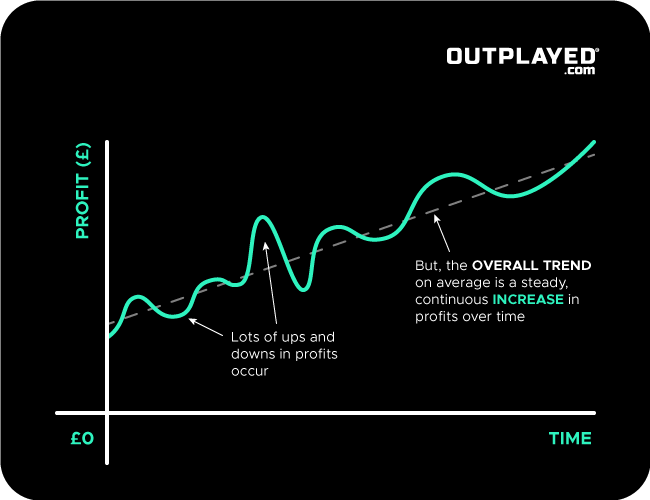
Value Betting does involve risk. Although you would expect to end up in profit in the long term, in the short term you will see upswings and downswings, which you need to be able to weather.
We therefore don’t recommend Value Betting as a strategy unless you’re an experienced matched bettor or sports bettor and you have a good starting bankroll, of around £1000 or more.
When it comes to Value Betting on football specifically, there are a number of strategies you can use to extract profit from the bookies. The most basic involves simply identifying bets whose true probability is higher than the odds would imply, perhaps because of conditions the bookie hasn’t accounted for, or a last minute change to the line-up for a match.
The main problem with this method, other than the difficulty of identifying those bets in the first place, is that bookies tend to be aware of when their odds have been higher than they should be, and consistently betting at those inflated odds is a surefire way to attract a bookie’s attention, risking a swift gubbing.
But there are other, subtler football Value Betting methods out there, which we’ll delve into later on.
How To Identify Football Value Bets
Value Betting hinges on the concept of ‘implied probability’, which refers to the fact that any set of odds can be used to indicate the probability of an outcome occurring. For example, odds of 2 (1/1 or evens in fractional odds) indicate a 50% chance of that outcome occurring, whereas odds of 4 (3/1 in fractional odds) indicate a 25% chance of that outcome occurring.
| Decimal odds | Fractional odds | Implied probability |
|---|---|---|
| 1.2 | 1/5 | 83.3% |
| 1.5 | 1/2 | 66.7% |
| 1.8 | 4/5 | 55.6% |
| 2 | 1/1 (evens) | 50% |
| 3 | 2/1 | 33.3% |
| 5 | 4/1 | 20% |
| 10 | 9/1 | 10% |
| 15 | 14/1 | 6.7% |
| 20 | 19/1 | 5% |
Of course, the fact that a bet is listed at odds of 4 with a bookie doesn’t mean that its true chance of winning is actually 25%, because probability isn’t the only factor used by bookies to determine their odds.
Normally, a bookie’s odds will be lower than the true probability of a win, allowing for their profit margin. Sometimes, though, a bookie might not have adjusted their odds to account for changes to the true probability of an outcome, or they might not be aware of a factor affecting it.
Expert Insight
Many bettors overestimate how much team reputation predicts match outcomes. Football is a low-scoring sport where small factors—tactical changes, player availability and schedule congestion—can shift probabilities more than public perception, creating opportunities before prices fully adjust.
For example, you might have good reason to believe that a team’s true chance of winning a match is 20%, which equates to odds of 5 (4/1 in fractional odds), sometimes known as 'true odds'. If, therefore, you managed to find a bookie offering odds of 6, you would have a bet that holds positive expected value.
Of course, you’d still expect your bet to lose 4 times out of 5, so you wouldn’t expect to make a profit from any individual bet. However, in the long run, betting at those odds and with this true probability of a win would statistically result in a profit.
If you placed 100 such bets with stakes of £10 each, you’d expect 20 of them to win and 80 to lose. On your losing bets, you’d therefore lose £800, but your winning bets would win you £1000 - meaning you’d have made an overall profit of £200.
| Number of bets | Stake per bet | Odds | True odds | Outcome | |
|---|---|---|---|---|---|
| Losing bets | 80 | £10 | 6 | 5 | -£800 |
| Winnings bets | 20 | £10 | 6 | 5 | +£1000 |
| Overall outcome | +£200 |
On this basis, each individual bet’s expected value would be £2 (even though it wouldn’t be possible actually to make £2 in profit from any single bet at these odds).
This illustrates exactly why Value Betting works in the long term - but it does rely on your placing a large volume of bets over time. You’ll see ups and downs, but the more bets you place, the more closely your total profit will reflect the expected value of all the bets you’ve placed.
Examples Of Football Value Bets
Successful Value Betting in football requires extensive research. You need to know everything there is to know about the players, grounds, coaches and performance history of both teams involved in any given match.
This probably means compiling your own statistical database and using this information to calculate the ‘true’ probability of any outcome in a match (ideally including as many markets as possible, such as total goals, handicap markets, and individual player markets), and then converting those probabilities into the true odds for each outcome.
Having done so - and assuming your results are accurate - you can then compare these true odds to those available at the bookies.
You’ll end up with something along the lines of the following - as an example, we’ll look at a basic 1X2 market:
| Outcome | Win for Brighton | Draw | Win for Newcastle |
|---|---|---|---|
| Bookie odds (implied probability) | 2.4 (41.7%) | 3.6 (27.8%) | 2.7 (37%) |
| True odds (implied probability | 2.77 (36.1) | 3.4 (29.4%) | 2.9 (34.5) |
As we can see, the available odds with the bookie for a win for either team are lower than the true odds, which is what we’d expect, as the bookies make their money by adding a margin onto their odds.
However, a draw is available at higher odds than we’ve calculated as the true odds, making for a Value Betting opportunity.
As this is the least likely of the three outcomes, we won’t be expecting to win this particular bet - but it still makes a valuable part of a long term Value Betting strategy. 29.4% of the time we would expect it to win, with those winnings being high enough to make up for the 70.6% of the time when it loses.
We can calculate the expected value of this bet by multiplying each possible outcome of the event by its probability of occurring, then adding up all those results.
For a £10 stake at odds of 3.6, you would win £26 on a successful bet, and lose your £10 stake if it lost. The EV can therefore be calculated as follows:
EV = (0.294 x £26) + (0.706 x -£10) = £7.64 - £7.06 = £0.58
This isn’t a huge amount of expected value, but Value Betting involves placing bets in such high volume that, over time, these small profits mount up to create very significant cumulative profit overall.
Expert Insight
One of the biggest mistakes football value bettors make is judging their edge by short-term results. The quality of your pricing model and your discipline in recording every bet matter far more than whether your last ten wagers happened to win or lose.
Different Football Value Betting Strategies
The basic principles of Value Betting in football are pretty simple, and it’s perfectly possible just to use your extensive research to work out the true odds for a match, and then manually look for bookies offering better odds.
However, there are other strategies and tools out there to make this process easier and less time-consuming.
Steam Chasing
This is an advanced technique employed by many professional sports bettors. It involves looking for bets whose prevailing odds have suddenly dropped significantly, which usually indicates a change in circumstances affecting the true likelihood of a particular outcome. This sudden drop is what’s known as ‘steam’.
If you’re able to detect this change before the mainstream bookies do, you’ve got a small window of opportunity to place a bet at the original higher odds before a particular bookie drops them.
Because this strategy relies on swift action, it can be incredibly difficult to do manually. However, Outplayed’s market-leading Steam Chaser, available with Outplayed Elite, solves this problem by doing all the hard work of tracking down suitable bets on your behalf.
As well as football, the Steam Chaser can be used on a range of other sports, including tennis and American football, and works with any bookie worldwide.
We would note, though, that steam chasing is a high risk strategy, and that we therefore recommend it only to experienced value bettors with a significant starting bankroll of at least £2000.
2UPs
Strictly speaking, taking advantage of 2UP offers isn’t a purely Value Betting strategy, but something of a combination of Matched Betting and Value Betting techniques. However, it can be a fantastic way of profiting from football betting, and a great addition to an overall Value Betting strategy.
Certain bookies offer 2UP early payout offers - where your bet is paid out if your team goes 2 goals up, even if they fail to eventually win the match.
By matching a 2UP bet, we get the opportunity to potentially win both our back and lay bets, if our team goes 2 goals up and subsequently fails to win.
Admittedly, this is a pretty rare phenomenon - but it happens frequently enough to make a 2UP strategy worthwhile.
Outplayed’s 2UP Master, available with Outplayed Pro, is the ideal tool to help you track down the best value 2UP bets. It identifies bets where the possibility of a full turnaround (where your team goes 2 goals up but doesn’t win) is sufficiently high to make the initial qualifying loss from your matched bet worthwhile.

A full turnaround (FTA) might happen only around 2% of the time - but the profits when it does are more than enough to make 2ups a fantastic long term strategy, with the potential to add hugely to your football betting profits.
Football Value Betting Vs Other Value Bets
In some ways, football can be a bit tricky for Value Betting, requiring extensive research and painstaking record-keeping if you decide to go it alone.
But with the help of Outplayed’s Pro and Elite tools, you can use football to add hundreds of pounds to your Value Betting profits, making football an essential part of your Value Betting strategy.
To find out more about our Value Betting tools, take a look at our guide to Outplayed Pro, which takes you through our advanced Matched Betting and Value Betting tools that can help you maximise your sports betting profits, month after month after month.
Lean more about value bettingFAQs
1. How does Value Betting work in football?
As with any other sport, Value Betting in football involves placing bets on football markets at odds that are higher than the true probability of a win would imply.
2. Is Value Betting on football beginner-friendly?
While it's certainly possible to embark on a Value Betting strategy as a newcomer to football sports betting, we'd recommend starting with Matched Betting to build your experience and bankroll before moving on to more advanced techniques.
3. Is Value Betting on football legal?
Yes, it's absolutely legal - all it involves is taking a sportsbook up on the odds they're offering. However, bookies aren't too keen on value bettors, who threaten their profit margins, so there is a possibility of being subbed if your Value Betting is too obvious.
4. What software does Outplayed offer for Value Betting on football?
The Steam Chaser and 2UP Master are Outplayed main football Value Betting tools - and we also offer a range of other tools designed to make both Matched Betting and Value Betting as easy as possible, across a wide range of sports.
5. How do I get started?
Sign up for a free trial, or alternatively dive right in with an Outplayed Pro membership if you're keen to get going with Value Betting right away.
Updated: 28 Aug 2026