
Value Betting In Horse Racing
.png&w=3840&q=75)
What Is Value Betting In Horse Racing?
Quick answer: Horse racing Value Betting is a long-term betting strategy that focuses on finding horses priced at higher odds than their true chance of winning. Rather than trying to predict every winner, successful value bettors aim to repeatedly place positive expected value (+EV) bets where the bookmaker has underestimated a horse's probability. Although individual bets regularly lose, consistently identifying value opportunities can produce profitable results over hundreds or thousands of bets.
Horse Racing Value Betting Background
Horse racing is one of the world’s oldest sports, going back thousands of years - and betting on horse racing has been going on, in one form or another, for almost as long.
Nowadays, there are horse races year round in the UK, with some festivals in particular, such as Cheltenham, attracting huge attention, both from bookies and the public.
📊 What the Data Says
"The UK Gambling Commission's latest Gambling Survey found that betting participation rose to 12.4% during a period covering major sporting events, while betting on horses or dogs increased from 3.9% to 6.6%. This highlights how major horse racing festivals drive significant betting activity, making efficient pricing even more important for value bettors."
Naturally, the chief object of anyone placing bets on horse racing is to turn a profit, but that’s not nearly as simple as it sounds. Bookies set their odds in such a way as to always make a profitable margin on the bets they take - meaning that punters will always end up losing money overall.
However, there is a statistically sound way to make money from horse racing, which is known as Value Betting. This technique, employed by both professional sports bettors and experienced recreational bettors, involves finding and placing bets at higher odds than the likelihood of a win would imply - meaning that, in the long run, you can expect to end up in profit.
In this article, we’ll explain what Value Betting is, how it works in horse racing, and the strategies and tools you can use to make a profit through Value Betting on horse racing yourself.
Value Betting In Horse Racing
We know that Value Betting involves betting at higher odds than the real likelihood of a win would imply - but how exactly does that work?
Well, a bet with higher odds than the true probability of a win would imply results in positive expected value. While that bet isn’t guaranteed to win, you would expect to end up with a profit if you placed a large number of similar bets long term.
This is a very different technique from Matched Betting, where you know in advance what your profit will be from each bet, meaning that you aren’t facing any real risk in your betting activity, except that of making an error.
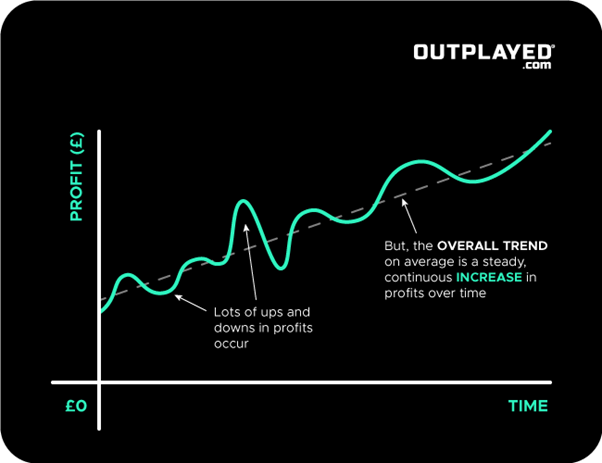
Value Betting does involve risk. Although you would expect to end up in profit in the long term, in the short term you will see upswings and downswings, which you need to be able to weather.
We therefore don’t recommend Value Betting as a strategy unless you’re an experienced matched bettor or sports bettor and you have a good starting bankroll, of around £1000 or more.
When it comes to Value Betting on horse racing specifically, there are a number of strategies you can use to extract profit from the bookies. The most basic involves simply identifying bets whose true probability is higher than the odds would imply, perhaps because of conditions the bookie hasn’t accounted for, or a last minute change to the competitors in a race.
The main problem with this method, other than the difficulty of identifying those bets in the first place, is that bookies tend to be aware of when their odds have been higher than they should be, and consistently betting at those inflated odds is a surefire way to attract a bookie’s attention, risking a swift gubbing.
But there are other, subtler horse racing Value Betting methods out there, which we’ll delve into later on.
How To Identify Horse Racing Value Bets
Value Betting hinges on the concept of ‘implied probability’, which refers to the fact that any set of odds can be used to indicate the probability of an outcome occurring. For example, odds of 2 (1/1 or evens in fractional odds) indicate a 50% chance of that outcome occurring, whereas odds of 4 (3/1 in fractional odds) indicate a 25% chance of that outcome occurring.
| Decimal Odds | Fractional Odds | Implied Probability |
| 1.2 | 1/5 | 83.3% |
| 1.5 | 1/2 | 66.7% |
| 1.8 | 4/5 | 55.6% |
| 2 | 1/1 (evens) | 50% |
| 3 | 2/1 | 33.3% |
| 5 | 4/1 | 20% |
| 10 | 9/1 | 10% |
| 15 | 14/1 | 6.7% |
| 20 | 19/1 | 5% |
Of course, the fact that a bet is listed at odds of 4 with a bookie doesn’t mean that its true chance of winning is actually 25%, because probability isn’t the only factor used by bookies to determine their odds.
Normally, a bookie’s odds will be lower than the true probability of a win, allowing for their profit margin. Sometimes, though, a bookie might not have adjusted their odds to account for changes to the true probability of an outcome, or they might not be aware of a factor affecting it.
💬 Expert Insight
One of the biggest mistakes bettors make is assuming every price bigger than their own estimate represents value. The edge comes from having a probability model that consistently outperforms the market, not from disagreeing with the bookmaker for the sake of it. Small but repeatable pricing advantages are far more valuable than chasing spectacular-looking odds.
For example, you might have good reason to believe that a horse’s true chance of winning a race is 20%, which equates to odds of 5 (4/1 in fractional odds), sometimes known as 'true odds'. If, therefore, you managed to find a bookie offering odds of 6, you would have a bet that holds positive expected value.
Of course, you’d still expect your bet to lose 4 times out of 5, so you wouldn’t expect to make a profit from any individual bet. However, in the long run, betting at those odds and with this true probability of a win would statistically result in a profit.
If you placed 100 such bets with stakes of £10 each, you’d expect 20 of them to win and 80 to lose. On your losing bets, you’d therefore lose £800, but your winning bets would win you £1000 - meaning you’d have made an overall profit of £200.
| Number of bets | Stake per bet | Odds | True odds | Outcome | |
| Losing bets | 80 | £10 | 6 | 5 | -£800 |
| Winning bets | 20 | £10 | 6 | 5 | +£1,000 |
| Overall outcome | +£200 |
On this basis, each individual bet’s expected value would be £2 (even though it wouldn’t be possible actually to make £2 in profit from any single bet at these odds).
This illustrates exactly why Value Betting works in the long term - but it does rely on your placing a large volume of bets over time. You’ll see ups and downs, but the more bets you place, the more closely your total profit will reflect the expected value of all the bets you’ve placed.
Examples Of Horse Racing Value Bets
Successful Value Betting in horse racing requires extensive research. You need to know everything there is to know about the horses, courses, trainers and jockeys involved in any given race.
This probably means compiling your own statistical database and using this information to calculate the ‘true’ probability of a win for all competitors in a race, and then converting those probabilities into the true odds for each horse.
Having done so - and assuming your results are accurate - you can then compare these true odds to those available at the bookies.
📊 What the Data Says
"British racecourses attracted 4,799,730 spectators during 2024, according to the British Horseracing Authority. Large, competitive racing markets generate vast amounts of betting activity, making accurate pricing and probability assessment increasingly important for bettors searching for value."
- British Horse Racing Authority
You’ll end up with something along the lines of the following:
| Horse | Action Pact | Dreams Adozen | Diamond de Vindecey | Fauleux du Clos | Ruler Legend |
| Bookie odds (implied probability) | 2.75 (36.4%) | 3.25 (30.8%) | 5 (20%) | 5 (20%) | 41 (2.4%) |
| True odds (implied probability) | 2.81 (35.6%) | 4 (25%) | 5.5 (18.2%) | 5.5 (18.2%) | 33 (3%) |
As we can see, for most of the runners the odds available from the bookie are lower than the true odds, which is what we’d expect, as the bookies make their money by adding a margin onto their odds .
However, Ruler Legend is available at significantly higher odds than we’ve calculated as the true odds, making for a Value Betting opportunity.
As the true odds are high, we certainly won’t be expecting to win this particular bet - but it still makes a valuable part of a long term Value Betting strategy. 3% of the time we would expect it to win, with those winnings being high enough to make up for the 97% of the time when it loses.
We can calculate the expected value of this bet by multiplying each possible outcome of the event by its probability of occurring, then adding up all those results.
For a £10 stake at odds of 41, you would win £400 on a successful bet, and lose your £10 stake if it lost. The EV can therefore be calculated as follows:
EV = (0.03 x £400) + (0.97 x -£10) = £12 - £9.70 = £2.30
Different Horse Racing Value Betting Strategies
Although the basic principles of Value Betting are relatively straightforward, there are more complex strategies you can employ, beyond simply looking for singles bets at inflated odds.
These have the benefits of making your Value Betting activity less obvious to a bookie, which will help your accounts stay healthier for longer.
💬 Expert Insight
The strongest long-term value betting strategies rarely rely on a single market or bet type. Spreading your activity across win, each-way and other racing markets not only creates more opportunities, but also produces betting patterns that more closely resemble those of recreational punters, helping maintain account longevity.
Place Markets (Each Way Bets)
Bookies will offer a certain number of paid places on horse racing bets, depending on the number of runners involved. When you place an each way bet, you’re placing two separate bets in one, both on a horse to win and to hit one of the paid places.
This type of bet can be particularly profitable for Value Betting, because bookies set the odds for places at a certain fraction of the win odds (usually 1/4 or 1/5), rather than separately assessing a horse’s chances of hitting a paid place.
It’s therefore often possible to make each way bets that hold fantastic expected value in the place part of the bet, without inflated win odds that attract the bookie’s attention.
While it’s certainly possible, through extensive research and statistical analysis, to locate each way value bets for yourself, Outplayed’s powerful Extra Place Master is a total game-changer.
Using our proprietary algorithms, it analyses all runners to produce reliable true odds for each race and compares these to the odds available at the bookies. Whenever a bet holds positive expected value, it will appear on your results, making it a matter of seconds to click through to the bookie and place your bet.
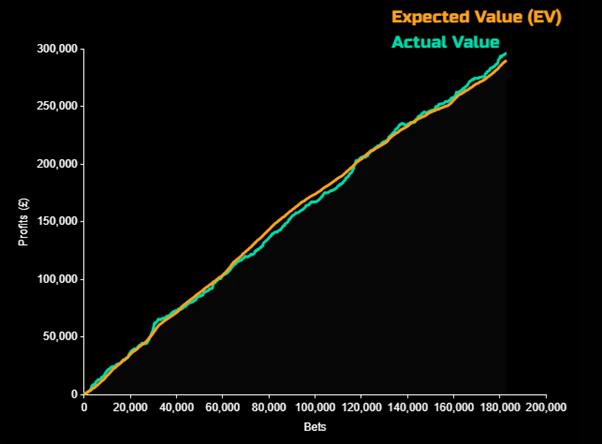
The Extra Place Master is responsible for tens of thousands of profits in horse racing Value Betting for Outplayed Pro members.
Here's a real example of our members results from using the Extra Place Master.
Accumulators (Lucky15s)
Another particularly valuable Value Betting horse racing strategy is to take advantage of each way accumulator bets, such as Lucky 15s. This is a bet made up of 15 individual bets across 4 selections, as follows:
- 4 singles
- 6 doubles
- 4 trebles
- 1 four-fold
When placed each way, you get a total of 30 individual bets all rolled into one.
Because this type of accumulator bet often involves additional bonuses from the bookies, this strategy takes the benefits of simple each way bets and multiplies them, resulting in betslips that hold incredibly high value.
Again, it is possible to do all the research required to identify accumulator horse racing bets with value manually, but Outplayed’s tools make this process a matter of seconds rather than hours.
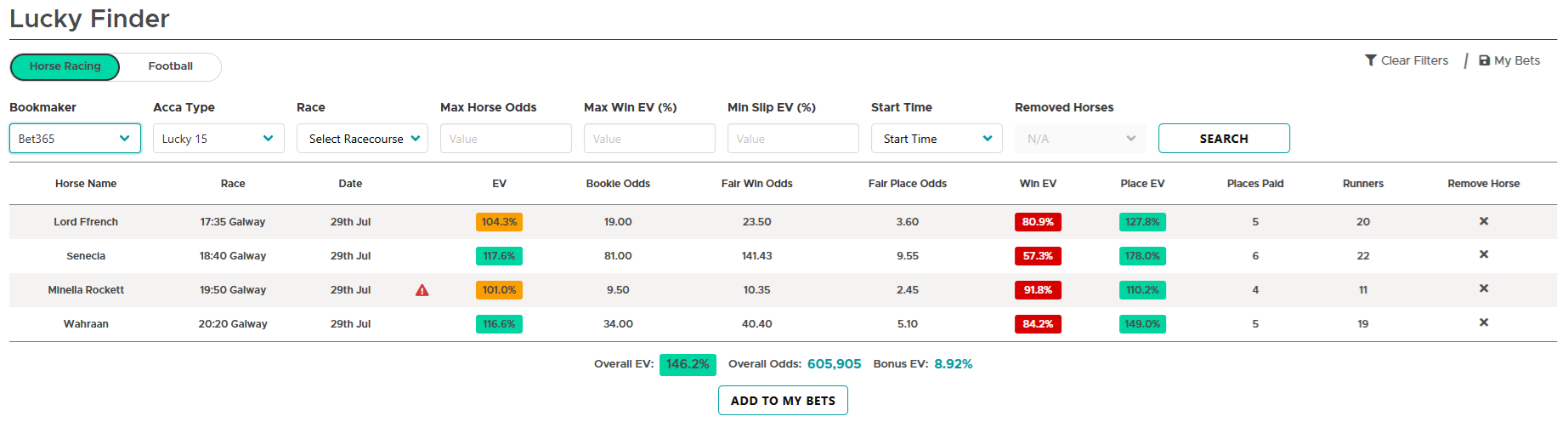
The Lucky Finder, available with an Outplayed Pro subscription, puts together each way Lucky 15 bets with positive expected value on your behalf - all you have to do is add the selections to your betslip with the bookie and then place your bet.
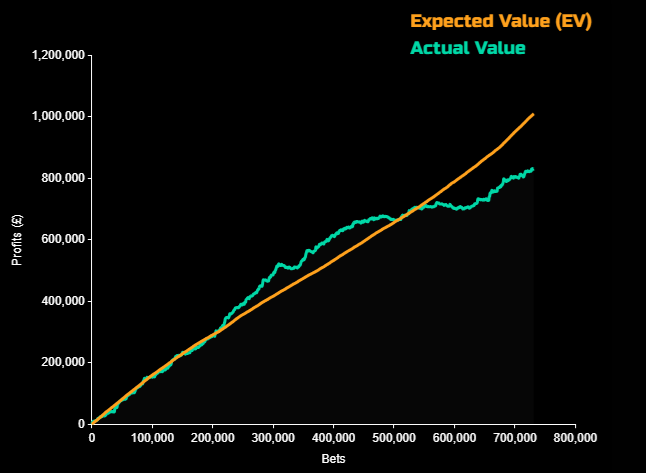
Once again, this tool is responsible for tens of thousands of pounds of profit for Outplayed members. Although there will be ups and downs in your profit from day to day, and even month to month, over time it’s highly likely that your total profit will match your total EV pretty closely, as you can see in our member profit graph below.
Here's a real example of our members results from using the Lucky Finder.
Horse Racing Value Betting Vs Other Value Bets
Horse racing Value Betting is one of the most popular types of Value Betting because, with the help of Outplayed’s tools, it’s particularly easy to place enough bets to start seeing profits relatively quickly.
But there are other forms of Value Betting out there, on other sports such as golf and football, and using other strategies.
| Strategy | Risk | Long-Term Profit | Uses Promotions |
| Matched Betting | Very Low | Yes | Yes |
| Arbitrage Betting | Low | Yes | No |
| Value Betting | Medium-High | Potentially | No |
If you’re a matched bettor considering taking up Value Betting, horse racing Value Betting is one of the best places to start, especially if you’re an Outplayed Pro member.
The process of placing and tracking your bets is incredibly straightforward, both with the Extra Place Master and the Lucky Finder, and both types of bets can actually benefit your account health, helping to balance out your Matched Betting activity and avoid being gubbed for longer.
In short, Value Betting on horse racing is one of the best ways to start as a new value bettor, so long as you’re already an experienced matched bettor with a good bankroll to get you going.
To find out more about our Value Betting tools, take a look at our guide to Outplayed Pro, which takes you through our advanced Matched Betting and Value Betting tools that can help you maximise your sports betting profits, month after month after month.
Common Mistakes New Horse Racing Value Bettors Make
New value bettors often focus too heavily on finding winners rather than identifying value. Other common mistakes include overestimating their own probability assessments, failing to manage their bankroll, chasing losses after inevitable losing streaks, and placing too few bets for expected value to work over the long term. Successful value betting depends on consistency, discipline and accurate probability modelling rather than short-term results.
Learn More About Value BettingReady To Find Horse Racing Value Bets Faster?
Estimating probabilities manually can take hours of research for every race. Outplayed helps simplify the process with expected value calculators, implied probability tools, betting trackers and educational resources designed to help UK bettors identify potential value betting opportunities more efficiently.
Sign up for a free trial, or alternatively dive right in with an Outplayed Pro membership if you're keen to get going with Value Betting right away.
Get Started Today With A Free TrialFrequently Asked Questions About Horse Racing Value Betting
Is value betting in horse racing profitable?
Yes, value betting can be profitable over the long term if you consistently place bets where the odds are higher than the true probability of a horse winning. Individual bets can lose, but a disciplined approach across hundreds or thousands of bets aims to produce positive returns over time.
How do you identify value bets in horse racing?
Value bets are found by comparing your estimated probability of a horse winning with the bookmaker's implied probability. If your assessment suggests a horse has a better chance than the odds indicate, the bet may have positive expected value (+EV).
Is horse racing value betting the same as matched betting?
No. Matched betting uses sportsbook promotions and opposing bets to generate predictable profits with minimal risk when executed correctly. Horse racing value betting involves accepting short-term variance in pursuit of long-term profitability through positive expected value bets.
How much bankroll do I need for horse racing value betting?
A larger bankroll is generally recommended because losing streaks are a normal part of value betting. Many experienced bettors suggest starting with enough funds to comfortably withstand variance while following a consistent staking strategy.
Can beginners make money from horse racing value betting?
Beginners can learn value betting, but success requires patience, bankroll management, and an understanding of probability. Many new bettors benefit from using value betting software and learning the fundamentals before risking significant amounts.
What is implied probability in horse racing betting?
Implied probability is the percentage chance of an outcome based on the bookmaker's odds. Converting odds into probability helps you determine whether a horse is priced fairly or whether the available odds may represent betting value.
What types of horse racing bets offer the best value opportunities?
While win bets can provide value, many experienced bettors also look at each-way bets, extra place promotions, and selected accumulator bets. These markets can occasionally present pricing inefficiencies that create positive expected value opportunities.
Do professional bettors use value betting?
Yes. Value betting is widely regarded as one of the core principles used by professional sports bettors. Rather than trying to predict every winner, professionals focus on consistently backing selections whose odds are greater than their estimated true probability.
Is value betting legal in the UK?
Yes. Value betting is completely legal in the United Kingdom. However, bookmakers may choose to restrict or limit accounts they believe are consistently profitable.
Can sportsbooks restrict accounts for value betting?
Yes. Some bookmakers may limit stakes, restrict promotions, or close accounts if they identify consistently profitable betting patterns. This is a commercial decision by the bookmaker rather than an indication that value betting is against the rules.
What tools help with horse racing value betting?
Many bettors use odds comparison software, expected value calculators, probability models, race databases, and betting trackers to identify opportunities more efficiently. These tools can speed up research and help maintain consistency, although they cannot guarantee profits.
Updated: 11 Sep 2026
The Author

Paul brings over four years of Matched Betting experience to Outplayed. His extensive background in financial services and e-commerce, combined with his expertise in online marketing and Matched Betting, makes him a valuable asset to the team.