
A Complete Guide To Dutching Betting Strategies
12 min read
Stephanie Sorrell
28 Oct 2026

Quick answer: dutching can be a useful alternative to traditional Matched Betting, as well as a potentially profitable strategy in its own right. Some bettors may focus their dutching strategy on creating arbitrage bets, or improving their chances of winning on horse racing or football markets with a large number of outcomes.
Dutching as a betting strategy has a long history - it’s thought to date back all the way to the 1920s or ‘30s, when a New York gangster known as ‘Dutch Schultz’ probably pioneered the strategy alongside his more straightforward criminal activities.
Nowadays, Matched Betting is the more common choice for those who hope to make money from sports betting while limiting risk, but there is still a place for dutching in the smart bettor’s toolbox.
In this article, we’ll explain how dutching works, when it can be of use, and what the best strategies are to make the most of dutch bets.
What Is Dutching?
For a full breakdown of how dutching works, check out our dedicated guide - but for now, we’ll talk you through dutching in a nutshell.
Dutching is the practice of placing bets on multiple outcomes within a single market (across different bookmakers) in order to increase the likelihood of a win.
In some cases, you may be able to cover all possible outcomes within that market, while in others (e.g. in horse racing) you may only cover a few possible outcomes.
Ideally, you’ll find odds and place your bets in such a way that you’ll make a profit if any of them wins. In some situations, though, such as if you’re trying to qualify for an offer as part of a Matched Betting strategy, you may be happy to accept a small loss on your dutched bet.
Types of dutching
There are three main sub-categories of dutching:
- Equal stakes dutching. This involves placing the same stake on all the selections you bet on, meaning that your profit will vary depending on which of your bets wins.
- Equal profit dutching. You adjust your stake according to the odds of each selection in order to produce the same (or roughly the same) profit no matter which wins. Of course, if you leave some selections uncovered, it’s possible that none of your bets will win.
- Covering all outcomes (arbitrage). If the odds make it worth your while, you can bet on all selections within a market and come out with a profit no matter which wins. This is a form of arbitrage.
An example of a dutch bet
You notice that a particular bookie (let’s call them Bookie A) is offering surprisingly good odds of 2.4 on the ‘Both Teams To Score - Yes’ market for an upcoming Premier League match between Arsenal and Leeds, and wonder if any other bookies are offering favourable odds on the opposing market.
You use Oddschecker to check the best available odds on ‘Both Teams To Score - No’, and find odds of 1.8 with another bookie (Bookie B), which are good enough to make a profit if you dutch your bet between those two bookies.
Using a Dutching Calculator like Outplayed’s, you work out the optimal stakes to produce a profit regardless of whether both teams do indeed score.
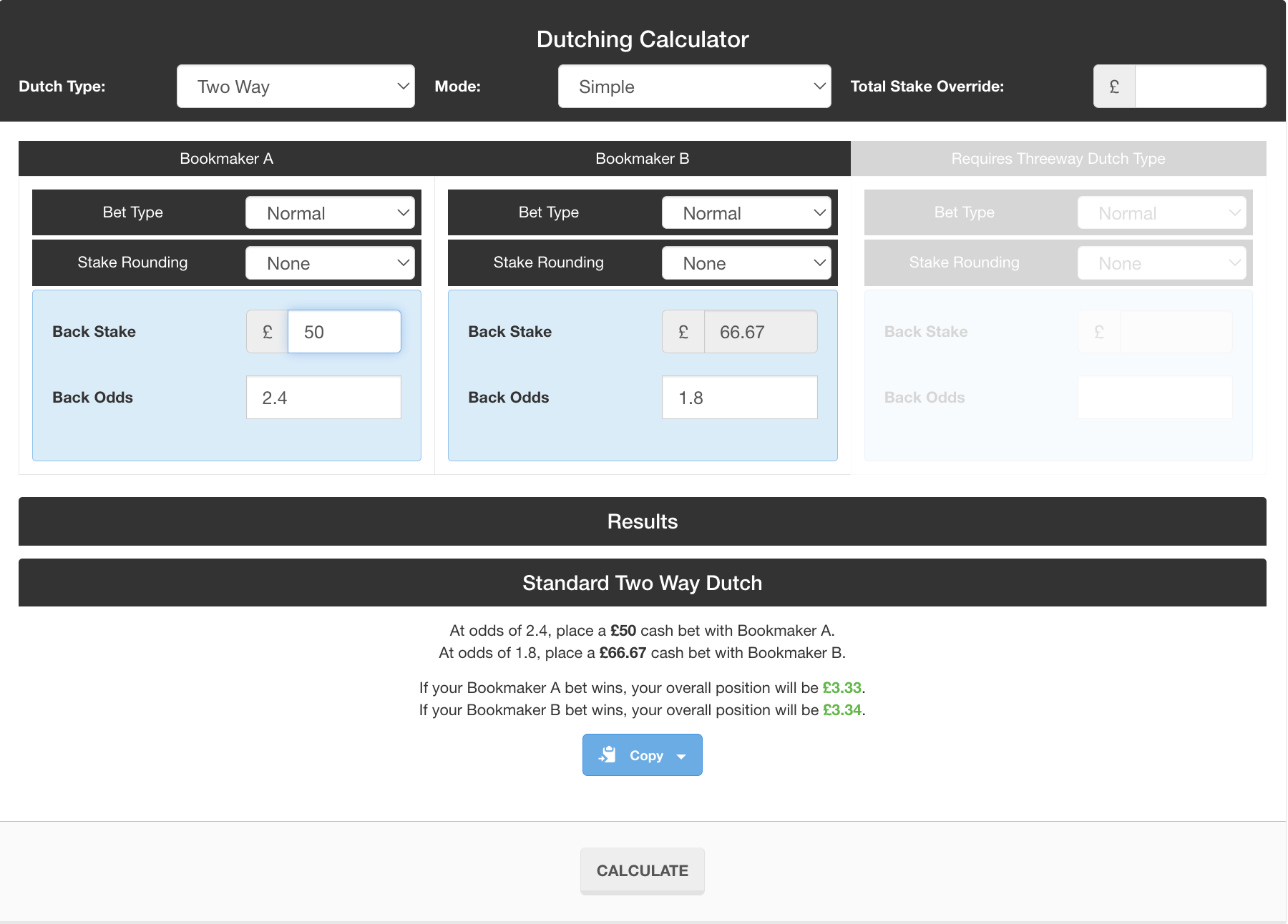
If you place a bet of £50 with Bookie A, you can lock in a profit of around £3.33 if you place a bet of £66.67 with Bookie B. However, it may be wise to round your stake up to the nearest £1 to avoid suspicious-looking stake sizes with Bookie B.
Using Advanced Mode on the calculator, you can adjust your stake to a rounder number while still protecting your profit.
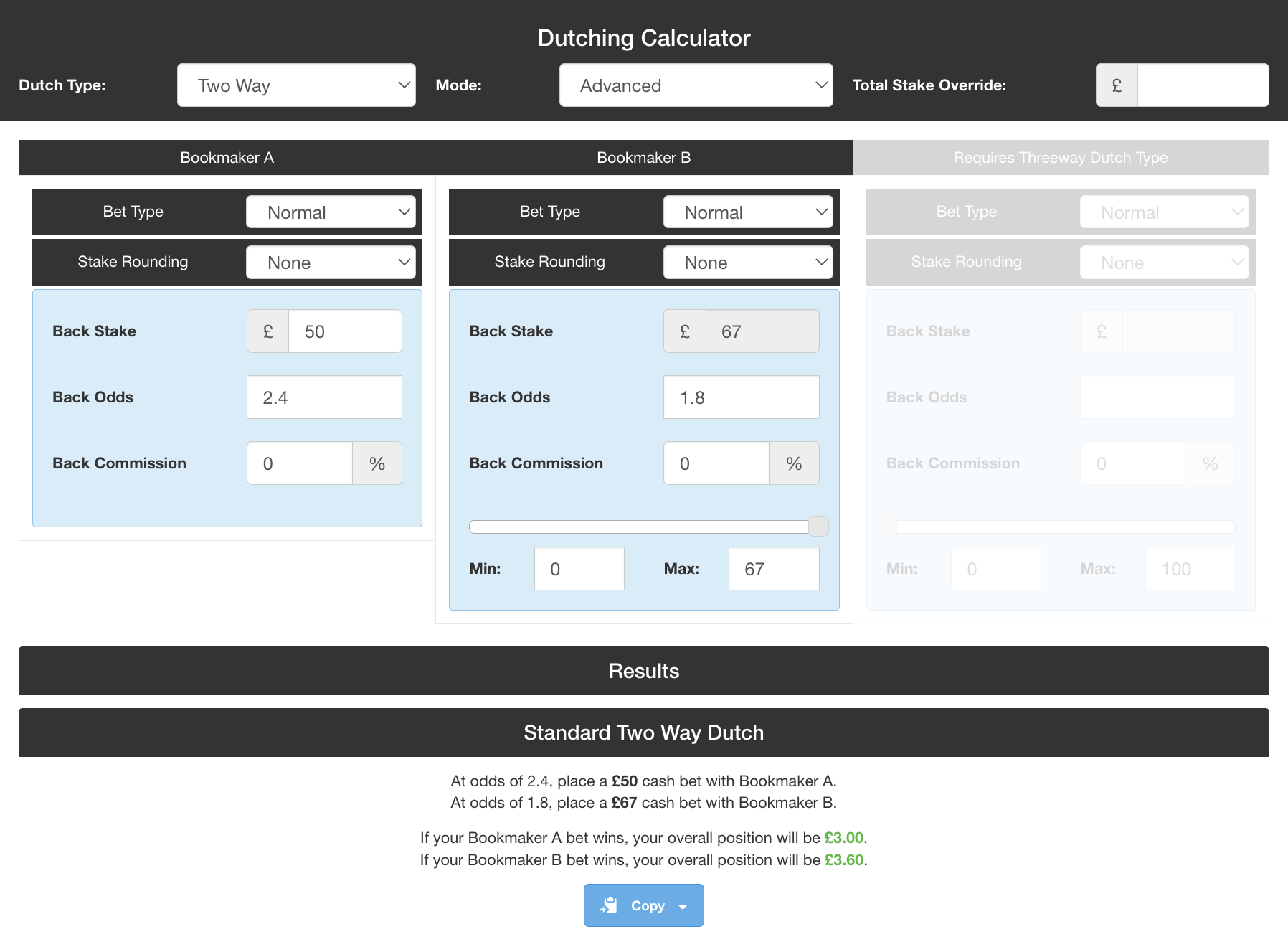
Although we have slightly adjusted our stakes, we’ve used the Equal Profit model of dutching, as well as covering all outcomes, making this particular dutch bet an arbitrage bet.
What Are The Best Dutching Betting Strategies?
Depending on your tolerance of risk and your aims, there are a few different dutching strategies you may choose to employ when betting on sports.
If you’re a matched bettor, you’re likely to use dutching in situations where a traditional matched bet may be less effective or leave you open to risk. If so, you’ll probably choose to cover all outcomes.
If you’re a recreational sports bettor, meanwhile, you may decide to dutch your bet in order to increase your chances of a win, without necessarily covering all outcomes.
Dutching as part of a Matched Betting strategy
In some circumstances, it may be easier or safer to dutch your bet when Matched Betting than it is to lay it with a betting exchange, either for a qualifying bet or a free bet. There are a few situations when this is likely to be the case:
- Betting on the match winner market in tennis. Tennis retirement rules vary between bookmakers and betting exchanges, which can make this market problematic for Matched Betting - it’s often the case that no betting exchange’s rules line up with a bookmaker’s.
In this situation, it can be safer to dutch your bet with another bookmaker who falls into the same group (check our dedicated post regarding tennis retirement rules for the full list), so you can be sure that there’s no risk of a mismatch.
- Limited availability of liquidity at exchange. For less popular events, or for events some way in the future, there may not be much liquidity available at any betting exchange, making it impossible to lay your bet at acceptable odds.
If so, you may find that dutching your bet with another bookmaker produces a more profitable outcome, whether you’re placing a qualifying bet or a free bet.
- High liability required at exchange. If you’re betting at high odds, or having to match a bet with a large stake size, the liability required to match your bet can be very high.
If you don’t have enough funds at the betting exchange to cover it, or if you’re just reluctant to tie up a high proportion of your bankroll for a single bet, you may decide to see if you can dutch your bet instead, to keep more of your money available for use.
If any of these situations apply, you can use a dutching calculator like Outplayed’s to work out your ideal stakes as well as your resulting qualifying loss or profit.
Dutching to create an arbitrage bet
If you’ve located especially favourable odds on opposing markets between two (or more) bookmakers, it may be possible to create a bookmaker-bookmaker arbitrage bet through dutching.
Again, you’ll need to use a dutching calculator to work out your stakes so that you make a profit no matter what happens in the event.
You should also be aware that in situations where you’ve found a potential dutch arbitrage bet, it’s likely to be possible to simply lay your bet at a betting exchange for a similar (or higher) level of profit, so do make sure to check the odds at the exchange before you go ahead and dutch your bet.
Expert Insight
‘The key is to check the combined implied probability. Add together the implied probabilities of each set of odds you plan to dutch your bet on, and you’ll see whether the full set of odds between each bookmaker actually creates an edge. Small price changes can turn an apparent arbitrage into a guaranteed loss.’
Dutching on horse racing
For bettors who are comfortable with a degree of risk, but who want to improve their chances of a win, dutching on horse racing can be a good strategy.
Data Insight
The Gambling Commission’s participation data from 2025 found that 8% of adults in Great Britain had bet on sports and racing online or through an app in the previous four weeks. That makes online sports and racing a significant part of the regulated betting landscape in which dutching strategies are used.
Bettors will often focus on a handful of the most likely winners in a horse race, ignoring the long shots, and dutch their bet in such a way that, so long as one of their choices wins, they’ll come out in profit.
For example, let’s have a look at some of the horses in an upcoming race:
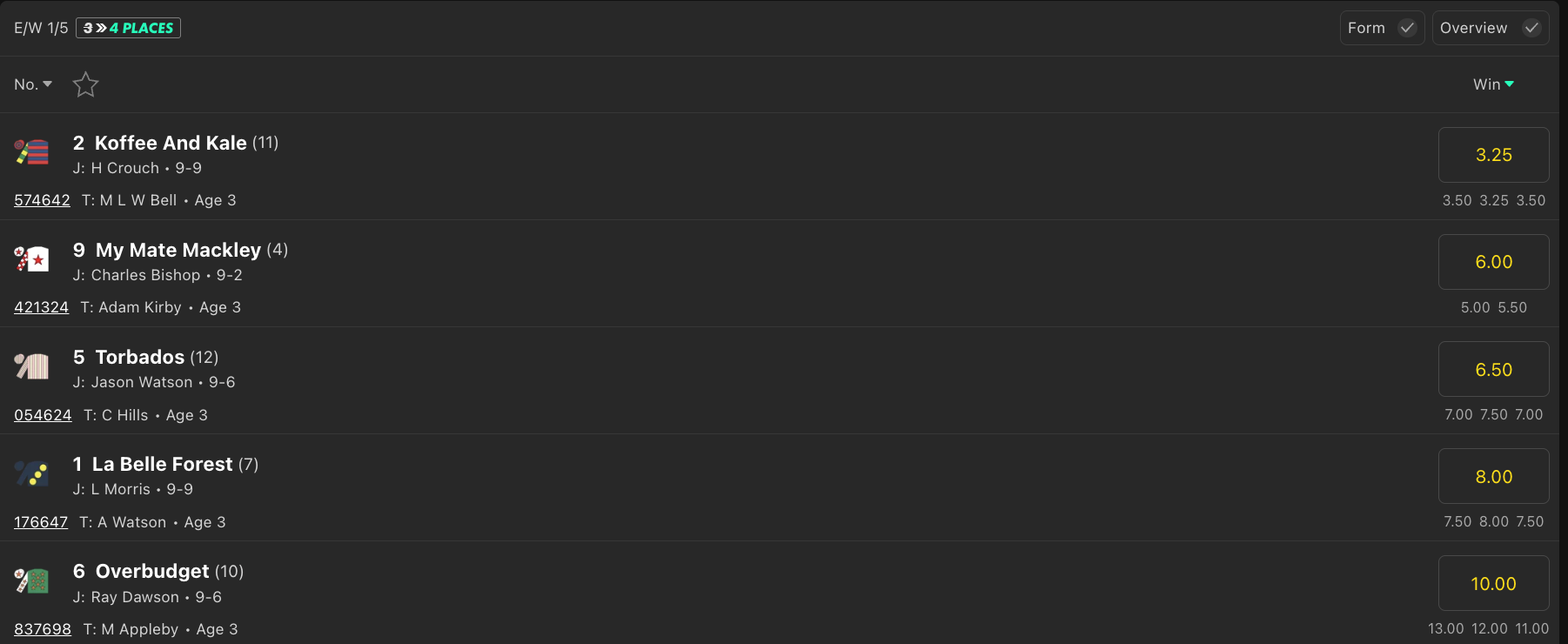
If we wanted to dutch this race, we might decide to place our bets across Koffee And Kale at decimal odds of 3.25, My Mate Mackley at 6 and Torbados at 6.5. If we want to bet a total of £50 on the race, we can use a dutching calculator to work out our ideal stakes and see the results.
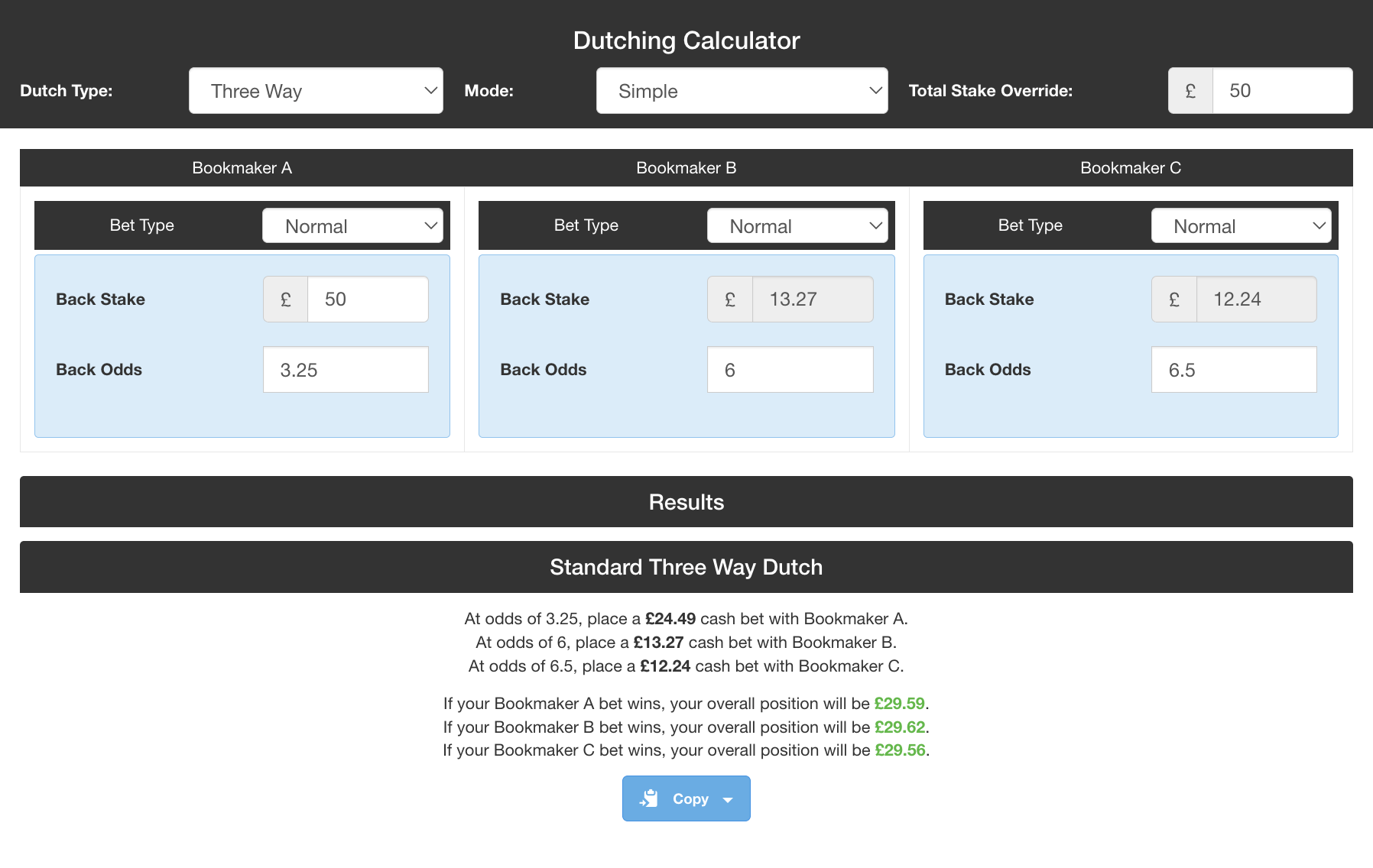
As you can see, with the right stake size on each selection, we can produce roughly the same profit as long as one of our bets wins.
| Selection | Odds | Stake | Profit |
|---|---|---|---|
| Koffee And Kale | 3.25 | £24.49 | £29.59 |
| My Mate Mackley | 6 | £13.27 | £29.62 |
| Torbados | 6.5 | £12.24 | £29.56 |
Of course, if another horse wins the race, we’ll be down our full £50 stake. It’s therefore important to remember that there is still significant risk in a strategy that doesn’t cover all outcomes, and never to bet more than you can afford to lose.
We’d also recommend rounding your stake size up or down to the nearest £1, as extremely precise stakes can look suspicious to bookmakers.
Expert Insight
‘Adding another runner isn’t automatically an improvement. Each extra selection increases your coverage, but it also consumes part of the available return. The useful question is whether the additional horse meaningfully improves your estimated chance of success relative to the odds you’re accepting for including it.’
Dutching on the football correct score market
You can adopt a similar strategy when dutching on football, if you’re comfortable with a degree of risk but keen to maximise your chances of a win.
One popular strategy is to cover the most likely results across the correct score market.
In its simplest form, you can back all the most common scores, adjusting your stakes in order to produce roughly the same profit no matter which wins. Those scores are:
- 0-0
- 0-1
- 1-0
- 1-1
- 2-1
- 1-2
- 2-0
- 0-2
As a general rule, it’s possible to make about £40 profit for every £100 staked by backing all the above scores, assuming one of them wins.
To refine this strategy further, put some time into research to assess whether any particular match is likely to be high or low scoring, and focus your bets accordingly.
Again, it’s important to remember that this strategy does involve risk, so do your research and make certain never to bet more than you can afford to lose.
And if you aren’t happy with the possibility of losing your full stake if none of your selections win, stick to Matched Betting to minimise risk and protect your peace of mind.
Are There Any Other Ways To Mitigate Risk Or Lock In Profits From Sports Betting?
Dutching can be a great way to limit the risk of a bet, or even to cover all outcomes to lock in a profit, but there are other strategies out there that can make it even easier to generate profits from sports betting while substantially limiting risk.
Matched Betting
Matched Betting is our thing here at Outplayed, so unsurprisingly we’re huge advocates for this strategy. It’s very similar to dutching (and as we’ve seen, dutching can be used as part of a Matched Betting strategy), but is generally easier to execute and more profitable.
Matched Betting involves placing bets both for and against the same outcome, between a bookmaker and a betting exchange, meaning that one of your bets must win. You make a profit by taking advantage of bookmaker offers in what is typically a two-step process.
First, you place what’s known as a ‘qualifying bet’, which unlocks a free bet or another reward. You match this bet with a lay bet at a betting exchange, which typically results in a small loss of a few pence, known as a qualifying loss.
Once your initial bet has settled, you repeat the process with the free bet you’ve unlocked, usually making a profit of 70-80% of the value of your free bet (e.g. on a free bet of £10, you’d expect to make £7-£8 in profit).
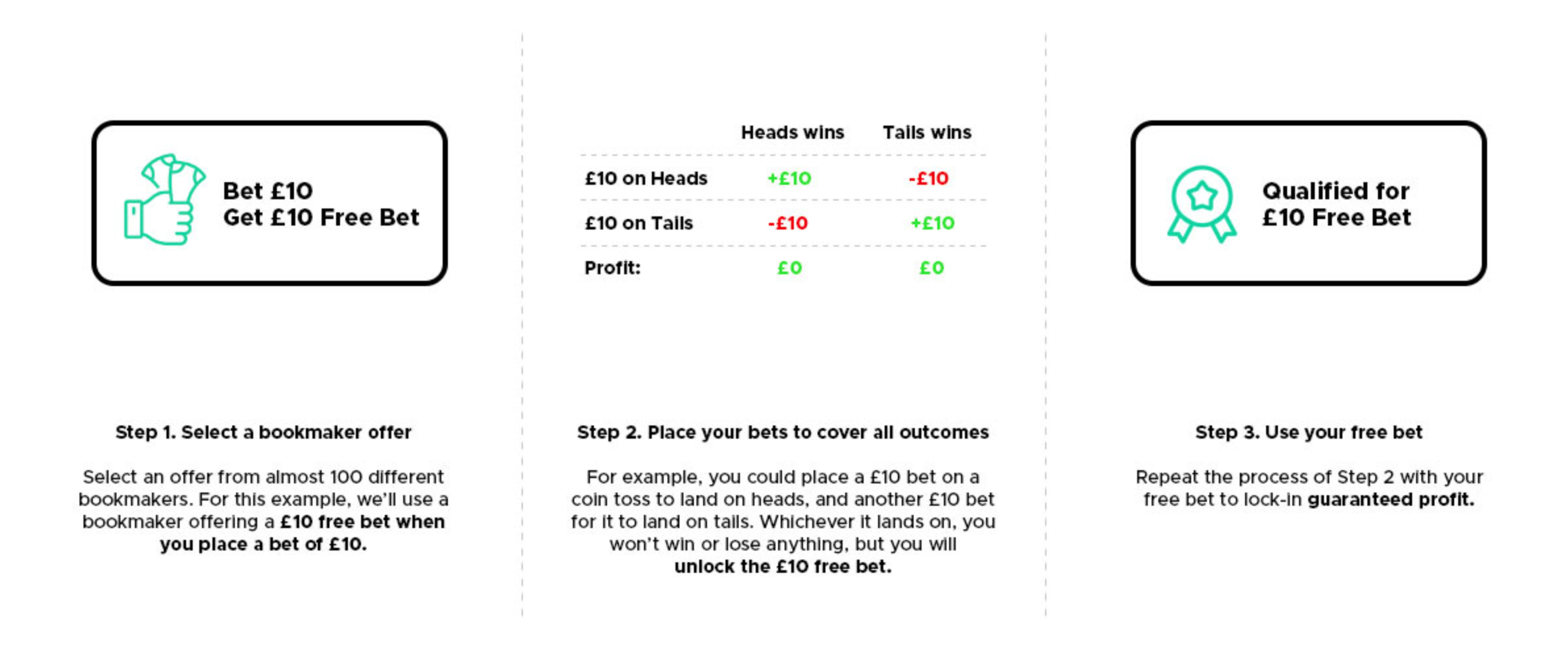
Many matched bettors are able to make hundreds of pounds a month, with a very low risk of any losses - generally speaking, you should only ever end up losing money if you’ve made a mistake.
To find out more, check out our Beginner’s Guide to Matched Betting for a full breakdown of the process and how you can get started.
Arbitrage Betting
Arbitrage betting is another very similar technique (again, dutching can be used as part of an arbitrage strategy), which involves placing bets for and against the same outcome.
The trick to arbitrage comes in finding pairs of disproportionately favourable odds that allow you to lock in a profit with every single bet.
This is easiest when you place a back bet with a bookmaker and a lay bet with a betting exchange. All you need to do is find odds for your back bet that are higher than the lay odds; if this is the case, you’ve got an arbitrage bet, which will generate you a profit regardless of the outcome of the event.
It’s also possible to dutch your bet between bookmakers to create an arbitrage bet, as we’ve seen above, but it can be trickier to locate pairs of odds that will produce a profit.
To find out more, take a look at our dedicated guide to arbitrage betting for all you need to know about how this strategy works.
Hedge Betting
Hedge betting is a more advanced strategy, and it doesn’t eliminate risk. However, it can reduce risk and sometimes even lock in a profit.
This strategy relies on the movement of odds over time after you’ve placed an initial bet. As the odds shift, you may discover that there are opportunities to place additional bets on markets opposing your original bet that allow you to reduce any potential losses from that bet, or even lock in a profit.
To find out more about how this strategy works, check out our dedicated guide to hedge betting for a full breakdown of the process and how it can be used to improve your position when sports betting.
What Are The Advantages And Disadvantages Of Dutching?
Advantages
- Allows you to matched bet on tennis match result markets where retirement rules can make traditional Matched Betting difficult
- Can be used to reduce risk and increase likelihood of a win as part of basic sports betting strategy
- Opens up extra arbitrage opportunities
- Opens up Matched Betting opportunities when liquidity at betting exchanges is low
- Doesn’t involve any liability at betting exchanges, which can make it easier to execute with a smaller bankroll
Disadvantages
- Laying your bet at a betting exchange is likely to produce a better result in most cases
- Can be more difficult to locate dutching opportunities
- If trying to achieve an equal profit, abnormal stake sizes can be suspicious and may lead to greater scrutiny of a bettor’s activity
- There are fewer tools available in the UK to make dutching easier when compared to Matched Betting
Tips And Tricks For Successful Dutching
- Use rounded stakes. Because dutching allows the bettor to limit their risk and potentially profit no matter the result of an event, bookies aren’t too keen on dutch bettors. For this reason, it’s best to avoid making it obvious what you’re up to.
Oddly precise stakes are a key sign of dutching, so it’s best to round your stakes at least to the nearest pound - even better if you can round to the nearest £5 or £10 and still come out with a result you’re happy with.
Use Outplayed’s dutching calculator in advanced mode to round your stake sizes and check that the possible outcomes will still produce an acceptable result.
Data Insight
The Gambling Commission found that 4.31% of active customer accounts in its sample had been commercially restricted. Of those restricted accounts, 62.17% were subject to a stake-factor restriction, showing that reduced maximum stakes are a significant form of operator intervention.
- Use an odds checking site (e.g. Oddschecker) to find the best odds for a particular market. The main difficulty when dutching is finding odds favourable enough to make a dutch bet worthwhile.
One option is to use Outplayed’s Oddsmatcher (available with all membership tiers) to find a selection with particularly good odds, then use an odds checking site like Oddschecker to find the bookie with the best odds on other selections within the same market.
- Use a dutching calculator. Unless you’re using the equal stakes type of dutching, the maths involved in working out the stakes for a dutch bet can be quite complicated.
To avoid making any mistakes, we strongly recommend using a dutching calculator (Outplayed’s is available to all members), which will calculate your optimal stakes and confirm your profit depending on the outcome of the event.
- Be cautious about highly favourable odds. Exceptionally high odds are likely to represent a great dutching opportunity, but it’s wise to be cautious.
For one thing, consistently betting on unusually favourable odds can attract the bookie’s attention, and they may catch on to what you’re up to and restrict or even ban your account.
Secondly, they could be the result of a palpable error - a term indicating the odds are so inflated that it’s obviously due to an error with the bookie’s software. A bet could be voided if the odds are deemed a palpable error, so if the odds seem wildly inflated, they’re best avoided.
- Keep your stakes consistent. Another sign to a bookie that a bettor might be engaging in arbitrage or dutching is a sudden change in stake size. If you normally bet in small increments - say, £10 or £20 - suddenly betting £100 or more can attract unwelcome scrutiny. If you’re keen to increase your stake size to improve your dutching profits, do so gradually to avoid attracting the bookie’s attention.
- Don’t forget about potential risk. If you aren’t covering all outcomes with your dutch bet, it’s important not to get carried away with your staking.
Placing three or four bets across the most likely winners in a race can give you a feeling of great confidence, and you may be tempted to increase your stakes to produce higher profits. Don’t forget that there’s still a possibility of one of the other horses winning, which would mean you losing everything you’ve staked on that race.
Summary
Dutching can be a handy technique to have in your back pocket, whether you’re a recreational sports bettor hoping to improve your chances of a win, or a matched bettor using dutching techniques to profit from low-liquidity events or tennis matches.
It does have its downsides, though, and it’s often the case that traditional Matched Betting will produce a better result if you’re covering all outcomes.
If you’re interested in finding out more about how you can make money from Matched Betting, take a look at our Beginner’s Guide to Matched Betting for all the information you need to get started.
Or if you’re ready to dive right in, sign up for our trial to gain access to 40+ sign up offers worth over £800 in profit completely free of charge!
sign up nowFAQs
1. Is dutching the same as Matched Betting?
No, although dutching can be used as part of a Matched Betting strategy. Dutching doesn’t necessarily cover all outcomes in the way that Matched Betting does, and doesn’t involve using a betting exchange as you would when Matched Betting.
2. Why is it called ‘dutching’?
We can’t be 100% sure about the word’s origin, but it’s thought to come from a New York gangster nicknamed ‘Dutch Schultz’, who’s believed to have come up with the concept as part of his horse racing operation.
3. Can I guarantee a profit through dutching?
In some cases you can lock in a profit by covering all outcomes, though you’ll need to make sure your odds are favourable enough to produce a profit, and be careful to avoid making a mistake.
4. Is dutching legal?
Yes, dutching is perfectly legal, though it isn’t looked on kindly by bookies.
5. Can dutching get my account restricted?
If a bookie catches on to what you’re up to, they may well restrict your account, or even ban you. For this reason, it’s best to round your stakes and do your best to blend in with regular punters to disguise your dutching.
Updated: 28 Oct 2026