
A Complete Guide to Football Dutching
10 min read
Stephanie Sorrell
29 Oct 2026

Quick answer: football can be a great sport to dutch on, as its enormous popularity means there are a wide range of available markets. Whether you prefer to cover all outcomes or just a few, you’ll find plenty of opportunities to dutch your bets on football when you start looking for them.
Dutching has a surprisingly long history. It probably goes back all the way to the 1920s or 1930s, when a New York gangster nicknamed Dutch Schultz is believed to have invented the concept as a way to get more from the horse racing side of his operation.
But dutching isn’t limited to horse racing - it can be profitable on any sport, and as football is the most popular sport in the UK, we expect that many bettors will be keen to make the most of any strategy available to improve their fortunes on football bets.
Data Insight
Football generated £1.2 billion in Gross Gambling Yield from remote betting in Great Britain during April 2025–March 2026, making it the largest remote betting category, and responsible for half of all remote betting revenue. Horse racing generated £769.3 million over the same period.
So what are the best strategies for dutching your bets on football? Which matches and markets should you go for? And will the bookies catch on to what you’re up to?
In this article, we’ll take you through everything you need to know about football dutching, as well as suggesting a few alternative strategies that might be even more successful for budding sports bettors.
Dutching In A Nutshell
For a full breakdown of how the strategy works, take a look at our complete guide to dutching. For now, we’ll just take you through the basics of how dutching works.
In essence, dutching is nothing more complicated than placing more than one bet on a single market, across different bookmakers. You might choose to place the same stake on each bet (known as equal stake dutching), or vary your stakes in order to produce the same profit no matter the outcome (known as equal profit dutching).
You can also choose between covering all outcomes (e.g. betting on both players to win a tennis match) or just covering some of the possible outcomes (e.g. betting on three runners in a horse race, out of a field of eight).
If you cover all outcomes, it’s possible to lock in a profit with an arbitrage bet, but it can be difficult to locate sets of odds that will make this possible.
An example of a dutch bet
To illustrate how this can work in practice, we’ll run through an example of a dutch bet on a football match where you’re covering all outcomes in order to lock in a profit.
You’re considering betting on an upcoming UEFA Nations League match between France and Italy, and find the following odds available across three different bookmakers:
| Outcome | Odds | |
|---|---|---|
| Bookie A | France win | 1.55 |
| Bookie B | Draw | 5.5 |
| Bookie B | Italy win | 7 |
You suspect you might have found a potential chance to dutch your bet and create an arb, and entering the details into a dutching calculator proves you’re right. For a £50 back bet on France to win, you get the following results:
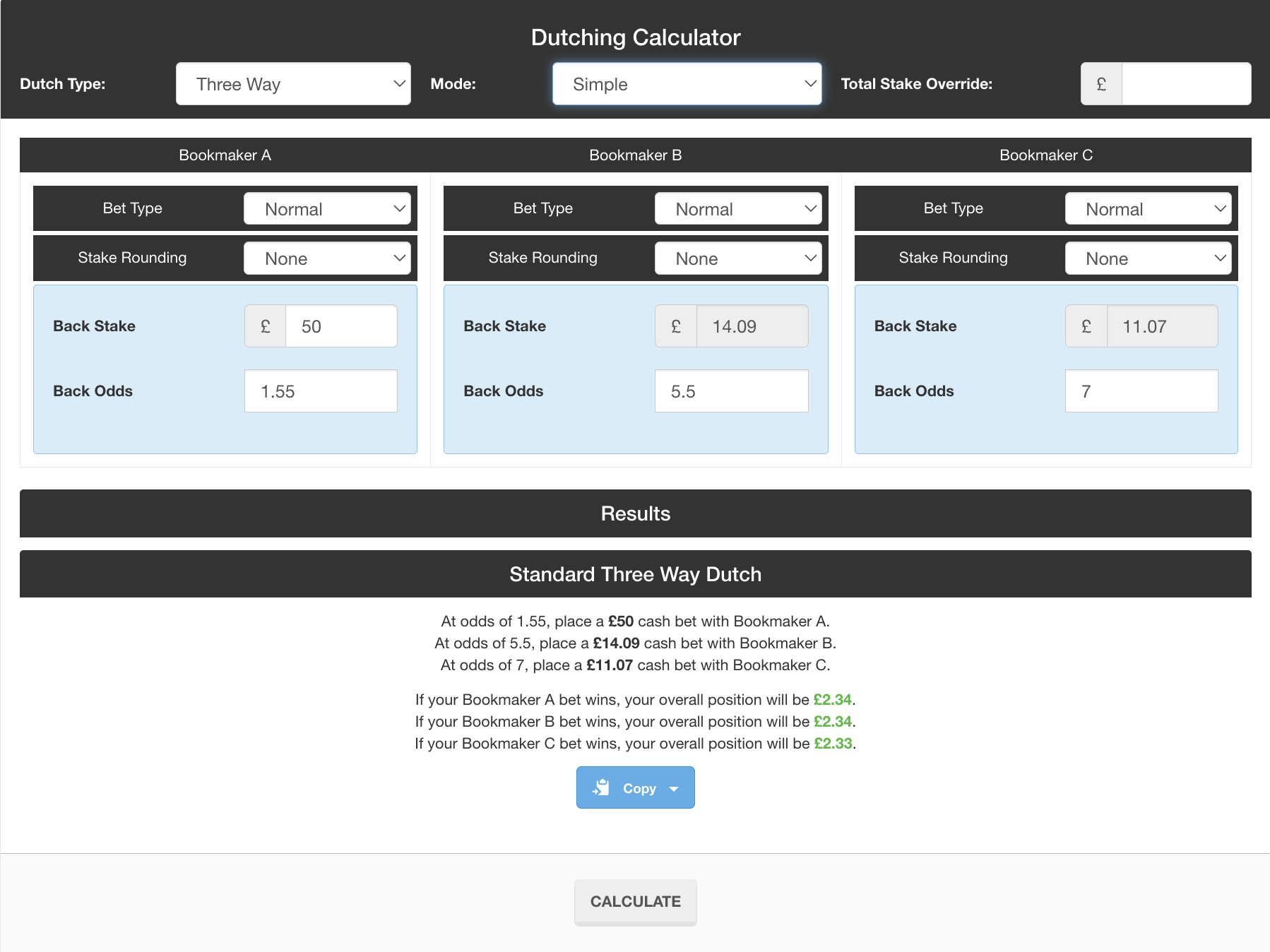
As you can see above, if you place a £14.09 bet with Bookie B on a draw, and an £11.07 bet with Bookie C on a win for Italy, you can lock in a profit of £2.33 no matter how the match goes.
| Outcome | Odds | Stake | Return | Overall Profit |
|---|---|---|---|---|
| France win | 1.55 | £50 | £77.50 | £2.34 |
| Draw | 5.5 | £14.09 | £77.50 | £2.34 |
| Italy win | 7 | £11.07 | £77.49 | £2.33 |
Of course, given the total amount staked (£75.16), a £2.33 profit might not seem like a lot. However, repeating this process again and again will allow your profits to build over time - without the risk of losing your stakes.
What’s The Best Way To Dutch Bet On Football?
So, what is the best football dutching strategy? Well, there are a few possibilities; some of the popular options are as follows.
Football Arbitrage Dutching
If you’re keen to limit risk, this strategy is likely to appeal to you. The example we worked through in the previous section falls into this category - you’re taking advantage of favourable odds to create an arbitrage bet across three different bookmakers, resulting in the same profit no matter the outcome of the event.
Equal Stake Dutching
A somewhat riskier option is to stake the same amount on each outcome. If the odds are good enough, you may be able to profit no matter which outcome ends up winning. However, in many cases this strategy results in excellent profits if the outcomes at higher odds win, but a loss if the lowest odds outcome wins.
For example, let’s imagine we’d gone with equal stake dutching for our example in the previous section. If we choose to stake £10 on all three possible outcomes, we get the following results:
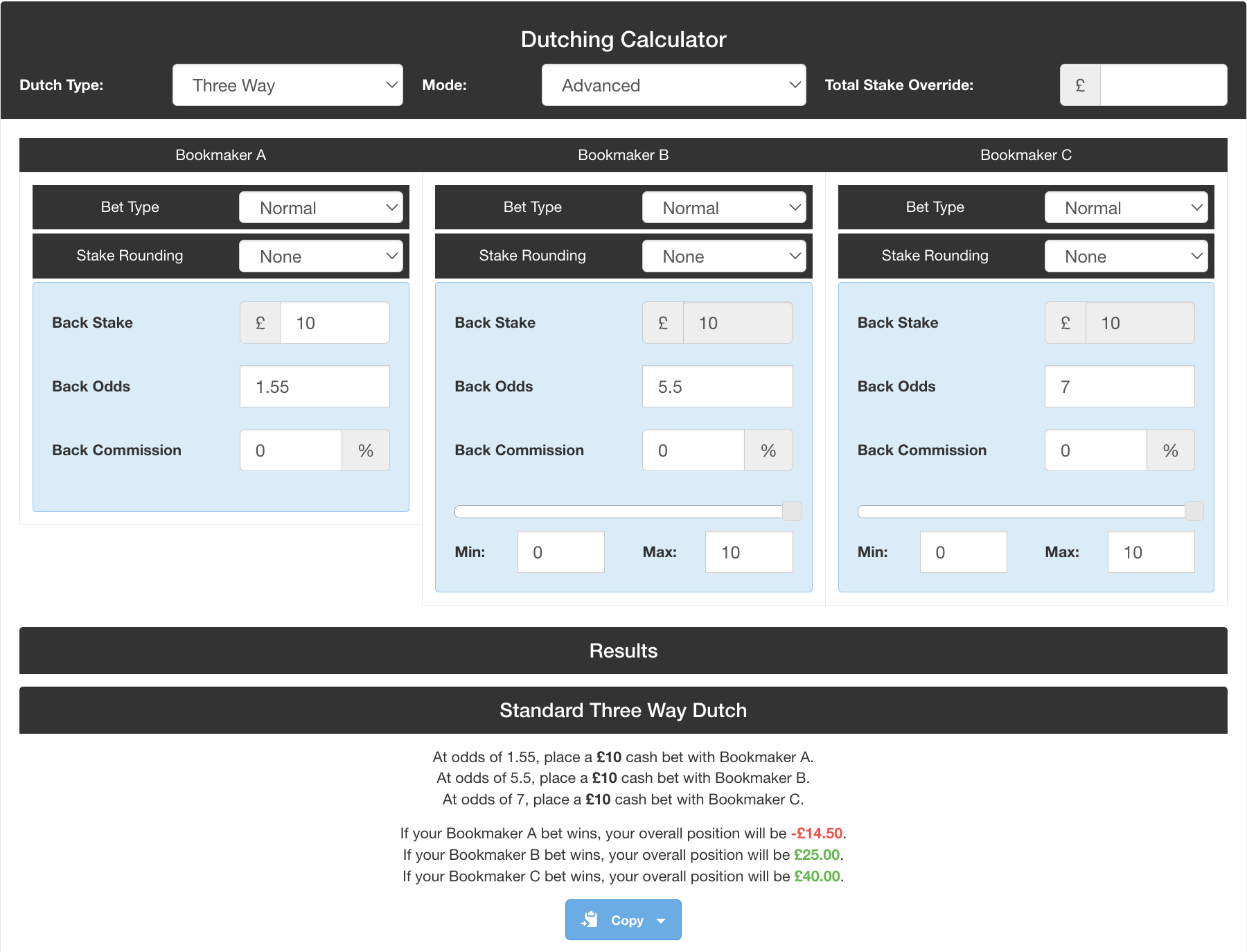
As you can see, we’d lose £14.50 with a France win at odds of 1.55, but we’d make £25 profit on a draw, and £40 profit if Italy pulled off a win.
| Outcome | Odds | Stake | Return | Overall Profit |
|---|---|---|---|---|
| France win | 1.55 | £10 | £15.50 | -£14.50 |
| Draw | 5.5 | £10 | £55 | £25 |
| Italy win | 7 | £10 | £70 | £40 |
With more evenly matched teams, though, you might well find that equal stakes dutching produces better results.
Correct Score Dutching
If you’re comfortable with a higher degree of risk, you could consider dutching on the Correct Score market. This strategy doesn’t involve covering all outcomes, so there is still a chance of losing your bet.
However, if you cover only the most likely scores, the odds are typically good enough to net you a fairly good return if one of them wins - and your chances of winning aren’t bad at all.
Generally speaking, most dutch bettors choose to cover the following selections when betting on the Correct Score market:
- 0-0
- 0-1
- 1-0
- 1-1
- 2-1
- 1-2
- 2-0
- 0-2
You can improve your chances still further by studying the teams involved in any particular match to assess the likelihood of it being a high scoring or low scoring match, and adjusting the scores you choose to bet on accordingly.
Expert Insight
‘Correct Score dutching can look attractive because a handful of plausible results can offer big prices, but the shortest-priced scores aren’t automatically the best selections. Compare the available odds with your assessment of the match rather than simply choosing the outcomes with the lowest odds.’
Dutching for Matched Betting
If you’re a matched bettor, you’ll normally find it easiest simply to lay your bet at a betting exchange.
However, occasionally it may be easier or more profitable to dutch your bet instead.
For example, if you’re trying to bet on a less popular football match with limited liquidity at the betting exchange, you might have more success looking for another bookie to dutch your bet with. Or alternatively, if you’re low on funds at the exchange, a dutch bet might allow you to proceed without tying up significant funds in exchange liability.
And if the stars align, you might even be able to qualify for multiple offers at different bookies at the same time, if the odds and your stakes allow. This is relatively unlikely, though, given the restrictive nature of the terms of many offers.
What Are The Risks And Downsides Of Dutching On Football?
It’s important to be aware that dutching can involve risk, whether it’s on football or on any other sport.
Of course, the level of risk is pretty limited if you’re covering all outcomes - you should only be at risk of losing money if you make a mistake when placing your bets - but if you’re only covering some outcomes then your level of risk is much higher.
Expert Insight
‘A dutch can stop being worthwhile surprisingly quickly if the odds move while you’re placing the individual bets. Football markets can change in seconds, so check each price immediately before confirming the next stake, and recalculate if necessary.’
- Losing money. As mentioned, if you choose not to cover all outcomes in a market, you could easily lose all the money staked on your dutch bet.
- Difficulty of locating suitable opportunities. It can be much more difficult to locate good dutching opportunities than it is to locate a straightforward match if you’re Matched Betting. You could easily waste a lot of time in fruitless searching, which might be more profitably spent on other strategies.
- Complexity. A basic dutching calculator makes things quite straightforward if you stick to two- or three-way dutch bets. If you decide to cover more selections than that, though, the maths can get quite complicated, and regular dutching calculators may not be equipped to cover those situations.
- Added margins. Each additional bookmaker you use means you’re paying an additional margin that goes towards their profits, making it harder to make any money yourself.
- Lack of beginner-friendly software. Strategies like Matched Betting are made easy for beginners with dedicated software like Outplayed’s Oddsmatcher. This kind of software isn’t really available for dutching in the UK, meaning that there’s more of a learning curve for newcomers to dutching.
- Bookmaker restrictions. Bookies don’t appreciate bettors who use strategies like dutching to improve their success, and are constantly on the lookout for signs of dutching (and other smart betting strategies). That means that obvious dutching behaviour - e.g. betting on highly obscure markets because you’ve found great odds, or with oddly precise stakes - can result in the bookie catching on to what you’re up to, and potentially restricting your account, or even banning you.
Take steps to blend in and avoid being gubbed to mitigate this risk, such as sticking to high profile football matches and rounding your stakes to avoid them looking too suspicious.
Data Insight
The Gambling Commission found that 4.31% of 14.9 million active customer accounts in its sample were subject to some form of commercial restriction. Stake-factor restrictions affected 2.68% of all active accounts, while 0.83% had betting facilities withdrawn entirely.
Are There Any Other Strategies You Can Use When Betting On Football To Maximise Your Profits?
Dutching can be a great way to optimise your sports betting, but it’s not the only strategy out there - and there are other strategies that can do even more to maximise your success.
Matched Betting
Here at Outplayed, we’re the experts in Matched Betting, so naturally this is the first strategy we recommend, especially to newcomers to sports betting.
Matched Betting has most of the advantages of dutching, but involves less risk, and it’s generally much easier to find good matches which you can use to turn a profit.
The strategy relies on bookmaker offers, e.g. ‘bet £10 and get a £10 free bet’. By betting both for and against the same outcome, both on your initial qualifying bet and on your free bet, it’s possible to lock in a reasonable profit no matter the outcome of that event.
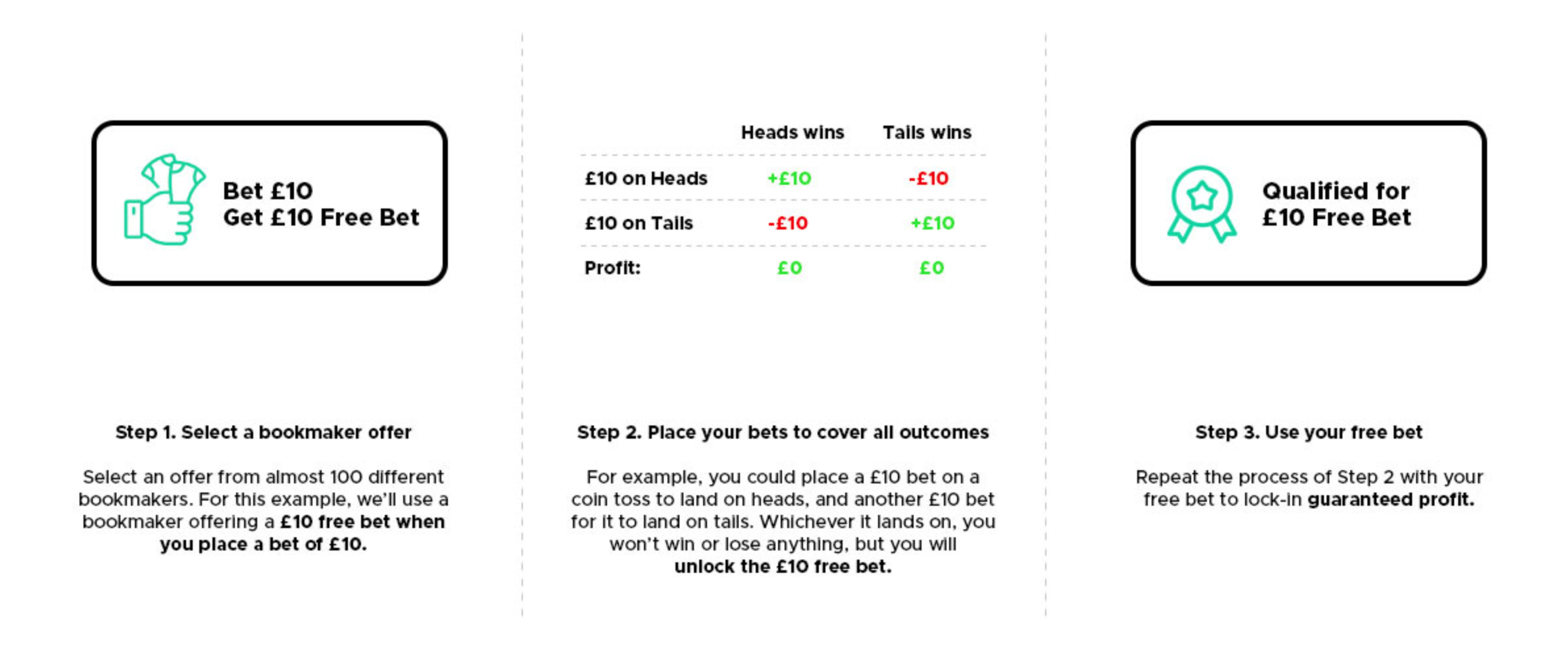
With so many offers available on football matches, Matched Betting is the ideal technique for football bettors to employ to get the most out of their betting activity.
To find out more, check out the Outplayed Beginner’s Guide to Matched Betting for all the information you need to get started.
Arbitrage Betting
Arbitrage betting has a lot in common with dutching - and, as we’ve seen, it’s possible to create an arbitrage bet with dutching techniques.
Arbitrage isn’t restricted to dutching (also known as the bookmaker-bookmaker model of arbitrage), though, and can in fact be more profitable using the bookmaker-exchange model.
When placing a bookmaker-exchange arbitrage bet, you back your bet with the bookie, and then lay it with an exchange, just as you would when Matched Betting. To create an arbitrage bet, you just need to find a match where the back odds are higher than the lay odds - if so, that’s an arb, and you should net a profit no matter the outcome of the event.
To find out more, take a look at our dedicated guide to arbitrage betting for all you need to know about how this strategy works.
Value Betting
Value Betting is a more advanced and higher risk strategy, so we recommend that you only attempt it if you’re already an experienced sports bettor with a solid bankroll.
The idea of Value Betting is that you bet only on selections with disproportionately high odds - i.e. those that are higher than the true probability would imply. Statistically speaking, if you consistently bet on those excessively high odds, you’re likely to end up making a profit overall, even though any individual bet could win or lose.
To find out more about how Value Betting works and how you can get started, check out the dedicated Outplayed guide.
Summary
Dutching can be a very handy strategy for football bettors to know about, making it possible to improve the chances of a win or even to lock in a profit.
However, it’s not the only strategy out there, and depending on your comfort level, you might prefer Value Betting or Arbitrage Betting. If you’re a newcomer to football betting, meanwhile, your best option is to start with Matched Betting, which is the perfect way to gain some experience and build your bankroll.
To find out more, check out the Outplayed Beginner’s Guide to Matched Betting for all the information you need to get started.
Or if you’ve already heard all you need to, take out the Outplayed free trial to get started on 40+ sign up offers worth potentially £800 or more!
sign up nowFAQs
1. Can you dutch any football bet?
In theory you can, but that doesn’t mean it would be a good idea. You should only dutch a bet if there’s a clear advantage to doing so. If you aren’t sure if that’s the case, you probably shouldn’t be dutching your bet.
2. Does dutching always guarantee me a profit?
No, if you aren’t covering all outcomes then you could lose your full stake if another selection goes on to win. And even if you do cover all outcomes, it is still possible for human error to creep in.
3. Is dutching suitable for beginners?
It’s not a terribly difficult strategy for beginners to learn, but it’s far from being the best for beginners. We’d recommend that new sports bettors start with Matched Betting before they consider dutching.
4. Do I have to use a dutching calculator?
No, you can certainly work out your stakes and profits manually if you prefer. A dutching calculator can be very useful for making sure you’ve got the maths right, though, especially if you’re trying to work quickly to get your bets in before the odds change.
5. Is dutching legal?
Yes, it’s completely legal. It may not go down well with bookies, though, so do your best to blend in by focusing on popular events and rounding your stakes.
Updated: 29 Oct 2026