
How To Get Started With Dutching
12 min read
Stephanie Sorrell
28 Oct 2026

Quick answer: the best way to get started with dutching is to use odds checking software and a dutching calculator to find good matches and work out ideal stakes. Make sure never to risk more than you can afford to lose, and consider Matched Betting as an alternative if you’re a new sports bettor.
There are millions of people who engage in sports betting in the UK - around 10% of the population, according to 2026 figures.
All of them are hoping to turn a profit from their betting, but surprisingly few are successful. When the Gambling Commission looked at all active betting accounts across British betting operators they found that over 70% were in a net loss position.
So any technique or strategy that can help a bettor limit their risk and improve their profits is likely to be popular with the betting public - and dutching is one such strategy.
Data Insight
57% of adults who gambled in the past 12 months said they gambled to make money, according to the Gambling Survey for Great Britain’s 2025 findings, but comparatively few are successful. This highlights the importance of understanding the risks and costs involved before starting a betting strategy such as dutching.
In this article, we’ll explain how you can embark on a dutching strategy and get the best out of it, as well as the risks and downsides to be aware of, and a brief rundown of other strategies you can use to get the best possible profits out of sports betting.
How Does Dutching Work?
Dutching is a sports betting technique that involves placing multiple bets across a single market, in order to increase the likelihood of a win and potentially to reduce risk.
Depending on the type of dutch betting method you choose, you may be able to cover all outcomes and still produce a profit (which would be a form of arbitrage), or you may simply cover several of the most likely possible outcomes. If the latter, you still run the risk of losing all your bets, but the chance of winning some money is significantly higher.
An example of a dutch bet
You’re considering betting on an upcoming horse race at Newmarket, and keen to maximise the chances of making some money from your bet. Rather than pin all your hopes on a single horse, you decide to spread your stakes across the most likely horses to win.

Having had a good look at the top of the racecard, you decide to dutch your bet across the three horses most likely to win according to the odds: Lazurite at decimal odds of 4, Minzelle at 4.5 and Black Velvet Boy at 5.5. For convenience, we’ll take the odds shown here from a single bookie, though in reality you should spread your bets across different bookies when dutching.
You intend to stake £50 in total, so you use a dutching calculator to work out your optimal stakes across the three horses to produce the best profit if any one of the three goes on to win. The results are as follows:
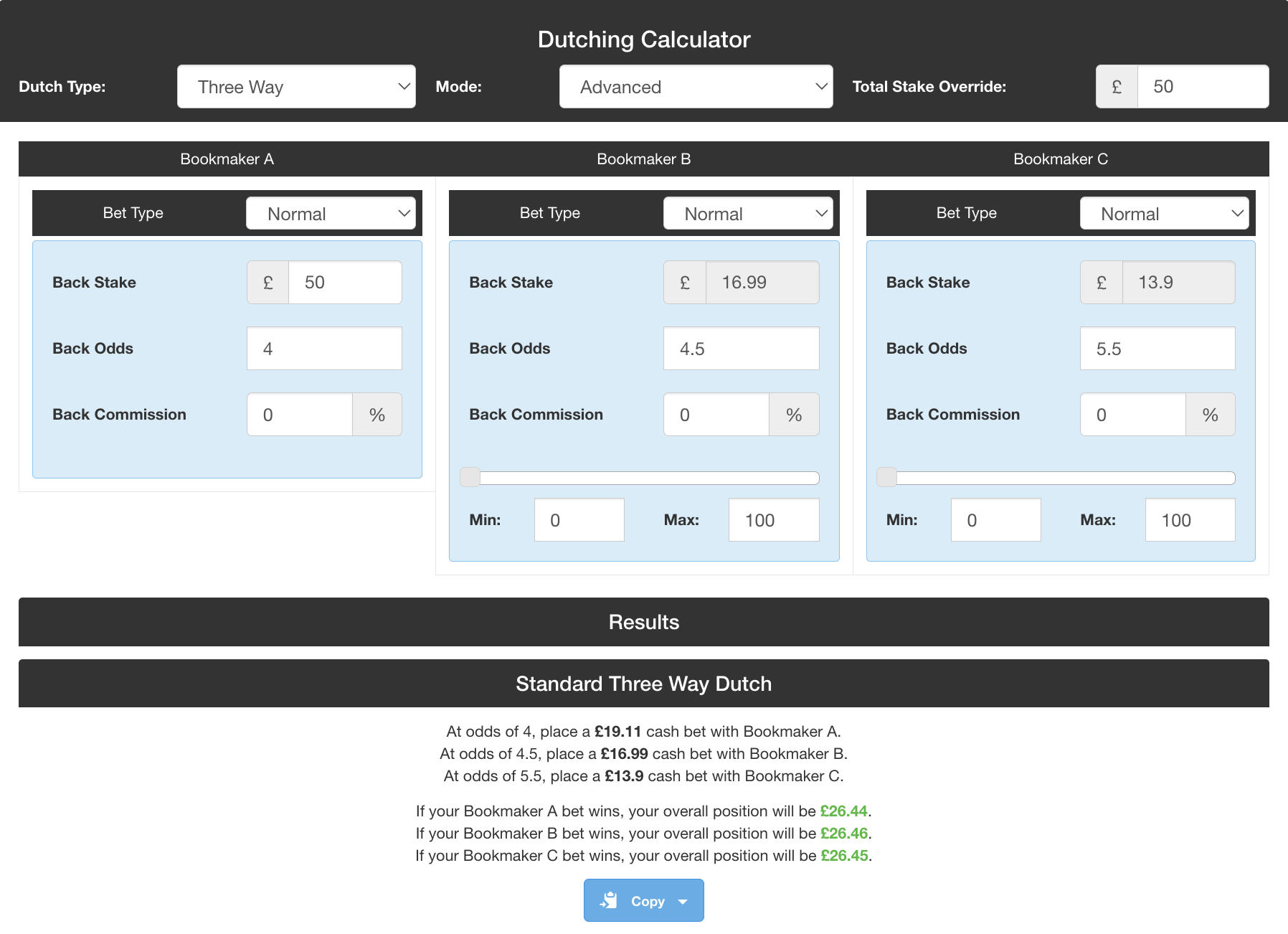
As you can see, it’s possible to produce roughly the same profit of around £26.45 regardless of which of the three horses wins. Of course, if another horse wins the race, you’ll be down your full £50 stake.
| Winning horse | Odds | Stake | Return | Overall profit |
|---|---|---|---|---|
| Lazurite | 4 | £19.11 | £76.44 | £26.44 |
| Minzelle | 4.5 | £16.99 | £76.46 | £26.46 |
| Black Velvet Boy | 5.5 | £13.90 | £76.45 | £26.45 |
| Another horse | N/A | N/A | £0 | -£50 |
Depending on your preference, you can also use the calculator to adjust your stakes, maximising your profits if one particular horse wins. Choosing rounded stakes also has the benefit of avoiding the bookie scrutiny that can result from staking extremely precise amounts.
For example, you could weight your £50 stake more heavily towards Black Velvet Boy if you felt positive about his chances, resulting in more profit if he were to win and less if another horse won.
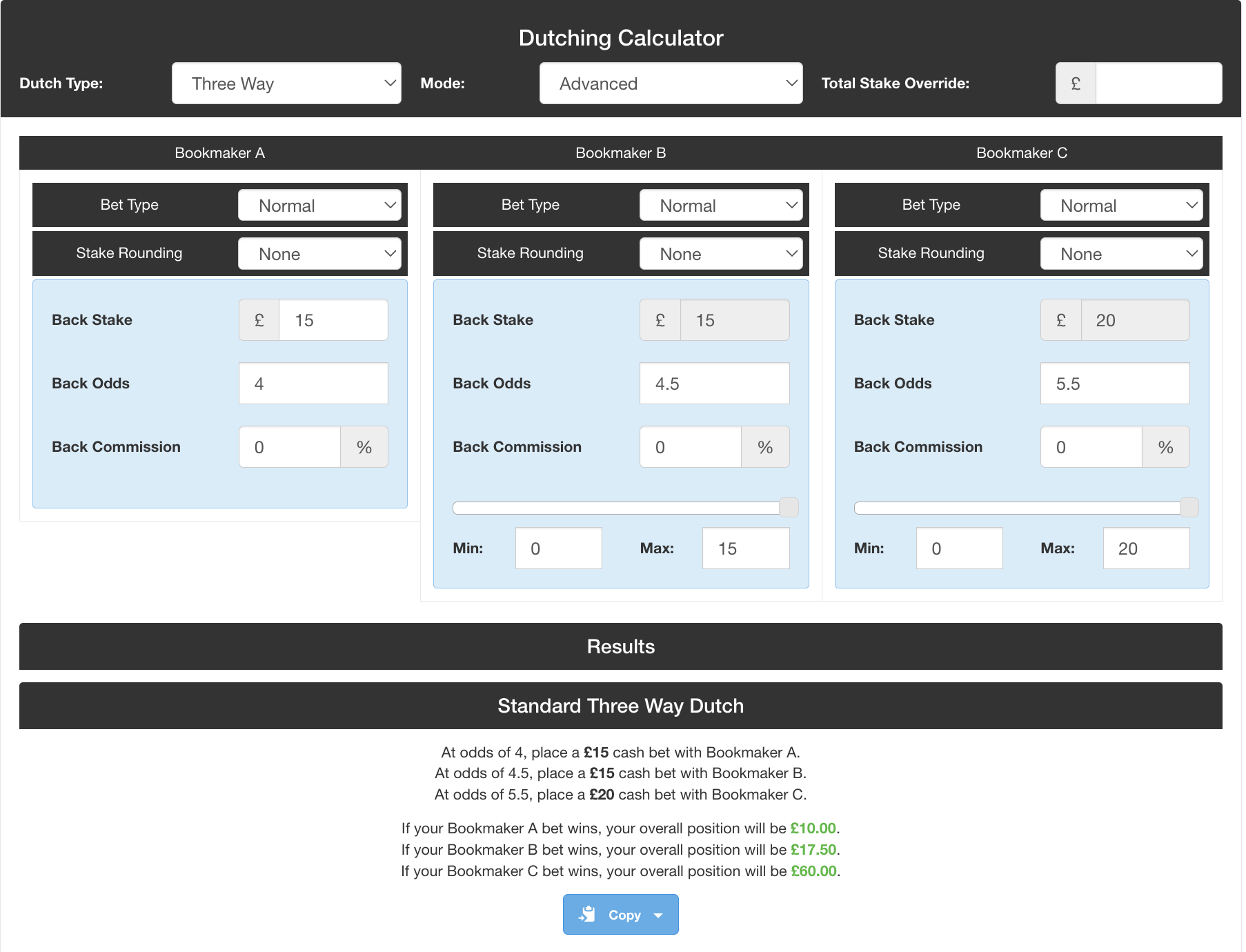
As you can see, you’re best off if Black Boy Velvet wins, but you’ll still be in profit if any of your three chosen horses come in.
| Winning horse | Odds | Stake | Return | Overall profit |
|---|---|---|---|---|
| Lazurite | 4 | £15 | £60 | £10 |
| Minzelle | 4.5 | £15 | £67.50 | £17.50 |
| Black Velvet Boy | 5.5 | £20 | £110 | £60 |
| Another horse | N/A | N/A | £0 | -£50 |
In other circumstances, especially in sports like football, where the most popular markets have a smaller number of possible outcomes, it’s possible to cover all outcomes with a dutch bet.
If the odds you find are favourable enough, you may be able to lock in a profit from your bet, making your dutching a form of arbitrage. For more information on this type of dutch bet, take a look at our complete guide to dutching.
Data Insight
22% of adults who had gambled in the past 12 months rated their most recent gambling experience negatively, giving it a score between 0 and 4 out of 10. This finding highlights the mixed relationship many bettors have with gambling, and how important it is to keep your betting within manageable levels.
How Do You Get Started With Dutching?
It isn’t difficult to get started with dutching; just a few simple steps will get you going.
1. Sign up to bookmakers.
If you’re already a recreational sports bettor with a reasonable number of bookie accounts, you won’t need to worry about this, but if you’re new to sports betting you’ll need to sign up with at least a few bookies to allow you to dutch bets between them.
We recommend doing a little research to check which bookies tend to offer the most competitive odds, and to sign up to those first. It may also be worth signing up for a couple of betting exchanges to give yourself more options, as it’s not uncommon for the best available odds to be found at a betting exchange. This also gives you the option of laying your bet, rather than dutching it, if you ever struggle to fully cover all outcomes with a dutch bet.
Expert Insight
‘Don’t start by deciding how many selections you want to dutch and then force the numbers to fit. Start with the prices available and work backwards. A wider set of selections can look safer, but every additional runner increases the combined implied probability and can quickly turn an apparently attractive opportunity into a poor one.’
2. Find markets with suitable odds.
It’s possible to do this manually by scouring bookie websites, but it’s much easier with the help of dedicated software. Outplayed’s Oddsmatching tool can be used to track down particularly favourable odds; although it displays matches with a betting exchange, it’s safe to assume that any bookie odds shown at the top of this tool will be pretty high.
You can then use a site like Oddschecker to find the best odds on opposing markets, which will help ensure you get the best profits from your bet.
3. Calculate your optimal stakes.
Whether you’re covering all outcomes, or just a few of the favourites, a dutching calculator will be your best friend when it comes to working out your stakes.
It’s worth experimenting with different stake options before you place your bets, to make sure you’ve identified the most advantageous stakes for your particular circumstances. We also recommend rounding your stakes to at least the nearest £1, but ideally the nearest £5, to avoid placing suspiciously precise stakes, which can alert bookies to your dutching activity.
Whatever you choose, you should take care to calculate your stakes accurately and, if you aren’t covering all outcomes, don’t bet more than you’re comfortable losing.
4. Place your bets, and await the results.
Place your bets at the bookies in question, and then sit back and see what happens. If you’ve covered all outcomes, you’ll be able to relax in the knowledge that your position is covered no matter what happens.
If you’ve only covered some of the possible outcomes, you may be a little more anxious, but hopefully the potential reward from a winning bet will be worth the risk you’ve taken.
What Risks And Downsides Does A Beginner Dutcher Need To Know About?
Dutching can be a great way to improve your chances of winning a bet, or even to lock in a profit with an arbitrage bet.
However, it has its downsides and risks, and it’s important to be aware of these.
- Risk. If you don’t cover all outcomes, there’s still a risk of losing your stakes - and the amount you lose may be higher if you’ve backed multiple different selections.
- Difficulty of locating good opportunities. It can be very difficult to locate good sets of odds when you’re dutching, given the number of bookies out there, especially when compared to Matched Betting, where an Oddsmatcher like Outplayed’s can make this part a doddle.
- Rare to improve on a lay bet. In many cases, you’re likely to find that you’d be better off simply laying your bet at a betting exchange, if you’re covering all outcomes with your dutch bet.
- Added margins. By placing multiple bets at different bookies, you’re contributing to bookmaker profits several times over, at a rate of around 5% (often more!). In contrast, at a betting exchange you’ll typically pay as little as 2% commission, or even 0% with exchanges like Smarkets and Matchbook if you’re an Outplayed member.
- Available software is limited. You’ll struggle to find dedicated dutching software in the UK, making it trickier to streamline the process. That said, tools like Outplayed’s Oddsmatcher and Dutching Calculator can help to speed this up.
- Bookmaker restrictions. Obvious dutching can attract the bookmaker’s attention, and may lead to your account being restricted or even banned. To blend in, make sure to round your stakes (as overly precise stakes are a sure sign of dutching) and bet on popular sports and events as far as possible.
Expert Insight
‘When you’re placing several bets across different bookmakers, timing becomes part of the risk. Odds can change between placing your first and last bet, leaving you with an uneven position. Have a clear minimum acceptable return and be prepared to walk away if prices move against you.’
Are There Any Other Strategies You Can Use To Make Money From Sports Betting?
Dutching has its merits, and can allow bettors to improve their chances of a win or even lock in a profit no matter the outcome of an event.
However, it has its downsides too, so if you’re looking for ways to make money from sports betting while limiting risk, it’s worth considering the following strategies.
Matched Betting
In our opinion (and admittedly we’re probably biased), Matched Betting is the very best option for generating profits from sports betting, and it’s particularly well-suited to beginners.
It has a lot in common with dutching, in that it involves covering multiple outcomes across a single market, but is easier to execute and more consistent when it comes to producing profits.
When Matched Betting, you place bets both for and against a single outcome, at odds that are as close to each other as possible (hence the ‘matched’ aspect of the strategy). Your back bet (for the outcome) is placed with a bookmaker, while your lay bet (against the same outcome) is placed at a betting exchange.
By taking advantage of bookmaker offers that give you free bets and other rewards, you can produce a reliable profit from this technique, in what is usually a two-step process.
1. Place a ‘qualifying bet’ with your own money at a bookmaker, and then lay it at a betting exchange. You’ll roughly break even, typically losing just a few pence on this qualifying bet.
2. When your bet settles, you’ll receive your reward, most often a free bet. Repeat the process of placing and matching your bet, and you’ll come out with an overall profit - usually around 70%-80% of the value of your free bet.
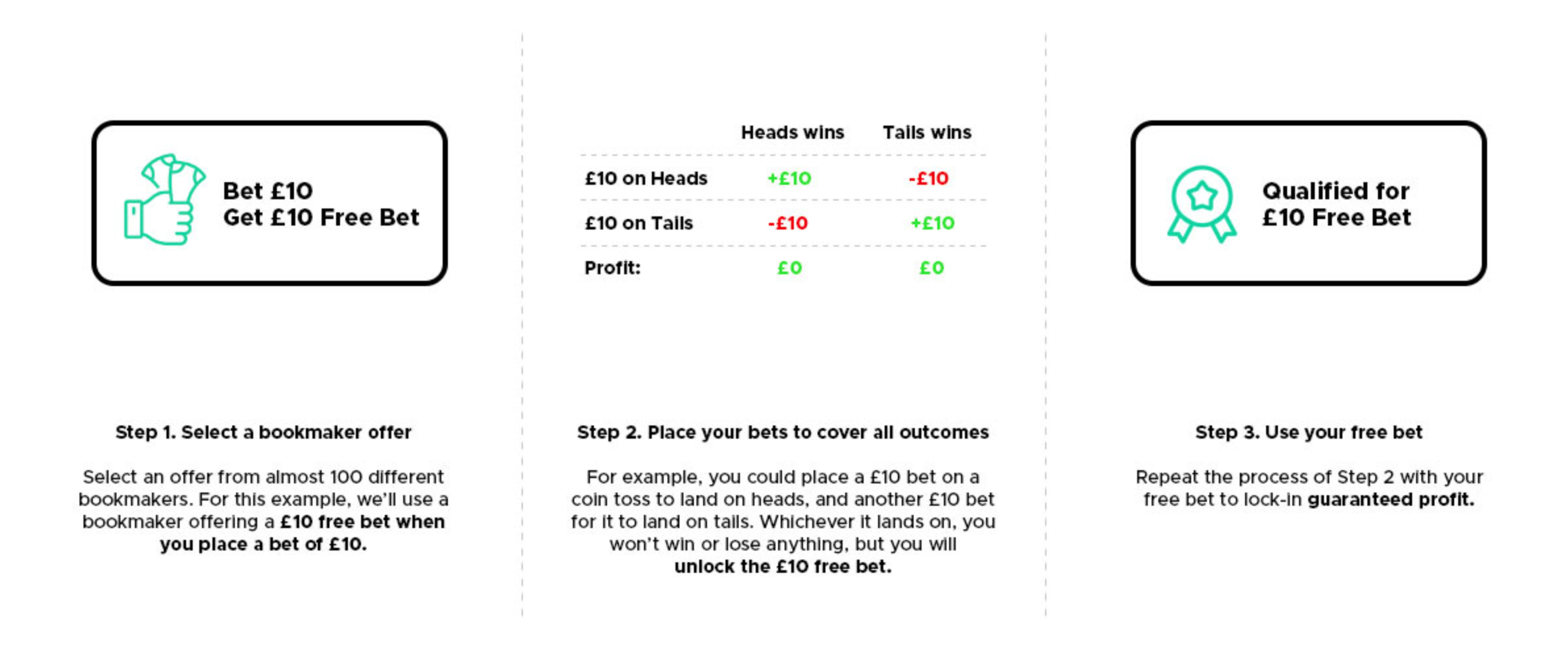
Matched Betting can also work well if you include an element of dutching - perhaps completing two bookmakers’ welcome offers at once, for example.
To find out more, check out the Outplayed Beginner’s Guide to Matched Betting for all the information you need to get started.
Arbitrage Betting
Arbitrage betting is another very similar technique - as we’ve seen, when covering all outcomes when dutching, we can produce an arbitrage bet.
Again, arbitrage betting involves placing opposing bets on a single outcome. The key to successful arbitrage comes in finding pairs of particularly high odds, which makes it possible to lock in a profit no matter the outcome of the event.
The easiest way to achieve this is by placing a back bet with a bookmaker and a lay bet with a betting exchange, as you would when Matched Betting. All you need to do is find odds for your back bet that are higher than the lay odds (something made much easier by Outplayed’s Oddsmatcher). When you do, you’ve found an arbitrage opportunity, which will generate you a profit regardless of the outcome of the event.
You can also use dutching techniques to create an arbitrage bet by covering all outcomes, as we’ve seen above, but it can be more difficult to locate pairs of odds that will produce a profit.
To find out more, take a look at our dedicated guide to arbitrage betting for all you need to know about how this strategy works.
Value Betting
Value Betting is a more advanced strategy than arbitrage betting or Matched Betting, so we’d only advise embarking on a Value Betting strategy if you’re already an experienced sports bettor. This is largely because Value Betting does involve risk; you aren’t locking in a profit with every bet, or increasing your chances of a win with multiple bets on a single market.
If you’ve already built up sports betting experience and a good bankroll, though, Value Betting can provide a massive boost to your profits. It relies on a similar principle to arbitrage betting - that of locating favourable odds from bookies, odds that are higher than the true probability of a win would imply.
Value bettors only bet on selections with those disproportionately favourable odds, which are statistically likely to contribute to generate profits in the long term, even though you won’t expect to win every bet you place.
To find out more about how Value Betting works and how you can get started, check out the dedicated Outplayed guide.
Summary
Getting started with dutching doesn’t have to be hugely challenging - but it can still be intimidating to newcomers.
Hopefully, this guide has helped you understand the basics of dutching, and given you some pointers as to how you might embark on a dutching strategy.
But if you’re hesitant, or looking for a safer, more beginner-friendly way to start making money from sports betting, Matched Betting is the perfect place to begin.
To find out more, check out the Outplayed Beginner’s Guide to Matched Betting for all the information you need to get started.
Or if you’ve heard enough and you’re already raring to go, sign up for our trial to gain access to 40+ sign up offers and over £800 worth of profit completely free of charge!
sign up nowFAQs
1. Is dutching beginner-friendly?
To an extent, but it can involve risk, and it isn’t always easy to find good dutching opportunities. For newcomers to sports betting, we’d recommend Matched Betting as a better place to start.
2. Is dutching legal?
Yes, it’s completely legal. It’s worth being aware that it isn’t looked upon kindly by bookies, though, so make sure you always dutch between different bookmakers and avoid obvious dutching betting patterns to blend in.
3. Will dutching get my account restricted?
It’s a possibility if the bookie catches on to what you’re doing. Make sure you don’t dutch your bet with the same bookie as your original bet, and try to round your stakes to the nearest £1 or £5 to better blend in with regular punters.
4. Can I lose money with dutching?
If you don’t cover all outcomes when dutching your bet, it’s very possible that you could lose money. If you do cover all outcomes, though, you should only lose money in the event that you’ve made a mistake.
5. Where does the term ‘dutching’ come from?
The origins of the term aren’t 100% certain, but it’s thought to come from a New York gangster known as ‘Dutch Schultz’, who’s believed to have invented dutching as part of his horse racing operation.
Updated: 28 Oct 2026