
Hedge Betting vs Matched Betting: Exploring The Differences
10 min read
Stephanie Sorrell
23 Sep 2026

Quick answer: both strategies make use of multiple bets on opposing outcomes, and both can lock in profits regardless of the result of an event. The key difference between hedge betting and Matched Betting is that Matched Betting uses bookmaker offers to lock in profits at minimal risk, while hedge betting aims to mitigate risk from an existing bet, and can sometimes lock in a profit.
There’s no shortage of strategies out there that promise to improve your fortunes when betting on sports, and it’s no surprise that people will look for anything that might give them a helping hand.
After all, most active bettors lose money overall; when the Gambling Commission looked at all active betting accounts with gambling operators in the UK, they found that almost three quarters of customers were in a net loss position.
Matched Betting and hedge betting are two strategies that can help to improve your odds of turning sports betting into profits - but how exactly do they work? Which is best for beginners? And how much risk are you exposing yourself to?
In this article, we’ll explore how each strategy works and the differences between them, to help you decide which you’d like to pursue.
What Is Hedge Betting?
Hedge betting is a way of mitigating risk on a bet you’ve already placed. It involves placing an opposing bet to your original bet in such a way as to improve your position, either by limiting potential losses or by locking in a profit.
Generally speaking, hedge betting works best with a space of time between your two opposing bets, as it relies on odds changing over that period of time. Ideally, the odds opposing your original bet will be more favourable when you place your hedge bet, so that it’s possible to create a more advantageous position for yourself.
Data Insight
Research into emotional hedging in the USA found that more than 45% of NCAA fans in two studies rejected a free real $5 bet against their own team. The finding suggests that bettors can be reluctant to hedge even when doing so offers a clear financial benefit.
For all the details about hedge betting, take a look at our dedicated guide - but for now, we’ll just give you a quick example of how hedge betting works to illustrate the process.
An example of a hedge bet
Early in the football season, you bet £100 on Liverpool to win the FA Cup, at odds of 10.
Liverpool go on to have a fantastic season and end up in the final against Arsenal, who had been the original favourites to win.
You still like Liverpool’s chances - they’re now considered the favourites for the title - but you’re a little worried that they might fall at the final hurdle, leaving you down £100.
So you decide to hedge your bet. You bet £200 on Arsenal to win the final at odds of 2.05, which allows you to emerge in profit regardless of who ends up winning.
| Outcome | Stake | Odds | Return | Overall profit |
|---|---|---|---|---|
| Liverpool win | £100 | 10 | £1000 | £700 |
| Arsenal win | £200 | 2.05 | £410 | £110 |
As you can see from the above table, you’re still best off with a Liverpool win, which will make you an overall profit of £700 (a £1000 total return, minus your stakes of £100 and £200), but even an Arsenal win will make you a respectable £110 profit.
Hedging with an exchange
Hedging with a second bet at another bookmaker is most people’s first thought when it comes to hedge betting (which is a form of dutching), but you can also hedge your bet with a simple lay bet at a betting exchange, just as you would when Matched Betting (for more detail about this process, skip to the next section).
This can often be the very easiest way to hedge a bet, as you can be confident that your lay bet directly opposes your back bet, and you can work out your stakes with a straightforward Matched Betting calculator.
Data Insight
The Gambling Commission’s 2023 survey found that 2% of male respondents and 0% of female respondents had used a betting exchange in the previous four weeks. This suggests exchange-based betting remains a relatively niche activity, despite its usefulness for strategies involving opposing bets.
What is Matched Betting?
For a full explanation of exactly how Matched Betting works, check out our detailed guide - but for now, we’ll go through the basics.
Matched Betting operates on a similar principle to hedge betting, in that you place opposing bets on a single event. With Matched Betting, though, both bets are placed at the same time, producing the same result no matter the outcome of the event.
With Matched Betting, turning your bets into profit is typically a two step process. First, you place what’s called a ‘qualifying bet’, which you use to unlock a reward such as a free bet. You match this bet with a lay bet at a betting exchange, and you typically make a very small loss, known as a qualifying loss.
Then you repeat the process with the free bet you’ve unlocked, usually making a profit of 70-80% of the value of your free bet.
An example of a matched bet
You see a sportsbook offering a bet & get offer: bet £10 to get a £10 free bet.
You use an Oddsmatcher (like Outplayed’s) to find a suitable qualifying bet with close odds - we usually try to keep the odds quite low for our qualifying bet, as this limits our qualifying loss.
The Oddsmatcher brings up an upcoming football match between Nottingham Forest and Leeds, with back odds of 2.15 on Nottingham Forest with the sportsbook and lay odds of 2.2 at the betting exchange, making for a nice close match. You use a Matched Betting calculator to work out your ideal stakes, as shown below:
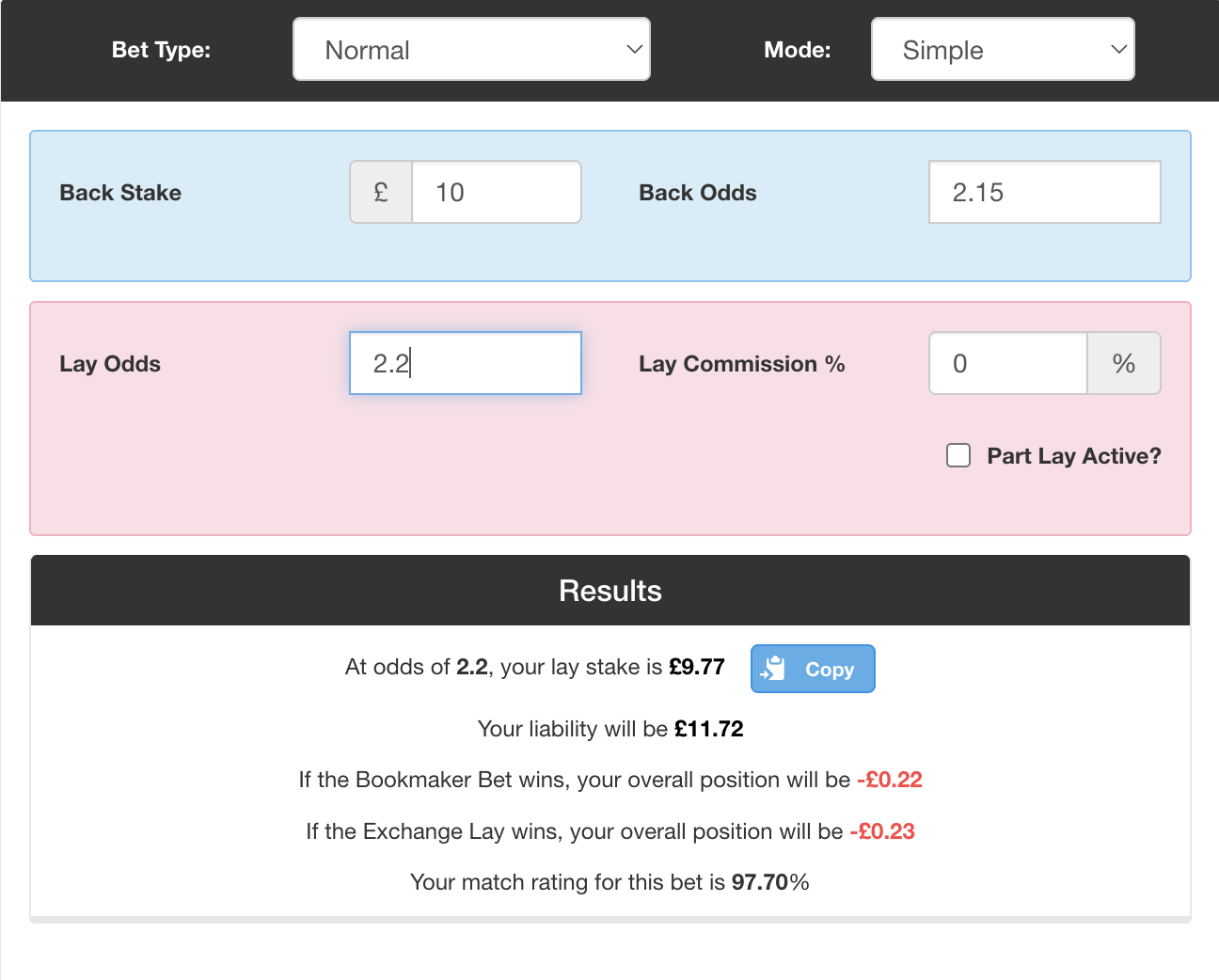
You place your bets accordingly, making a small qualifying loss of £0.23 on your qualifying bet. When the match finishes and your bets settle, you receive your £10 free bet from the bookie.
Once again, you use the Oddsmatcher to find a suitable matched bet. This time, you’re looking for higher odds to maximise your profit from the free bet. The Oddsmatcher brings up an upcoming horse race at Goodwood, where one horse has back odds of 8.5 and lay odds at the exchange of 9, which will lock in a great profit.
Using the calculator (in free bet mode this time) to check your ideal stakes, you see the following:
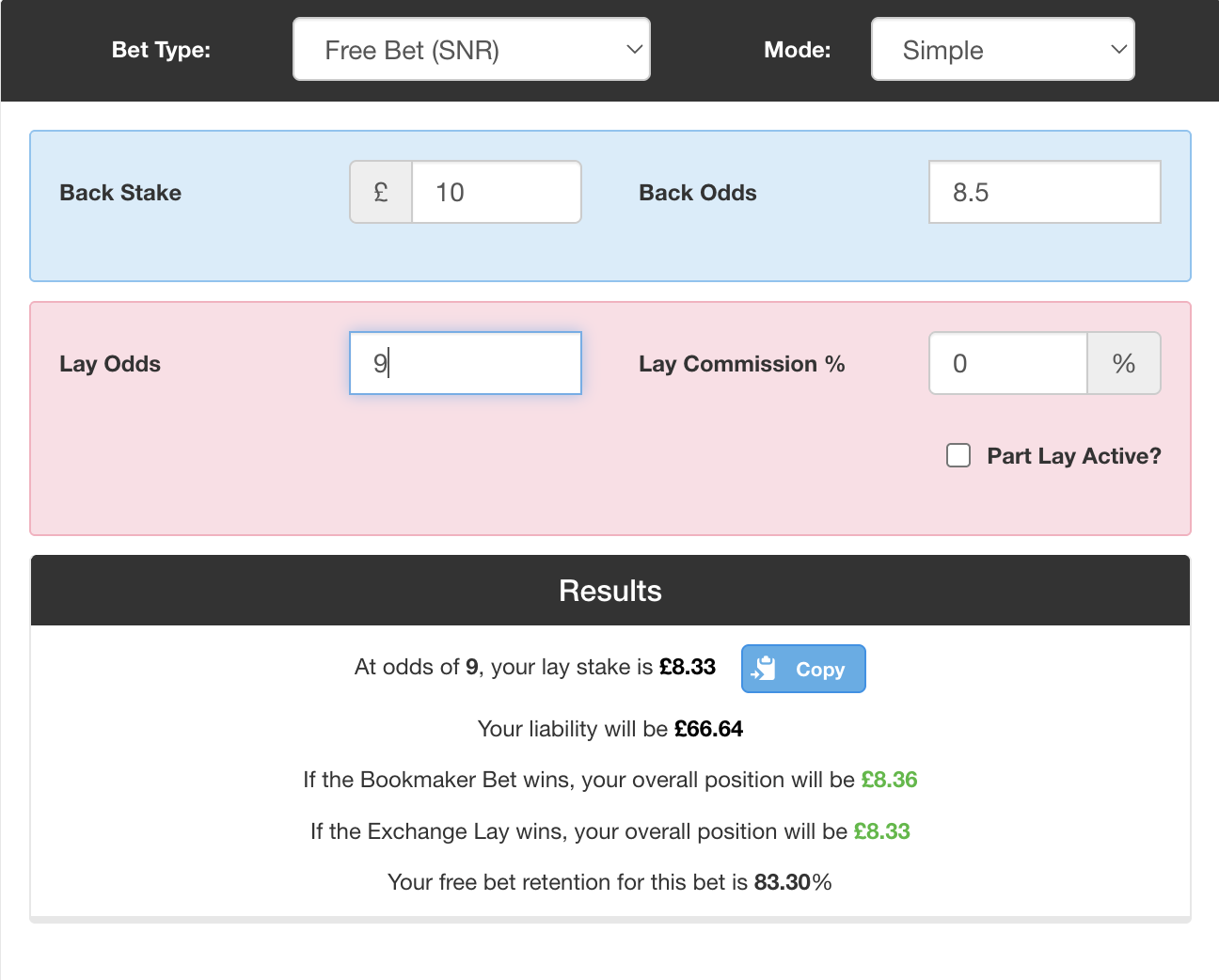
You go ahead and place your bets accordingly. Once the race has concluded, no matter what happens you’ve made a profit of at least £8.33 from your free bet, meaning that the whole process has resulted in a profit of £8.10 when you take into account your initial qualifying loss.
What Are The Differences Between Matched Betting And Hedge Betting?
Although there is some overlap between the two techniques, there are a lot of differences between them as well.
- Completing a Matched Betting offer should always result in a profit, whereas a hedge bet may only mitigate losses.
- When Matched Betting, both opposing bets are placed at the same time, whether for a qualifying bet or a free bet. When hedge betting, your opposing bet is typically made some time after your initial bet.
- Matched Betting is specifically designed to eliminate risk, so long as you get your bets right. There is always some risk involved in hedge betting, as you can’t ever be certain that you’ll get a good hedging opportunity after placing your initial bet.
- With a matched bet, you normally create the same profit regardless of the outcome of an event. With hedge betting, it’s more common to produce differing results depending on the outcome, even if both create a profit.
- Matched Betting is better suited to beginners, as less risk is involved, and a smaller bankroll is required.
Advantages and disadvantages of Matched Betting and hedge betting
Matched Betting
| Advantages | Disadvantages |
|---|---|
| Almost zero risk involved | Smaller profits than the best hedges, typically |
| Ideal for beginners | Limited by number of available offers |
| Can be certain of profits regardless of outcome | |
| Smaller bankroll required to get started | |
| No experience of sports betting needed | |
| Quick and easy to get started |
Hedge Betting
| Advantages | Disadvantages |
|---|---|
| Can limit risk | Risk can remain |
| Can lock in profit (often sizeable) | No guarantee of hedging opportunities |
| Can allow for peace of mind | Reduced profits due to hedge |
| No theoretical limit to number of bets you can place | Significant time and effort required |
| Significant bankroll required | |
| Less suitable for beginners |
Expert Insight
‘The hedge is a new bet, not just an adjustment to the old one. If the opposing odds are poor, you can end up paying a substantial price for certainty. Compare the hedge price with the current market before committing, rather than assuming that removing variance automatically improves the position.’
Can I Make More Money With Hedge Betting Or Matched Betting?
This is a somewhat more complicated question than it sounds, partly because the amount you can make with hedge betting is itself highly dependent on your circumstances and bankroll.
If you’re already an experienced sports bettor, with a strong bankroll, you may well be able to make more money from a good Value Betting strategy with some hedge betting thrown in, largely because there’s no real upper limit to the amount of money you can invest in hedge betting. On the other hand, your strategy will involve a significant element of risk, so it’s also possible that you could end up losing money rather than making it, especially if you’re an inexperienced bettor.
Expert Insight
‘A hedge shouldn’t be judged simply by whether it guarantees a profit. You’re also giving up some of the upside of your original position, so the decision should reflect the value you’re surrendering, the price available on the hedge, and how significant the potential loss would be to your bankroll.’
With Matched Betting, you are limited by the number of offers available, meaning that there is a definite upper limit to the amount you can make. However, because you’re exposing yourself to so much less risk, if you’re a newer bettor the chances are high that you’ll end up making more money from Matched Betting than you would from hedge betting.
Can I Combine Hedge Betting And Matched Betting?
If you like the sound of both hedge betting and Matched Betting, it is possible to combine the two - though if you’re new to sports betting, we’d strongly recommend starting off with Matched Betting.
The ideal way to combine these strategies is to use Matched Betting to build up your bankroll and experience to begin with. Then, when you’ve got some solid profits to play with, you can start to incorporate elements of Value Betting into your strategy, making sure never to bet more than you can afford to lose. We’d suggest dedicating only a portion of your Matched Betting profits to Value Betting, to limit the risk to your overall bankroll while you’re getting started.
Then, you can keep an eye on your value bets to see if any hold any hedging potential, and perhaps place a few longer term bets with the intention of hedging them if possible, depending on how events play out.
This hybrid approach allows you to explore the potential benefits of Value Betting and hedge betting, without exposing yourself to excessive risk, as you’re making use of profits you’ve made from Matched Betting rather than your existing funds.
Summary
Hedge betting and Matched Betting certainly have a few things in common, but they are still very different techniques that should be employed in different circumstances.
Hedge betting is ideal for experienced sports bettors who are looking to add an additional level of security to some of their bets, as part of their existing sports betting or Value Betting strategy.
Beginners, however, are best advised to start with Matched Betting and build up a bankroll, as no existing knowledge of sports or sports betting is needed and the level of risk is extremely low.
If you’re keen to find out how you can get started, check out the Outplayed Beginner’s Guide to Matched Betting for a full breakdown of how this strategy works and how much you can expect to make from it.
Alternatively, if you’re already ready to dive right in, sign up for our free trial to gain immediate access to 40+ sign up offers worth over £800 in potential profit!
sign up nowFAQs
1. Which is better for beginners, hedge betting or Matched Betting?
Matched Betting is definitely the better option for a beginner. It involves far less risk, and doesn’t require any sports knowledge. You can also get started with just £30 - £100 and build up your bankroll from there.
2. Do you need any knowledge of sports to start hedge betting?
It’s theoretically possible to try hedge betting without sporting knowledge, but we wouldn’t recommend it. Without a good sense of how a sport works and which team’s or player’s chances are best, you’re likely to struggle to identify bets that offer good hedging possibilities, and to know when to hedge them.
3. Are hedge betting and Matched Betting legal?
Yes, both hedge betting and Matched Betting are perfectly legal. Bookmakers aren’t keen on either strategy, though, so you do need to take care to blend in with regular punters to avoid being gubbed.
4. Is hedge betting the same as hedging in finance?
Although both are based on similar principles - that of offsetting risk by investing in or betting on an opposing selection - in practice they’re very different. You certainly shouldn’t assume you know anything about hedging in finance if all you’ve ever done is hedge sports bets!
5. Can I hedge any bet?
In theory it’s possible, but in many cases you may not be able to improve your position much. You should therefore think carefully before hedging a bet, to make sure you’re actually improving its overall value to your strategy.
Updated: 1 Oct 2026